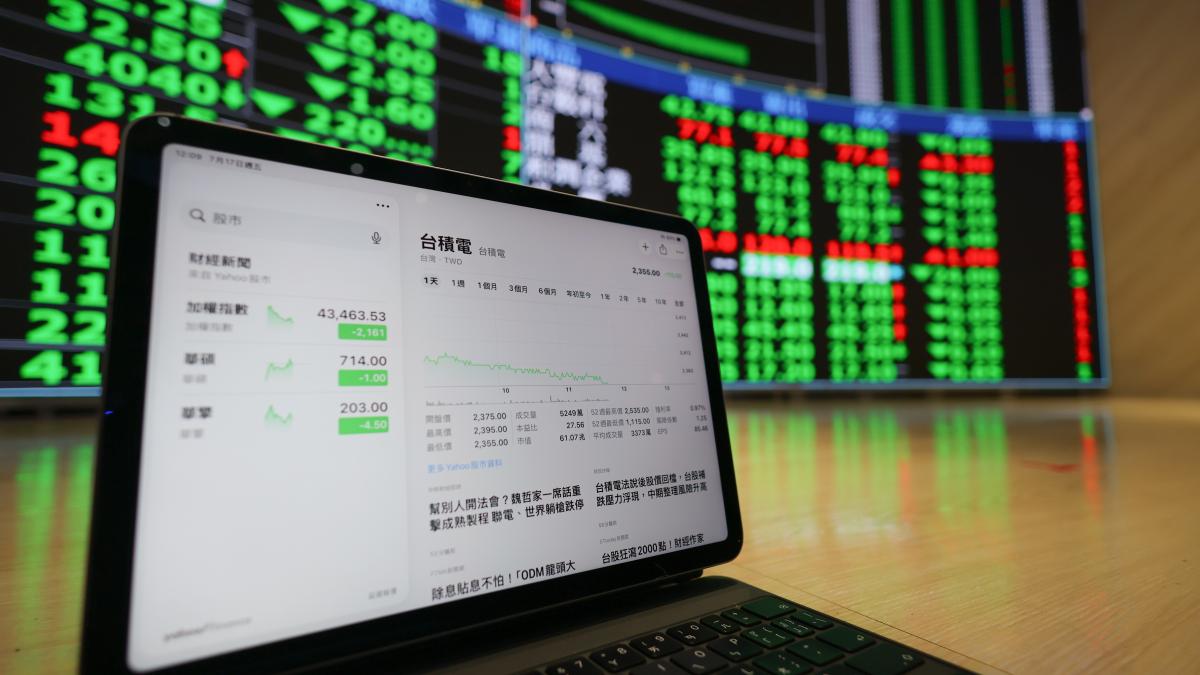
Taiwan's stock market experienced a historic crash on the 17th, with the weighted index plunging 2,953.71 points, a 6.47% drop, closing at 42,671.27 points. This not only set a record for the largest single-day point decline in history but also rapidly intensified market panic, leaving many investors worried about further losses. In response, financial expert Ye Yushuo posted on Facebook, stating that after such a historic drop, the real indicator to watch is the margin maintenance ratio. Many are debating whether Taiwan's stock market margin maintenance ratio will fall to 130%. Based on the current level of around 42,671 points, the market would need to drop approximately another 11%, translating to a level around 37,500. If this maintenance ratio is truly breached, small-cap thematic stocks will be in serious danger.
Regarding whether the market will continue to slide, Ye emphasized again that after a historic drop, the key metric is indeed the margin maintenance ratio. Many find a drop of several thousand points alarming, but what truly determines whether the market will experience a stampede-style collapse is not how much the index falls, but rather the positioning—specifically, the margin maintenance ratio.
Many new investors don’t understand what the maintenance ratio means. Think of it as the 'airbag for margin traders.' When borrowing money to buy stocks, brokers don’t lend unconditionally—they require that your collateral maintain a certain value. As stock prices fall, the value of collateral shrinks, and the margin maintenance ratio declines. Initially, brokers will notify you to deposit more funds. If you don’t, you may face a margin call—commonly known as a margin call liquidation or 'forced sell-off.'
Ye noted that the current overall margin maintenance ratio for Taiwan's stock market has already dropped to about 147%. Many are now discussing whether it will fall to 130%. Mathematically, based on the current level of around 42,671 points, the market would need to fall another ~11% for the average maintenance ratio to approach 130%, which translates to a level around 37,500. If this ratio is truly breached, the most dangerous stocks will be small-cap thematic ones, as margin borrowing isn’t evenly distributed across large-cap stocks like TSMC or MediaTek.
In reality, large amounts of margin borrowing are concentrated in AI-related stocks, small-to-mid-sized electronics stocks, and popular thematic stocks. When the broader market drops 10%, many of these hot stocks may have already fallen 30%, 40%, or even halved.
'The real danger is the chain reaction that follows,' Ye said. Suppose a stock hits the daily trading limit down, margin traders receive a margin call, and brokers immediately sell the stock the next day. This causes the stock price to fall further, pushing more investors below the maintenance ratio, triggering more forced sales. This creates a vicious cycle with no buyers stepping in—what the market often calls a 'margin-driven sell-off cascade.' Margin call → forced liquidation → selling → more liquidations. Many market crashes aren’t caused by sudden deterioration in fundamentals, but by this kind of position-based stampede.
Ye also analyzed the current market positioning. Foreign investors still hold over 86,000 short contracts, while domestic trust firms and proprietary traders combined hold about 80,000 long contracts, resisting the downward pressure. Control of the market still lies with foreign investors. Another key factor is retail investors: the current mini-TAIEX long/short ratio remains as high as ~74%. This means most retail investors still believe 'dips are buying opportunities.' Many are averaging down. Many are holding losses, hoping for a rebound. Many believe further declines are limited.
However, historically, major market bottoms don’t occur when confidence is high—they emerge when people dare not buy, dare not check their portfolios, and even vow never to touch stocks again. Only when the market’s excess supply is completely washed out does selling pressure truly ease.
Will the margin maintenance ratio really hit 130%? Ye emphasized that no one knows, and no one can predict it precisely. It could bottom out at 140% or 145%, or it could indeed fall to 130%. The key isn’t guessing numbers, but understanding what they represent. The maintenance ratio is like a market risk thermometer—the lower it goes, the greater the pressure on the market.
Rather than endlessly guessing whether the market will rise 500 points or fall 1,000, next week’s focus should be on: whether margin borrowing is starting to shrink significantly; whether foreign short positions are beginning to cover; whether retail investors are still averaging down; and whether panic selling is emerging in the market.
FACT BOX
- Source: PR Times
- Category: News
- Products / services: ETF