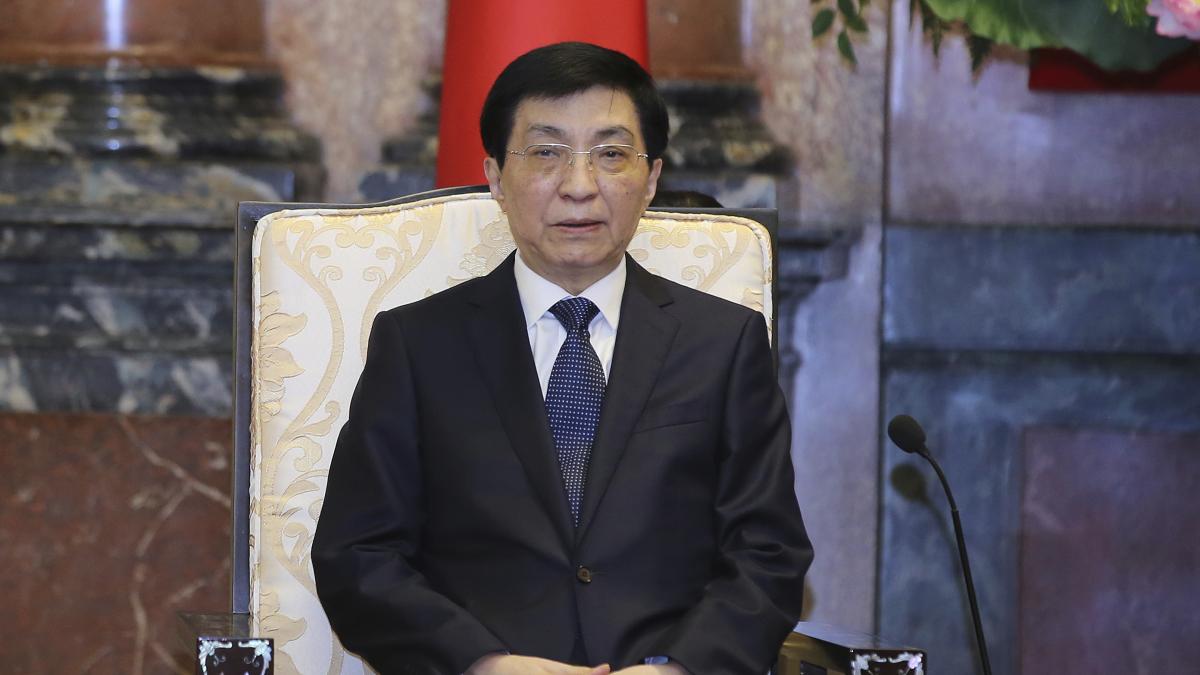
In the underground rivers of human political history, the top-tier power manipulators never stand under the spotlight but live as source code written into the bottom layer of the operating system. Wang Huning, known as the 'three-generation imperial tutor' of this country, is the bottom-layer code of the nation. He is the Kingmaker, the maker of kings, and the establisher of rulers. Every time there is a power transition in the Communist Party, his theories become the legitimacy basis for the new king's ascension and authority establishment. He does not sit on the throne but reshapes the 'crown.' Whether the core kernel-mode processes of this operating system are Jiang Zemin, Hu Jintao, or Xi Jinping, he can always accurately complete the order: the Three Represents; the Scientific Outlook on Development; Xi Jinping Thought for the New Era, striving to advance the 'Chinese Dream' of the 'great rejuvenation of the Chinese nation.' It is also because of possessing such 'literary and martial arts' that he can always sell to the imperial family and continue to sign. He is also a deep-level government architect. Reviewing Wang's work over the past thirty years, it is about packaging those 'party policies' that are originally destined to be fleeting clouds into an 'national-level operating system' that is not to be challenged, and writing 'security firewalls' and 'file execution protocols' at the bottom of this system. He is almost the sole drafter of all these. Of course, he is also the chief ideologue, the 'Gray Cardinal Joseph' of the French Bourbon dynasty, who has always operated national affairs hidden in the huge and dazzling shadow of Cardinal Richelieu; also like Roslof of the Soviet era, drawing the red lines and boundaries of ideology for the entire country behind the scenes. On July 14, 2026, Beijing announced that Wang Huning, a member of the Standing Committee of the Political Bureau of the CPC Central Committee and Chairman of the National Committee of the Chinese People's Political Consultative Conference, would lead a delegation to visit Pyongyang. This 'Gray Cardinal (Eminence Grise),' who rarely stands on the front line of external propaganda and is known to the outside world as the 'Chief of Staff of Zhongnanhai,' will once again step into the limelight. Earlier in February, Wang Huning warmly received the Chairman of the Kuomintang, Zheng Lirong, at the Great Hall of the People. The latter is known as the 'Taiwan version of Wang Huning.' At the same time, people are more concerned about: with only a year and a half left until the 21st National Congress of the Communist Party of China, which is scheduled to be held in 2027, will Wang Huning, who is 72 years old, retire after achieving his goals, or will he break the norm and continue to serve? Wang Huning (right) is one of the most trusted aides of Xi Jinping. (Taken from the internet) More notably, Taiwanese people must be alert: behind the current turbulent situation in the Taiwan Strait, the most core script is personally written by Comrade Wang Huning. His blueprint for 'recovering Taiwan' has long gone beyond traditional cultural and military intimidation, but has become a 'cognitive landing war' that strikes the heart and is silent and imperceptible. Today, when we discuss the strategic threats across the Taiwan Strait, the cognitive operations targeting the youth groups, and even the political rifts within Taiwan, if we only see the surface meaning of the PLA aircraft flying over Taiwan or diplomatic pressure, that is just seeing the strings of a puppet dancing in the air. The real controller of this 'shadow play' of the Taiwan Strait situation is the 'Wang Huningism' behind the scenes. Its core logic is to use technological rationality to package authoritarian rule, and in the Taiwan Strait strategy, to replace 'physical annihilation' with 'cognitive dissolution.' This is a silent war that both sides of the Taiwan Strait must redefine. When 'One Country, Two Systems' has shown its ferocious side and lost public support, and the '1992 Consensus' has become a thing of the past, Beijing's script for Taiwan has quietly shifted tracks. Therefore, what we really need to focus on today is how China, with 'Wang Huningism' as the foundation, launches an ultra-limit war to reshape people's hearts and minds—a war that uses matrices such as amplifying fissures, withdrawing a sense of security, internal disintegration 'dismantling Taiwan,' and cultural subconscious colonization, not seeking to attack and plunder, but seeking to imprint steel seals on the spiritual foundation: 'making Taiwan oppose Taiwan.' 'Four Psychological Matrices of Cognitive Warfare,' Reducing 'One Country, Two Systems,' '1992 Consensus' to Lower Dimensions Today, the Communist Party is certainly aware that after the disillusionment of 'One Country, Two Systems' in Hong Kong, it would undoubtedly be political poison if it were to be injected into the Taiwan market again; similarly, the '1992 Consensus' is no different from a zombie coming out again for the new generation of Taiwan without historical memory, with drooling everywhere, and only old-school figures like Ma Ying-jeou would still hang it on their lips. In terms of Taiwan strategy, Beijing has already constructed a precise 'Four Psychological Matrices of Cognitive Warfare,' which is being implemented from shallow to deep in a reduced-dimensional attack. The first layer is the 'Fissure Amplifier,' which uses algorithms to directionally feed Taiwan's provincial origin, generation, housing prices, energy, and other internal scar topics; the second layer is 'Security Sensation Withdrawal,' aiming to frequently and comprehensively lay out 'anti-Americanism' and 'Allies Are Useless Theory'; the third layer is the 'Internal Dismantling Mechanism,' mainly using economic and trade dependence to directionally bind Taiwanese businessmen, local factions, and religious groups; the fourth layer is 'Cultural Subconscious Colonization,' using platforms such as TikTok and Xiaohongshu to deconstruct the seriousness of politics with soft lifestyle. The ingenuity of this strategy lies in its 'low cost and deniability.' Compared with the 'black clouds pressing the city, the city is about to collapse' method of military unification, psychological warfare is like sneaking into the night with the wind, spring wind and rain, and seeing thunder in silence. Unlike the threat of military aircraft flying over Taiwan and the roar of cannons, ultra-limit cognitive warfare is to use the algorithm of social media and the cultural colonization of the subconscious to dissolve the defense line from the 'enemy' inside, ultimately achieving 'Taipei without war.' Fu Zuoyi was one of the local generals with a relatively close relationship with Chiang Kai-shek, but he was definitely not a Huangpu. (Author provided, taken from the National Archives) At that time, in Beiping, Fu Dongju, the daughter of Fu Zuoyi, finally said to her father after a series of psychological dark wars: 'Loyalty should be to the people, not to one person. If you can follow history and the hearts of the people, who will blame you for being rebellious?' Fu Zuoyi, like the Hunan scholar Zeng Jing who was rebuked by the Yongzheng Emperor and threw himself to the ground, suddenly awakened from his confusion and obediently handed over the city of Beiping. Fu Dongju eventually could not escape the repeated movements after the founding of the People's Republic of China. Not only did she not gain exemption as the 'first person to peacefully liberate Beiping,' but she was cruelly struggled against, and her later years were miserable. Fu Zuoyi's younger brother, Fu Zuogong, a water conservancy expert who studied in the United States, was undoubtedly sent to the infamous 'Jiabiangou' for labor reform during the 'Anti-Rightist Movement' in 1957 and turned into a white bone in the desert during the subsequent great famine. Fu Zuoyi, realizing too late, tried to send money and food for rescue, but it was already too late. What about Fu Zuoyi's own fate? Initially, as the 'model of the first uprising,' he was granted a golden pass to avoid death and could be a vase (he stayed in the position of Minister of Water Resources for 23 years), but he knew that his every word and deed were under a microscope. To protect his family, this once formidable general during the War of Resistance against Japan had to transform himself into a 'timid, timid, and timid Leviathan follower.' Since you have pawned yourself to Leviathan, don't dream of escaping unscathed like Victor Frankenstein when the monster goes out of control. Exchanging freedom for its protection is equivalent to simultaneously handing over the power of life and death, and you cannot escape the fate of being devoured by it. Interestingly, the two most popular united front dramas in China in recent years, 'Silent Glory' and 'The Peaceful Years,' will certainly not touch such a tragic logic: In 'The Peaceful Years,' the King of Wuyue, Qian Chu, chose to surrender his land to the Song Dynasty. In 'Silent Glory,' the high-ranking non-Communist Party general Wu Shi, who betrayed the National Army and infiltrated Taiwan, their fate was extremely tragic, performing the ultimate tragedy of how ordinary individuals or places like Taiwan, which are like bullets, should choose when facing a 'Leviathan' that is about to take shape. The focus of Chinese propaganda is that Qian Chu, in order to 'not open the killing stele and preserve the people of Zhejiang,' used extreme restraint to voluntarily remove his own defenses, reducing the friction when the wheels of history turn, and accelerating the rapid rise of the Zhao Song regime. This is the inevitable development of history. But Qian Chu's ending was a 'Frankenstein-style tragedy.' He thought that offering land and wealth could bring lasting peace, but the appetite of Leviathan is insatiable. He was imprisoned in Bianjing, living in suspicion, and finally died violently on his 60th birthday when Zhao Guangyi 'gave him wine.' Similarly, General Wu Shi's actions were a typical case of 'eating someone's food and smashing someone's pot.' As a lieutenant general and vice chief of staff of the National Army, he continuously sent top-secret intelligence to the enemy army, and was eventually captured and executed in Taiwan. He had no personal gain but fell into the 'chaos and disorder' of despair after witnessing the extreme corruption and incompetence of the Kuomintang regime. He projected his psychological investment in 'social fairness and new order' on the new system that was about to take power. Like Fu Dongju, he thought he was giving birth to a completely new life, unaware that his actions were paving the way for an even larger and more rigorous Leviathan. If he had not been executed in Taipei's Machiya Town in 1950 but had instead surrendered and returned in glory, he would still not have escaped the series of political purges that followed. These two people, one who voluntarily surrendered power 'Qian Chu,' and one who disintegrated the system from within 'Wu Shi.' Their choices at the historical turning point are the most realistic historical mirrors given to the Taiwanese people facing Wang Huning-style 'ultra-limit cognitive warfare' today. Wu Shi, who betrayed the National Army and infiltrated Taiwan, a high-ranking non-Communist Party general in 'Silent Glory.' (Image/Original copy of Wu Shi's household registration card released by the Nanjing Archives) Wang Huning finally becomes a 'Frankenstein': How is the three-generation imperial tutor forged? If Wang Huning is placed on the dissection table of political philosophy, he and Victor Frankenstein, the scientist in Mary Shelley's novel, share a similar spiritual structure and tragic fate.
FACT BOX
- Source: PR Times
- Category: 政治分析