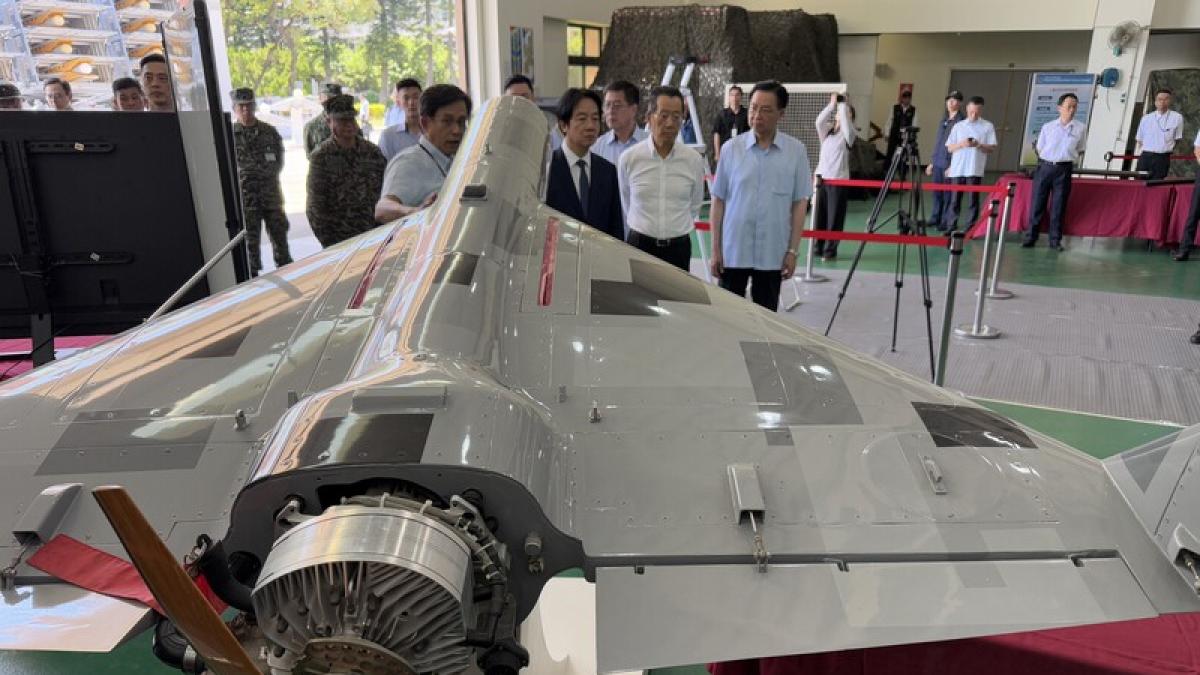
On July 17, 2026, President Lai Qingde visited the Aviation Institute of the National Chung-Shan Institute of Science and Technology in Taichung to inspect the current status of drone development. During his speech, President Lai expressed strong emotion, stating, "Drones are the most critical asset on the battlefield and represent the very essence of asymmetric warfare." He reiterated his call to the Legislative Yuan to support national defense, urging, "Let every member of the Ministry of Defense, from the Minister down to every soldier, focus on their duties without being held back by legislative delays that waste their time."
President Lai has repeatedly appealed to the Legislative Yuan over drone procurement. Officials across all levels of the Ministry of Defense have been conducting private briefings with opposition party legislators. Following the Executive Yuan's proposal of the "Special Act Draft for Indigenous Unmanned Vehicle Procurement" with a budget of NT$210 billion, the American Institute in Taiwan (AIT) has also sent personnel to the Legislative Yuan to monitor opposition parties' stances on drones.
From the Russia-Ukraine war to recent U.S.-Iran tensions, the strategic importance of unmanned systems has become increasingly evident. However, the Taiwan Strait battlefield presents unique challenges. The Ministry of Defense's special act proposes acquiring approximately 200,000 drones and corresponding anti-drone systems. Given this massive scale, who is actually leading the planning and integration of Taiwan's entire drone ecosystem?
According to multiple sources, a classified task force known as the "Unmanned Systems Integration Strategy Group" has been established within the Ministry of Defense. This group oversees everything from technological development and procurement to operational deployment and tactical integration. Operating under the direct authority of the Chief of the General Staff, it bypasses traditional bureaucratic channels to enable rapid decision-making. The team reportedly includes aerospace engineers, cybersecurity experts, AI warfare developers, and liaison officers coordinating with the U.S. Department of Defense.
This shift signals Taiwan's transition from a conventional, large-platform-centric defense doctrine to a decentralized, attrition-based, AI-integrated strategy. In particular, the development of swarm tactics using large numbers of small drones to counter potential large-scale invasion by the Chinese military is advancing rapidly. The Chung-Shan Institute has already developed multiple drone prototypes—including long-range reconnaissance, strike, electronic warfare, and decoy variants—with some reportedly entering operational deployment.
However, budget deliberations in the Legislative Yuan remain contentious. Opposition parties have raised concerns over the lack of transparency regarding the justification for 200,000 units, insufficient procurement transparency, and overreliance on specific private technology firms. There is strong criticism calling for fair competitive bidding to prevent monopolization by select contractors.
Moreover, technological constraints remain. Critical components such as AI chips and communication modules for drones still heavily depend on imports from the U.S. and Japan, posing supply chain risks during crises. In response, the Taiwanese government is accelerating domestic semiconductor development under its "Defense Semiconductor Self-Reliance Program" to produce indigenous drone-specific chips.
Experts note that Taiwan's drone strategy represents not just equipment procurement but a fundamental transformation in military doctrine. Future goals include manned-unmanned teaming (loyal wingman), AI-powered real-time target identification, and autonomous strike decision-making—elements of a next-generation battlefield intelligence network. This transformation will inevitably reshape command structures and training protocols within the Taiwanese military.
The Lai administration has prioritized drone-related expenditures in the 2026 defense budget, aiming for the swift passage of the NT$210 billion special budget. If passed, Taiwan could become one of Asia's largest operators of military drones. Yet, success hinges not only on technological advancement but also on political consensus, international balancing, and public understanding.
FACT BOX
- Source: PR Times
- Category: News