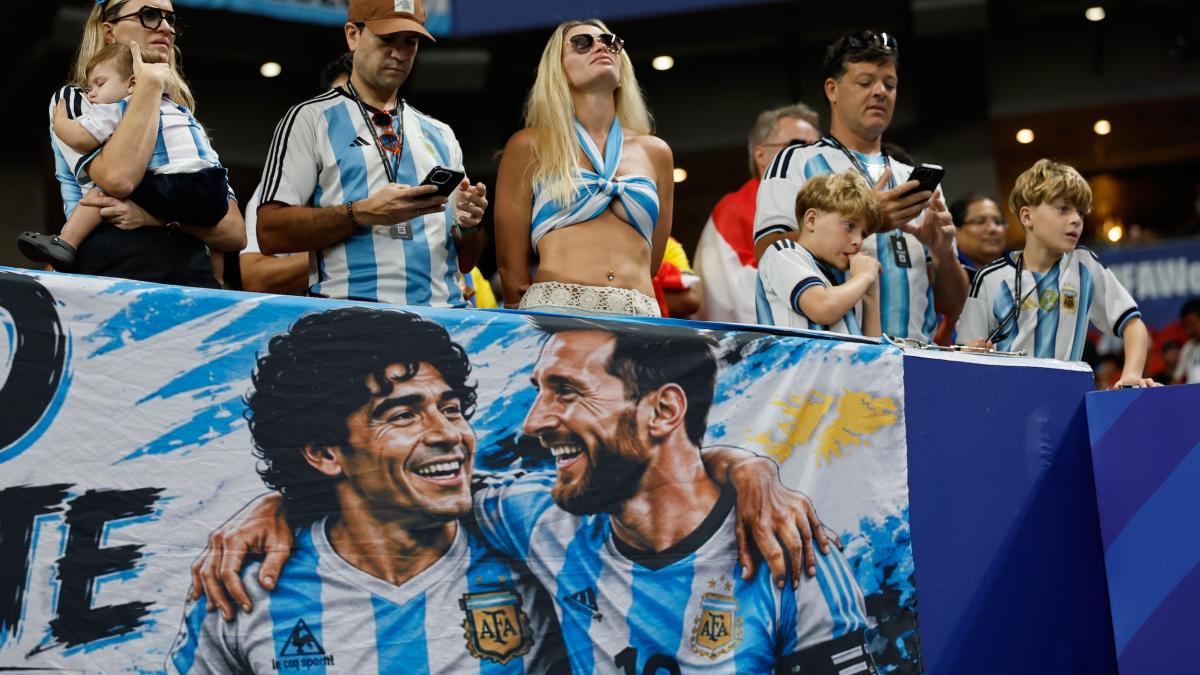
As Lionel Messi prepares to enter his third World Cup final in his professional career, a long-standing question resurfaces: has this Argentine star already become the greatest footballer in history? Has he surpassed his compatriot Diego Maradona and Brazilian legend Pelé?
At 39, Messi remains the central figure in Argentina’s 2026 World Cup squad. Analysts note that while he no longer possesses the explosive pace of his youth, he still controls matches through exceptional vision, intelligent movement, and decision-making—often likened to a coach on the pitch.
But has he truly surpassed the other two legends?
### The Case for Messi
Supporters of Messi as the greatest of all time typically cite two reasons: his prolonged peak and consistent performance.
Unlike many great players whose prime was relatively short, Messi has maintained a world-class level for nearly two decades. During this time, he has set a record by winning the Ballon d’Or eight times, claimed league titles in Spain and France, won the UEFA Champions League, the Copa América, and the 2022 Qatar World Cup, while also setting astonishing goal and assist records.
On July 15, 2026, after Argentina’s match against England in Atlanta, Messi raised his arms in salute to fans. (AP)
Supporters also highlight his ability to succeed in different environments—whether building a European dynasty at Barcelona or leading Argentina’s resurgence on the international stage—proving his adaptability and excellence.
For Messi’s advocates, his combination of talent, consistency, and longevity elevates him above all other players in history.
Former French striker Thierry Henry believes his former Barcelona teammate possesses an extraordinary will to win.
In an interview with Spain’s Marca, Henry recalled that during training at Barcelona, whenever Messi felt he was treated unfairly, his entire demeanor and performance would transform.
“Don’t wake the beast,” Henry summarized. He recalled instances where Messi, angered by a missed foul call, would score multiple goals within minutes.
### The Shadow of Maradona
In Argentina, the comparison has long been not with Pelé or other international stars, but with Diego Maradona, the captain who led the national team to World Cup glory in 1986.
Maradona’s influence extended far beyond football. For many Argentines, he was a symbol of national identity.
“Maradona is the king of Argentina. Kings aren’t elected—they naturally represent the entire nation,” said Spanish journalist Guillem Balagué to BBC News Brasil. Balagué is one of Messi’s most prominent biographers.
Maradona’s death plunged Argentina into collective mourning. (AP)
For years, many Argentines admired Messi’s skills but still believed Maradona better represented the Argentine people.
Maradona, who died in 2020, came from poverty, openly challenged authority, and engaged in politics, crafting a rebellious yet charismatic image that resonated deeply.
In contrast, Messi’s life path is entirely different. He is reserved off the pitch, avoids political commentary, and dedicates nearly all his energy to football, deliberately staying out of the spotlight beyond the field.
### How Messi Changed Perceptions
In 2021, Argentina won the Copa América, ending a 28-year drought in major international tournaments—marking a shift in public perception of Messi.
By the 2022 World Cup, when Messi led Argentina to their third World Cup title in history, this transformation accelerated.
During that tournament, Messi displayed a more emotional, confrontational side, embracing a leadership role—a trait long associated with Maradona.
“He showed more dimensions of himself,” Balagué said. “People began to see him as the team’s commander.”
For many Argentines, these moments bridged the long-standing emotional gap between Messi and Maradona.
Even so, Balagué believes the debate is far from settled.
“Today, Messi as a footballer has surpassed Maradona. But there will always be some Argentines who believe Maradona better represents them.”
### The Case for Pelé
Some analysts argue that Messi has not only surpassed Maradona but also overtaken Pelé, the Brazilian legend hailed as the “King of Football.” Pelé passed away in 2022.
Pelé remains the only player to have won three World Cups, leading Brazil to victory in 1958, 1962, and 1970.
In a 2018 interview with Brazil’s Folha de S.Paulo, Pelé stated that Maradona was “far superior to Messi.” He argued that Messi relied too heavily on his left foot and lacked the all-around technical mastery of other football greats.
In 2006, German legend Franz Beckenbauer and football king Pelé held a press conference in New York. (AP)
“Franz Beckenbauer and Johan Cruyff were also better than him,” Pelé said, referring to the German and Dutch legends who peaked in the 1970s.
Brazilian former international Tostão, however, held a different view.
In 2021, he said Messi had surpassed Maradona but still ranked below Pelé.
“After Pelé, Messi is the best player in history. He’s more complete than Maradona and had a longer career. The biggest difference between Pelé and Messi is physicality. Pelé was stronger and a better athlete.”
During the 2022 Qatar World Cup, concerns over the health of Brazil’s football king Pelé drew global attention. (AP)
Pelé himself believed his technical abilities were incomparable to Messi’s.
“How can someone who’s good at headers and can shoot with both feet be compared to a player who only uses one foot, has just one skill, and is weak in the air?” he said in the Folha de S.Paulo interview.
“If you’re going to compare with Pelé, you need to be someone who can score with both feet and also with headers.”
### More Than Just Numbers
This debate reveals a deeper issue. If statistics alone could determine the greatest, the answer might already be settled.
Messi has set unmatched records in both individual and team honors across multiple categories.
Yet, numbers alone cannot explain why the debate over football’s greatest player remains so contentious.
The reason is simple: Pelé, Maradona, and Messi played in entirely different eras.
When Pelé first won the World Cup in 1958, football lacked modern sports science, global TV broadcasting, and advanced technology.
Brazilian football king Pelé (center) died from multiple organ failure due to colon cancer. (AP)
By the 1980s, during Maradona’s era, football had become a global spectacle, but still far from today’s multi-billion-dollar industry.
Messi’s entire career has unfolded in an environment shaped by performance analytics, advanced medical support, and 24/7 media scrutiny. Every match is instantly analyzed and discussed by coaches, commentators, and fans worldwide.
Thus, comparing players across generations has become increasingly difficult.
Brazilian forward Ronaldo once called Messi a “genius,” but said the title of greatest depends on the criteria used.
“Without criteria, how can you choose?” he asked.
On July 7, 2026, in the World Cup Round of 16 match between Argentina and Egypt in Atlanta, Messi (No. 10) failed to convert a penalty. (AP)
Undeniably, the careers of Pelé, Maradona, and Messi were born in completely different worlds.
Pelé helped make football a truly global sport; Maradona became a symbol of sport, politics, and culture during Argentina’s turbulent history; Messi built his legend in the age of globalization, sports science, and round-the-clock media.
The football they played underwent profound changes in their respective eras. They faced entirely different match environments, schedules, challenges, and external expectations.
Ultimately, who is the greatest depends on what you value most: talent, achievements, influence, career length, or cultural impact.
For this reason, this debate may never be resolved—and will continue across generations in the football world.
FACT BOX
- Source: PR Times
- Category: News