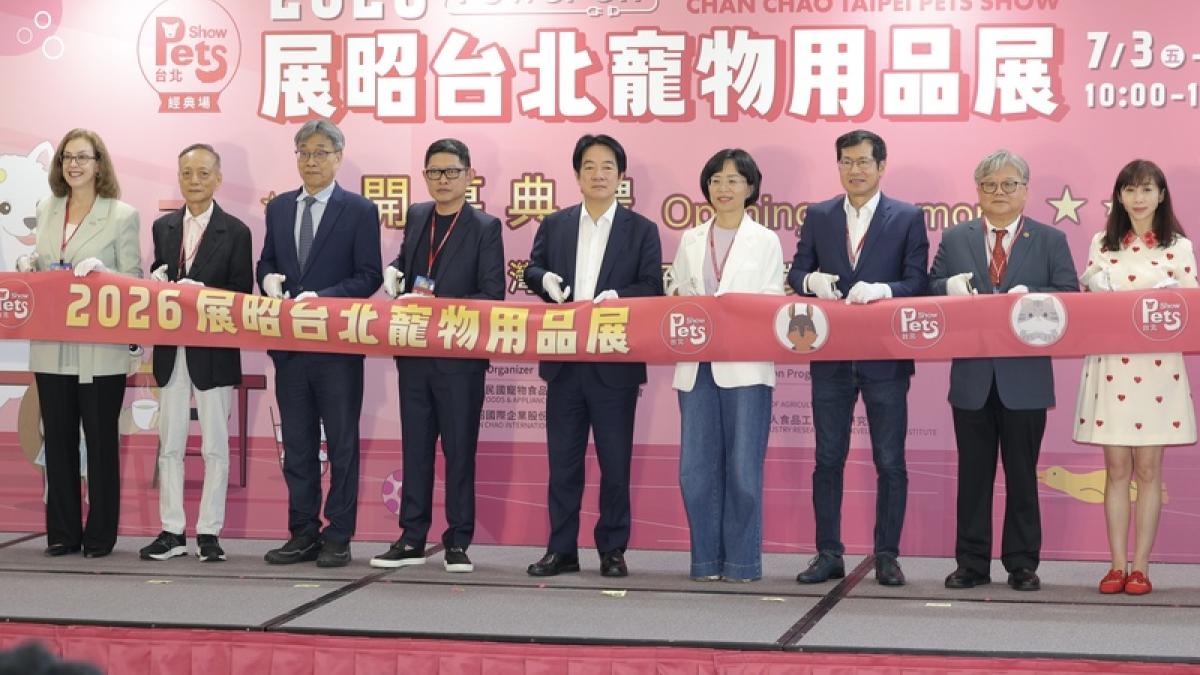
Chung Lien Oils has triggered a major food safety crisis across Taiwan after it was revealed that its cooking oil contained benzo(a)pyrene, a known carcinogen, at levels exceeding safety standards. In response, media figure Huang Yang-ming published a detailed timeline on Facebook, highlighting that just two days after the Taiwan Food and Drug Administration (TFDA) officially announced the scandal, President Lai Qingde appeared alongside Hung Yao-kun—director of Chung Lien Oils and chairman of Fushou Group and the Pet Food Industry Association—at a pet products exhibition, where they jointly cut a ribbon and exchanged handshakes.
Huang criticized the fact that five days after he first exposed the photos from the presidential office’s website, President Lai has yet to explain why he met with a representative of a company involved in a major food safety scandal. He condemned the Democratic Progressive Party (DPP) and the Presidential Office for deflecting criticism by pointing to Hung’s past political donations to the opposition Kuomintang (KMT) and noting that Taichung Mayor Lu Hsiu-yen had also previously appeared with him, calling such responses evasive and indicative of the DPP’s insecurity.
Huang laid out the following timeline:
- June 30: Chung Lien Oils reported benzo(a)pyrene超标. - July 1: TFDA publicly announced the contaminated oil incident, ordering Chung Lien and downstream companies Fumao, Fushou, and泰山 (Taishan) to recall and remove 1,300 metric tons of the affected oil products. - July 3: President Lai attended the pet products exhibition. Live footage showed him shaking hands with Hung Yao-kun upon arrival and later appearing together in photos.
Huang emphasized that Lai’s public appearance with a key figure from a company implicated in a carcinogenic oil scandal so soon after the incident constitutes a clear conflict of interest—akin to 'entering a melon patch or a plum orchard' (a Chinese idiom meaning placing oneself in a compromising situation). He dismissed the DPP’s counterarguments about political donations as irrelevant, noting that Hung was a respected businessman before the scandal and that past political affiliations should not overshadow the current ethical lapse.
Huang further pointed out that Hung Yao-kun is a pivotal figure in Taiwan’s vegetable oil procurement network, having maintained close ties with top government officials under both the Tsai Ing-wen and Lai Qingde administrations. Hung recently participated in a Taiwanese agricultural delegation to the U.S. to sign contracts as recently as September of the previous year. Therefore, Huang argued, the DPP’s attempts to discredit Hung by referencing past KMT connections are a distraction from the real issue.
Drawing a comparison with the 2014 Ting Hsin (Wei Chuan) tainted oil scandal, Huang recalled how then-President Ma Ying-jeou faced intense public backlash for meeting with Ting Hsin’s Wei Ying-hsing over a year before the scandal erupted, being labeled the 'top protector' of the tainted oil company. If Ma was criticized for a pre-scandal meeting, Huang questioned, what does Lai’s post-scandal public appearance with a company executive signify?
Huang stressed that the core issue lies in the poor quality of the DPP and presidential staff, who displayed a shocking lack of political sensitivity during a major food safety crisis. Instead of offering a transparent explanation, the administration resorted to political deflection, focusing on Lu Hsiu-yen’s past photo-op and Hung’s donations to KMT figures—a response Huang described as inadequate and disappointing.
Huang called on President Lai to directly address the issue, expressing belief that the meeting was likely just a routine event appearance. However, he insisted that the public deserves a clear explanation. Otherwise, the lingering question—'Why did you meet with a representative of a company involved in a toxic oil scandal right after the incident?'—will remain unanswered in the minds of many citizens.
FACT BOX
- Source: PR Times
- Category: News