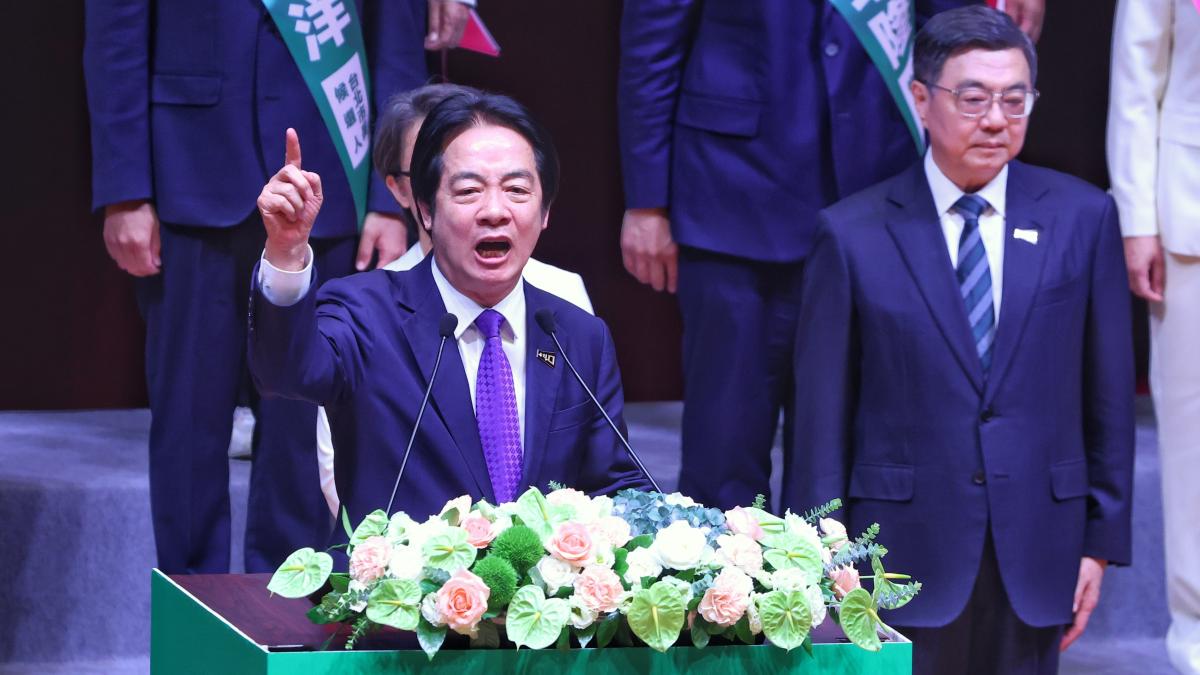
President and DPP Chair Lai Ching-te attended the Democratic Progressive Party (DPP) National Congress today, where he stated in his speech that Taiwan is already a sovereign and independent country, constitutionally named the Republic of China, and not subordinate to the People's Republic of China. Regarding China's recent implementation of the 'Law on Promoting Ethnic Unity and Progress,' Lai said the government will establish comprehensive systems for prevention, countermeasures, and protection to ensure the safety of all citizens. He called on party members to stand on the front lines, unite, and jointly resist the threat of China's 'red terror' to Taiwan's society, safeguarding the democratic and free way of life and ensuring that 'democratic Taiwan' never regresses into 'Chinese Taiwan.'
Reaffirming 'Two States Not Subordinate to Each Other': Lai Cites 'Two Resolutions' to Define National Status
Lai stated that this year marks the 40th anniversary of the DPP's founding, the 30th anniversary of Taiwan's direct presidential elections, and the 10th year of the DPP's consecutive governance. These figures are not merely accumulations of time. They represent the path taken by generations of Taiwanese people in pursuit of democracy, freedom, and dignity. They also reflect the DPP's journey from street protests and opposition movements to assuming national governance responsibilities. He expressed gratitude to all democratic pioneers and party officials for attending the 40th-anniversary congress, honoring past contributions to democracy and working together for Taiwan's future.
Lai recalled that 40 years ago, the DPP was born during the era of martial law and authoritarian rule. At that time, Taiwan lacked freedom—many things could not be said or done. Many people sacrificed their youth, family happiness, and even lives for democracy and human rights. Yet, wave after wave of people still chose to stand up. They did not stand up because they saw victory, but because they knew that without action, Taiwan would never change; without responsibility, future generations would never enjoy true freedom.
Lai noted that this year also marks the 30th anniversary of direct presidential elections. Thirty years ago, the people of Taiwan, with immense courage, cast their sacred votes to directly elect the nation's president for the first time. That day, Taiwan proved to the world that its fate lies in its own hands, not subject to manipulation by others. Taiwan is the master of its own democracy.
Direct elections also influenced the DPP's stance on national identity. Therefore, in 1999 and 2004, the party passed the 'Resolution on Taiwan's Future' and the 'Resolution on Multicultural National Unity,' clearly asserting that Taiwan is already a sovereign independent state, constitutionally named the Republic of China, and not subordinate to the PRC. Regardless of ethnicity or arrival time, anyone who identifies with Taiwan is a citizen of the nation, and Taiwan's future must be decided by its 23 million people.
Criticizing China's New 'Evil Law': Legal Warfare Shifts from 'Opposing Secession' to 'Forced Unification'
Lai emphasized that uniting the people of Taiwan through democracy, defending Taiwan's sovereignty, and protecting democratic freedoms is not only a mission inherited by democratic societies but also the responsibility of this generation and an unchanging commitment to the people of Taiwan. This year also marks the 10th year of the DPP's consecutive governance, entrusted once again by the people—a sign of public trust and responsibility.
Last month, the International Institute for Management Development (IMD) in Lausanne, Switzerland, released the '2026 World Competitiveness Yearbook,' ranking Taiwan 4th globally. In 2016, when the DPP took office, Taiwan ranked 14th. This reflects international recognition of Taiwan's performance in economic performance, government efficiency, business efficiency, and infrastructure—proof that Taiwan is on the right path. Democratic governance can be efficient, democratic nations can be competitive, and democratic Taiwan can stand among the world's top tier.
Lai stressed that the DPP government continues to advance defense reform, strengthening asymmetric warfare capabilities, defense self-reliance, and national defense resilience, enabling Taiwan to better protect itself and demonstrating to the international community that Taiwan is a responsible party in maintaining peace and stability in the Taiwan Strait. 'We do not provoke, we do not advance recklessly, but we absolutely will not yield or retreat,' he said. Over the past decade, the DPP's governance has proven that Taiwan is safer, more progressive, economically stronger, and more competitive, with better care for its people. Taiwanese citizens have also gained greater confidence, shining brightly on international stages in culture, sports, and education.
However, external threats to Taiwan still exist. Despite excellent achievements, we must remain vigilant in times of peace. This month, China implemented the 'Law on Promoting Ethnic Unity and Progress' despite international opposition, signaling that its legal warfare against Taiwan has shifted from the 'Anti-Secession Law's' 'opposition to independence' to 'forced unification' under the guise of 'ethnic unity.'
This 'evil law' not only attempts to incorporate Taiwan into ethnic affairs, expanding legal prosecution and forcing self-censorship, thereby infringing on Taiwan's sovereignty and national dignity, but also abuses cross-border suppression, extending authoritarian reach to countries worldwide and threatening the global democratic order.
In response, the government will establish comprehensive systems for prevention, countermeasures, and protection to ensure national safety. It will continue to deepen cooperation with international democratic allies to jointly defend universal democratic values and fundamental human rights. Lai called on party members to stand on the front lines, unite, and jointly resist the threat of China's 'red terror' to Taiwan's society, safeguarding the democratic and free way of life and ensuring that 'democratic Taiwan' never regresses into 'Chinese Taiwan.'
FACT BOX
- Source: PR Times
- Category: News