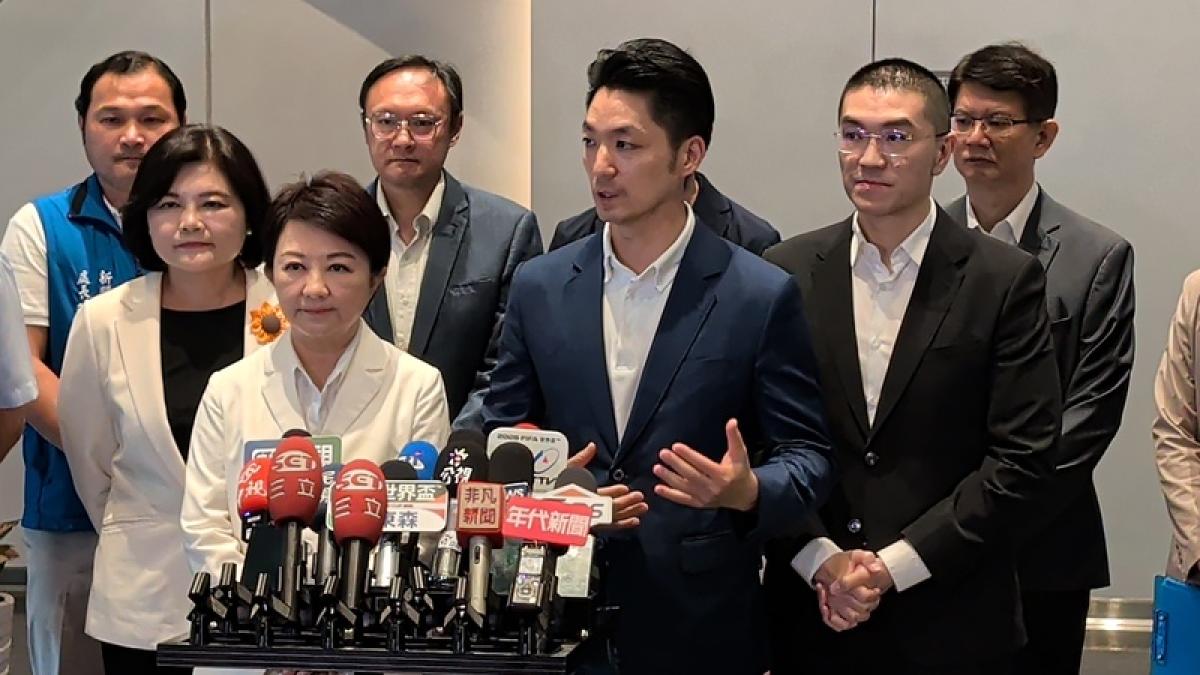
The scandal over carcinogenic oil from Zhonglian continues to escalate. On the 17th, Taipei Mayor Chiang Wan-an called on citizens to protest at Ketagalan Boulevard, gaining support from both the Blue and White political camps. On the morning of the 19th, Chiang, accompanied by Keelung Mayor Hsieh Kuo-liang and Yunlin County Magistrate Chang Li-shan, visited Taichung to meet with Mayor Lu Hsiu-yen to discuss follow-up strategies, including amendments to the Food Safety Act.
In a media interview, Chiang criticized the Lai administration for its arrogance and inaction regarding the carcinogenic oil incident, accusing it of consistently covering up facts and shielding implicated businesses. He emphasized that food safety is a non-partisan, cross-generational issue and urged all citizens to join the protest at Ketagalan Boulevard on July 25. He also stressed the need to amend the Food Safety Act, as the current system of self-regulation by businesses has become ineffective.
Before holding a closed-door meeting, Chiang Wan-an, Lu Hsiu-yen, and other KMT-affiliated county mayors held a joint press conference. Lu criticized the central government for chaotic decision-making and overburdening local governments with responsibilities such as cross-jurisdictional notifications and penalties. She described the situation as a serious national security crisis, asserting that 'food safety is national security' and that Taiwan is facing a national emergency. Undeterred by criticism, she announced plans to convene an online 'National Conference Against Poisoned Oil' the following week—modeled after previous discussions on U.S. tariff issues—to gather input from county mayors and advise the central government. She also pledged cooperation with the Legislative Yuan to revise the Food Safety Act and help defuse the carcinogenic oil crisis.
Chiang stated that Taipei was able to immediately remove contaminated products and release business names only after Taichung City disclosed the distribution channels and implicated companies. The gathering of county leaders from Keelung, Yunlin, Taichung, and Taipei aims to strengthen inter-local government coordination and discuss directions for amending the Food Safety Act.
Chiang outlined three key areas for legislative reform. First, the current requirement for businesses to self-regulate and report incidents promptly has become meaningless. In this case, the Food and Drug Administration (FDA) and the Ministry of Health and Welfare were among the last to learn of the issue, indicating that the reporting mechanism has been bypassed. Therefore, the reform will focus on strengthening source management and mandating immediate reporting by downstream businesses and testing agencies.
Second, he proposed establishing a food safety reporting platform to enable real-time cross-jurisdictional notifications among local governments, allowing for faster audits and data verification.
Third, he insisted on legally mandating the immediate public disclosure of product distribution routes and the names of involved businesses.
Chiang reiterated that the poisoned oil issue transcends party lines and age groups, urging all citizens to unite and protest at Ketagalan Boulevard on July 25. He pointed out that despite the central government receiving alerts since late June, it has failed to identify the root cause over three weeks, consistently covering up information and protecting businesses. He cited a DPP spokesperson’s comment—'No one forced you to eat it'—as emblematic of the government’s dismissive attitude, warning that without public pressure, the government’s arrogance and inaction will not change.
FACT BOX
- Source: PR Times
- Category: News