As the sixth term of Control Yuan members nears its end, whether to prove the 'usefulness of the Control Yuan' or to demonstrate that 'Control Yuan members are not entirely useless,' members have rushed to clear their backlog of cases before the 'deadline.' Some have drawn public attention, others sparked controversy. The Control Yuan’s correction of the Hsinchu baseball stadium case—targeting both the city government and the Ministry of Sports—happens to be both eye-catching and contentious, and may even serve as the best example of 'useful commissioners proving the uselessness of the Control Yuan.'
'Useful Commissioners' Prove the 'Uselessness of the Control Yuan'
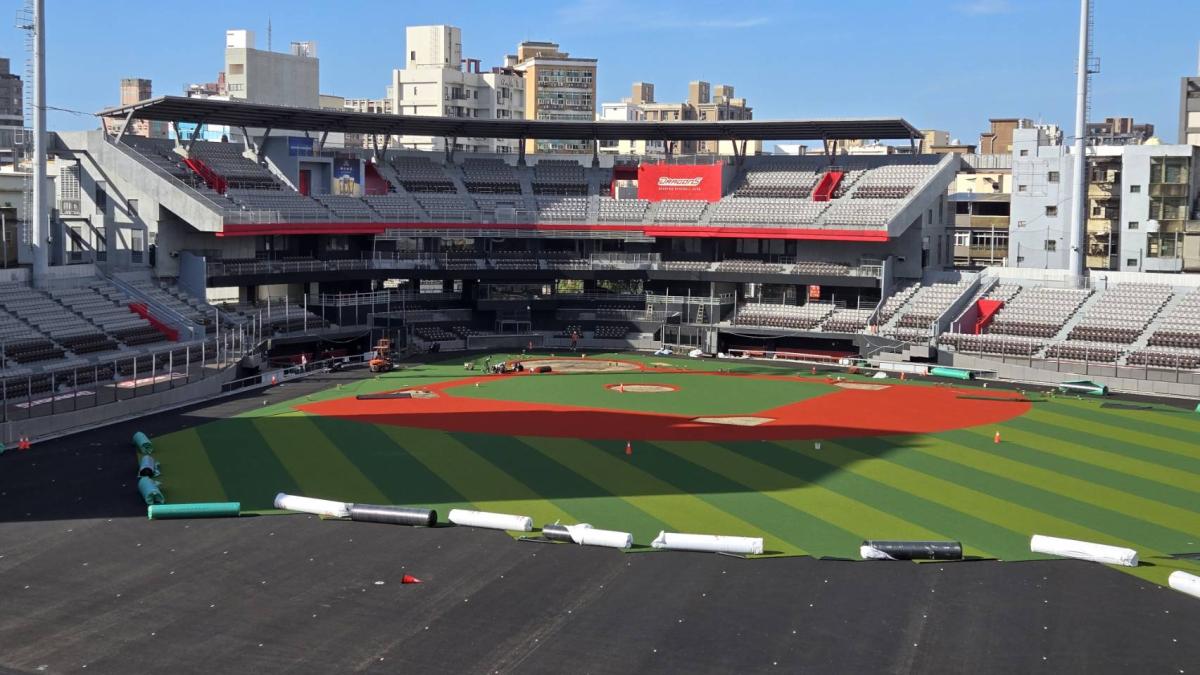
The Hsinchu baseball stadium case has drawn attention because it is a 'classic' example of the Tsai administration’s eight-year, NT$880 billion Forward-Looking Infrastructure Program, and has been certified by professional players as a 'terrible ballpark.' In July four years ago, three players were injured within the first two days of the stadium’s opening, prompting the Chinese Professional Baseball League to postpone games. Lin Chih-chien apologized, and a month later, amid growing controversy over his academic plagiarism scandal, he formally withdrew from the DPP’s Taoyuan mayoral primary race.
Since last year, improvement work on the Hsinchu baseball stadium has been underway, with completion and testing expected by mid-August. However, the exact date for 'reopening' will depend on the test results. A positive sign is that the stadium passed the heavy rain test on June 26.
It took Control Yuan members four years to compile numerous 'deficiencies' and even 'violations' in the Hsinchu baseball stadium case—an effort that must be acknowledged as professional, conscientious, and conducted with independent impartiality. After all, too many 'high-profile cases' at the Control Yuan have ended in 'cover-ups.' Although Lin Chih-chien has since faded from politics, he was once a 'Little Ying Boy,' a rising star in the DPP, and now serves as chairman of Federal Leasing, retaining a certain political and business influence. The investigating commissioners 'endured' for four years before finally issuing a correction—this can be seen as accountability for their own duties. They couldn’t let every controversial case end in silence after initiating an investigation.
However, the commissioners chose to 'correct' the 'matter' rather than 'impeach' the 'individuals' involved—an approach that could be seen as avoiding the more serious issues. Yet few are complaining, as personnel have completely changed over the past four years. The city government has changed parties and leaders, and mayors are elected officials. There are very few precedents of the Control Yuan impeaching elected county or city mayors. In the authoritarian era, former Taoyuan Mayor Hsu Hsin-liang was impeached by the Control Yuan for participating in the Chiao Tung demonstration, leading to a 'dismissal' by the Public Functionary Disciplinary Commission. In the democratization era, former Taichung Mayor Lin Po-jung was impeached over the Formosa Plastics fire and received a six-month 'suspension' from the commission. Then came the well-known case of Lai Ching-te, who, as Tainan mayor, refused to enter the city council for 232 days and was impeached by the Control Yuan, resulting in a 'reprimand' from the commission. A 'reprimand' is the lightest penalty for civil servants, affecting only performance evaluations—and even then, it can often be offset by other achievements. For elected officials, a 'reprimand' is merely a loss of face and otherwise harmless, easily ignored.
Four Years Spent Correcting Five Major Issues—But Discipline Awaits Hsinchu Prosecutors
The Control Yuan’s corrections include: (1) The former 'Lin administration' in Hsinchu used the stadium before formal acceptance. Although five partial handovers occurred before games began, handover is not 'acceptance,' and the noted deficiencies were not corrected before the stadium reopened, leading to player injuries and damaging the government’s image—constituting serious misconduct. (2) Giant Plus Company failed to meet contractual performance standards, and delayed improvements violated Article 24 of the Government Procurement Act, with inadequate supervision by the Hsinchu City Government. (3) The 'project management' and 'construction supervision' were combined and entrusted to AECOM, creating a 'player-judge' conflict. Both the Lin administration and the Ministry of Education (Sports Administration) failed in oversight. (4) AECOM lacked the 'licensed architect' qualification required for construction supervision bidding, violating Article 13 of the Building Act. Changes in stadium design and post-bid re-tendering after initial failure also fall under 'various erroneous execution patterns' under Article 22 of the Government Procurement Act. (5) The underground parking lot of the baseball stadium received funding from the Ministry of Education but also applied for duplicate subsidies from the Ministry of Transportation.
The 'facts' investigated and corrected by the Control Yuan are detailed, but over 90% of the content was already exposed within a week of the player injuries—even triggering scrutiny of other Forward-Looking projects. The commissioners spent four long years on this case, yet ignored other controversial construction projects. Focusing solely on the stadium is acceptable, but it’s regrettable that beyond correcting the now-former Hsinchu City Government and the Sports Department, the companies named—Giant Plus and AECOM—for failing to meet construction standards and lacking bidding qualifications, have, according to the Taiwan Government Procurement Network, won government contracts worth NT$1 billion and nearly NT$2 billion respectively in the past four years, completely unaffected by the scandal. As for the duplicate subsidy application for the underground parking lot, the correction merely urges the Ministry of Transportation to 'supervise and improve' Forward-Looking parking projects, with no indication that the companies returned the funds.
This is the problem with the commissioners and the Control Yuan: after four years and immense effort, the correction cannot prevent future issues nor correct existing ones. Does it matter if bidding qualifications are flawed? Companies keep winning contracts. Does duplicate subsidy application matter? The Control Yuan doesn’t even have the authority to demand repayment. The commissioners certainly know their powers are limited. In the final statement of the correction press release, they explicitly state: 'Regarding administrative accountability for public officials in this case, since related criminal cases are still under investigation by the Taiwan Hsinchu District Prosecutors Office, and administrative accountability is linked to criminal investigation data, we plan to wait for the outcome of that investigation before proceeding.' In other words, the Control Yuan’s 'discipline of public officials' still depends on the prosecutors’ investigation.
The 'Corrected' Becomes Chairman, the One Improving the Stadium Gets Suspended for 1.5 Years
Prosecutors investigate 'criminal responsibility,' while the Control Yuan pursues 'administrative responsibility.' Since the Hsinchu prosecutors are still investigating, administrative accountability is temporarily on hold. The irony is this: the commissioners spent four years knowing they had to deliver some accountability. But how much has changed at the prosecutors’ office in four years? Are there still prosecutors handling this case? The Control Yuan took four years for its correction—how long will the prosecutors take to decide on indictment or non-indictment? If the prosecutors take another ten or eight years and finally 'indict,' by then the Control Yuan might have 'an institution but no commissioners,' or might not exist at all. How could they 'proceed' then? More importantly, regardless of the prosecutors’ outcome, since the Control Yuan only issued a correction and not an impeachment, there is no basis to 'refer to the Public Functionary Disciplinary Court.' Future 'handling' leaves no room for the Control Yuan to speak.
The Control Yuan’s correction is not 'delayed justice'—at best, it’s the last remnant of conscience before the institution disappears. At least it proves Lin Chih-chien did have shortcomings in governance, and his withdrawal from the DPP’s Taoyuan mayoral primary was not unjust. Truly unjust is the current mayor, Kao Hung-an, who was elected amid a storm of DPP attacks, yet was suspended for 1.5 years over assistant overtime pay. Notably, the DPP Hsinchu caucus 'reported' her for 'five major cases,' which remain as 'other case files' in the hands of the Hsinchu prosecutors.
This question is worth the entire nation betting on: as the Control Yuan waits for the prosecutors, which will come first—justice or conscience?
FACT BOX
- Source: PR Times
- Category: News