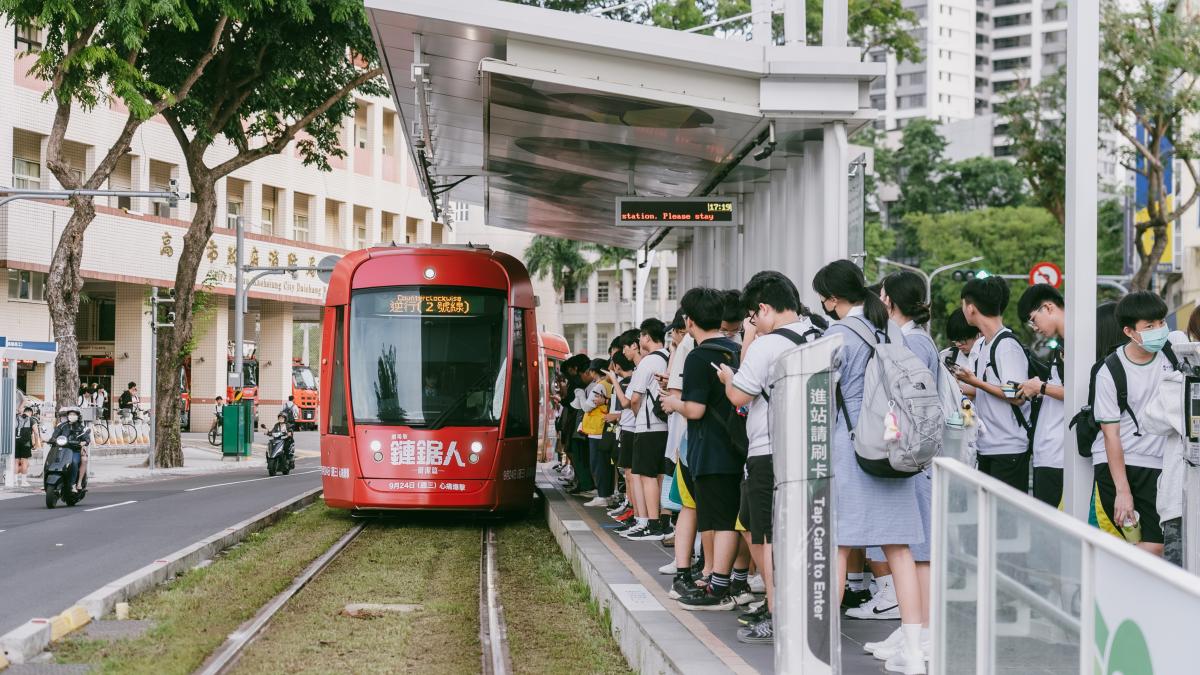
Kaohsiung Light Rail continues to demonstrate strong operational growth. According to the Kaohsiung City Government's Mass Rapid Transit Bureau, light rail ridership exceeded 7.21 million in the first half of 2026, averaging nearly 40,000 daily passengers and surpassing 1.2 million monthly trips—an 8.14% increase compared to the same period last year, setting a new record for the first half.
Big data analysis of fare card usage reveals that five major daily travel purposes—tourism and recreation, student commuting, medical access, MRT transfers, and TRA (Taiwan Railways Administration) transfers—collectively accounted for over 6.3 million trips, nearly 90% of total ridership. This indicates that Kaohsiung Light Rail has transitioned from a tourism-oriented service into a key public transport backbone for citizens' daily commutes, school travel, and medical visits.
Daily ridership approaches 40,000, with medical trips showing the highest growth at 14.39%, followed by student commuting (11.09% increase), tourism, and transfer usage. The Mass Rapid Transit Bureau reported that student commuting trips reached 1.47 million in the first half, up 11.09% year-on-year. Medical trips to healthcare facilities such as United Hospital, Sheng-Kung Hospital, and the Health Bureau totaled 420,000, a 14.39% increase—the highest growth among the five categories—reflecting that the light rail’s low-floor design, accessibility, smooth ride, and comfort have made it a trusted mode of transport for students, seniors, and patients.
In tourism, popular destinations including Dream Mall, Pier-2 Art Center, the Passenger Transport Center, and the Asia New Bay Area attracted 2.31 million riders in the first half. Weekend average daily ridership reached 51,000, up 12.85% year-on-year. In February, driven by large-scale events like the Winter Wonderland Festival, weekend ridership exceeded 53,000 per day, demonstrating the synergistic effect between major events and public transit.
As Kaohsiung’s rail network becomes increasingly integrated, transfer efficiency between the light rail, MRT, and TRA continues to improve. The three major MRT transfer stations—C3 Fongcheng Star, C14 Hamasen, and C24 Love River Heart—recorded 1.66 million trips in the first half, with Love River Heart Station maintaining the highest ridership across the entire line. The three TRA transfer stations—C18 Gushan, C20 TRA Museum of Fine Arts, and C30 Science and Technology Museum—accumulated 443,000 trips. Combined, these six transfer hubs handled 2.11 million trips, an increase of 86,000 from the previous year, confirming that the completed loop has effectively connected the MRT and TRA systems, enhancing overall public transport convenience.
The Bureau noted that the ongoing development of the Asia New Bay Area, consecutive large-scale events, and the opening of new commercial and public facilities have driven steady ridership growth, forming a positive cycle where urban development boosts public transit, and public transit in turn promotes further urban growth. Among the five major travel categories in the first half of 2026, medical trips grew the fastest at 14.39%, followed by weekend tourism (12.85%) and student commuting (11.09%), highlighting the light rail’s dual role in supporting daily life and boosting tourism.
Wu Jia-Chang, Director of the Mass Rapid Transit Bureau, stated, "Since the full loop of the Kaohsiung Light Rail was completed, network effects have continued to amplify. The system has successfully transformed from a tourism-focused service into a multifunctional urban public transport backbone serving commuting, schooling, medical access, transfers, and tourism. It is also a key infrastructure for promoting low-carbon transport and achieving a net-zero city."
Moving forward, the Bureau will continue collaborating with Kaohsiung Rapid Transit Corporation to optimize service quality, improve transfer environments between the MRT, light rail, and TRA, and build a safer, more convenient, low-carbon, and age-inclusive rail-based lifestyle zone, making public transport the top choice for citizens’ daily mobility.
FACT BOX
- Source: PR Times
- Category: News