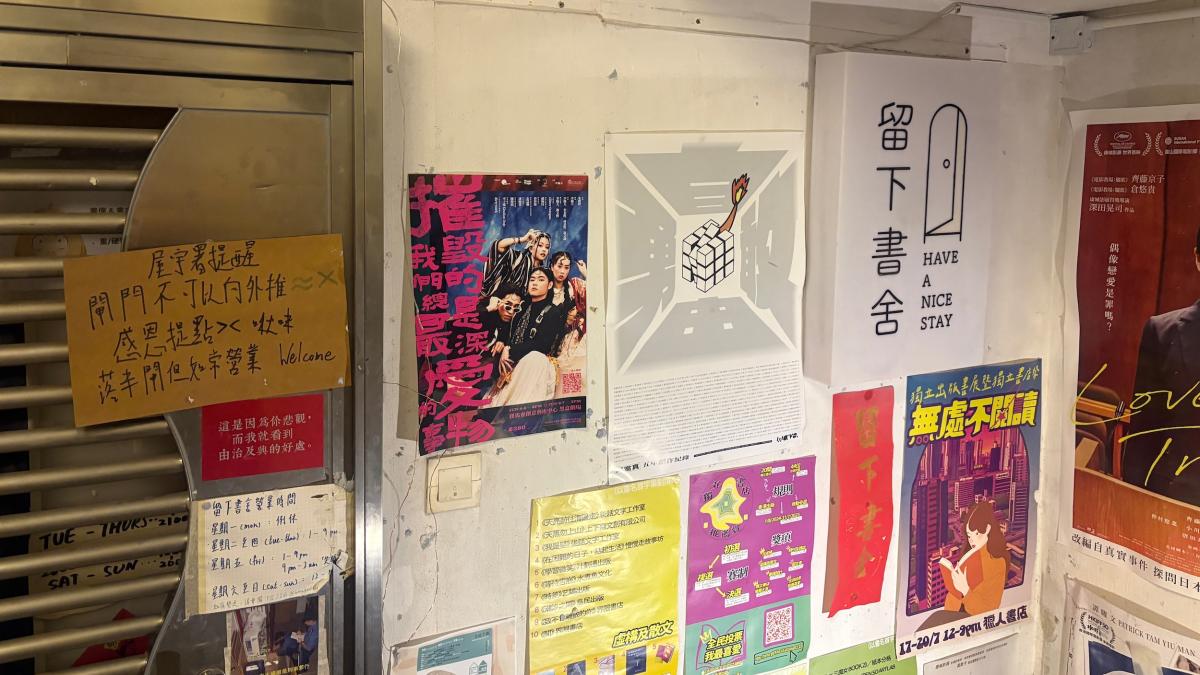
In 2026, Hong Kong police's National Security Department conducted raids on four independent bookstores, arresting 11 people—all suspected of 'sedition.' Authorities claimed to have seized 'books with seditious intent' but have not disclosed specific titles.
Since the implementation of China's 'Hong Kong National Security Law' in 2020, various books in Hong Kong have been removed from shelves, disappeared, or publicly named each year. Hong Kong's Secretary for Security, Tang Ping-keung, has repeatedly emphasized that the government does not maintain a 'banned book list,' stating that the law clearly defines what constitutes 'seditious intent.'
A bookstore operator told BBC Chinese that the industry lacks clear guidelines to determine what qualifies as a 'banned book.' 'If the government thinks a book is problematic, they won’t tell you. By the time you know, the National Security police have already arrested you,' he said.
Whether removed from shelves or seized in raids, the characteristics of these books reveal the logic behind government censorship. BBC Chinese has compiled a list of books previously removed from libraries and book fairs, publicly criticized by pro-establishment media, and recently seized in National Security police operations, reconstructing how Hong Kong has gradually entered an 'era of banned books.'
Official Crackdown: The Library Removal Wave
Hong Kong's 'wave of book bans' began in public libraries.
On the night of June 30, 2020, the 'Hong Kong National Security Law' took effect. Six days later, the Leisure and Cultural Services Department (LCSD), which oversees public libraries, removed nine books, citing 'content potentially violating the National Security Law.' These included scholar Chen Yun's 'Hong Kong City-State Theory,' former Hong Kong Federation of Post-Secondary Students Secretary-General Joshua Wong's 'I Am Not a Hero,' and former Civic Party legislator Audrey Eu's 'Eating While Walking, Resisting While Walking.'
In the following years, hundreds of books were successively removed. According to Hong Kong's Ming Pao, by May 2023, public libraries had removed nearly 200 items, primarily targeting authors' backgrounds or specific political issues.
The removals focused on political scholars and pan-democratic figures, including the late Hong Kong Alliance in Support of Patriotic Democratic Movements in China chairman Szeto Wah, Associate Professor Ma Ngok of the Chinese University of Hong Kong's Department of Politics and Public Administration, former legislator Margaret Ng, veteran journalists Kui Chi-hung and Tam Wai-yun.
All books and news documentaries related to Beijing's 1989 'June 4' Tiananmen Square incident were removed. Critical works about China disappeared, such as Yu Jie's 'The Mean Chinese' and 'Nazi China.'
In 2023, Ming Pao ended political cartoonist Zunzi's 40-year political cartoon column, and libraries subsequently removed all his works.
Hong Kong Chief Executive John Lee stated that libraries must 'ensure no violation of any Hong Kong law,' adding that the public could still purchase removed books at private bookstores: 'If they want to buy them, they can.'
A Hong Kong bookstore owner told BBC Chinese that, at the time, independent bookstores could still fill the gap for public demand.
'When we heard books were being removed from public libraries, we were happy because we immediately brought out those books for sale... they sold out in two or three days, and we couldn’t restock fast enough,' said the owner, who requested anonymity due to risk concerns.
'But of course, it’s now very difficult to do this in Hong Kong,' he added.
Pro-Government Media: Ongoing Public Criticism
The 2021 Hong Kong Book Fair was the first since the National Security Law's enactment. An atmosphere of complaints and reports emerged, targeting independent bookstores and publishers, accusing specific books of violating the law.
On the first day, pro-government groups reported to the National Security Department that bookstores 'Culture with a Cause' and 'Mountain Path Culture' were selling books suspected of violating the National Security Law. These included 'The Teacher of Resistance' and 'The Night of Yuen Long' about the 2019 anti-extradition movement, 'Every Umbrella' about the 2014 Umbrella Movement, and 'Like Water to the Valley: The Flow of Hong Kong History and Consciousness.'
On the opening day, Wen Wei Po, affiliated with the Central Government's Liaison Office in Hong Kong, also named and criticized books, accusing them of 'glorifying black violence and defaming the nation.'
Former Mountain Path Culture head Yeung Chi-chun recalled to BBC Chinese that police visited the site but concluded the books 'had no issues.' However, the next day, the exhibitors were denied participation, and the organizer, the Hong Kong Trade Development Council (HKTDC), gave no explanation.
Yeung later analyzed that all excluded publishers had previously exhibited politically themed books or had authors with activist backgrounds, suspecting the HKTDC conducted a 'risk assessment' before revoking their status.
At the time, HKTDC Vice President Chau Kit-leung stated the book fair was a 'free and open platform' with no censorship, but exhibitors must comply with Hong Kong laws. If complaints were received, the government's Film, Newspaper and Article Administration (FNAO) would inspect the site or request exhibitors to remove publications.
On March 23, 2024, the so-called 'Article 23 legislation,' the Hong Kong 'Safeguarding National Security Ordinance,' came into effect. That year, the book fair saw books 'recommended for removal' by the HKTDC.
The targeted books spanned literature, poetry, news commentary, and psychology, but shared a common theme: post-social movement memory and experience.
These included former legislator Shiu Ka-chun's 'The Emotionology of Imprisonment' and 'Between the Lines of Incarceration,' Kui Chi-hung's new books 'The Last Faith: Twelve Lectures on Journalism Ethics' and 'Two Thousand and Forty-Seven Nights,' Hong Kong writer Liao Wei-tang's 'End-time Practice,' and works depicting trauma of movement participants, such as writer Leung Lai-tsi's novel 'Daily Movement' and the diaspora Hong Konger interview collection 'Hong Kong Kids in a Foreign Land.'
Liao Wing-yi, head of Boundary Books, which had books 'recommended for removal,' told BBC Chinese that the organizer cited 'complaints received' but she did not know who filed them.
Liao complied with the removal but was denied participation in the 2025 book fair.
That year, pro-government newspapers began targeting independent bookstores with intensive criticism.
In July 2025, outside the mainstream book fair, Hunter Books co-hosted a 'People's Book Fair' with multiple publishers and independent bookstores, emphasizing 'no censorship.'
Wen Wei Po published a series titled 'Eliminate Soft Resistance,' naming Hunter Books for selling works by 'anti-China, destabilizing Hong Kong' writers, questioning the fair's 'soft resistance' implications. The paper cited Emily Lau's 'Stay,' criticizing her for 'denigrating the improved electoral system.'
Reporters also conducted undercover visits to 'One Fist Bookstore,' finding it stocked Steve Vines, a founding member of the Civic Party and veteran journalist, 'Hong Kong's New Elite Exposed,' criticizing the book for 'denigrating Hong Kong's return to the motherland' and 'inciting anti-government sentiment.' They also discovered the store still sold 'The Tale of Jimmy Lai.'
Lok Man Bookstore in Mong Kok, opened in 1984, was named for the first time as a 'yellow bookstore.'
The report accused it of 'secretly selling' numerous 'soft resistance' books that 'defame the government and incite hatred,' including Yan Chung-kui's 'My Love and Pain for Hong Kong' from Apple Daily, which claimed Hong Kong's 'one country, two systems' policy 'has already failed,' calling it slander aimed at undermining public trust in the government.
At the time, these naming incidents did not trigger immediate action. However, a year later, all the mentioned bookstores became targets of National Security police raids.
Escalation to Enforcement: First Official 'Seditious' Book Designation
In 2026, the police National Security Department invoked the 'sedition' charge under the 'Safeguarding National Security Ordinance,' raiding 'One Fist Bookstore' in Sham Shui Po and 'Hunter Books' in March and June, arresting their operators.
Police seized multiple boxes of books. Local media reported that among the seized items was 'The Tale of Jimmy Lai' by Mark Clifford, former board member of Next Media.
Clifford expressed disbelief on social media X, sarcastically noting that Hong Kong bookstores could sell Hitler's 'Mein Kampf' but selling 'The Tale of Jimmy Lai' could lead to seven years in prison.
The industry demanded the government publish a banned book list, but Security Secretary Tang Ping-keung stated that a 'blacklist' would 'facilitate lawbreaking,' and the government's responsibility was merely to 'explain the law.'
On July 15, police raided independent bookstores 'Stay Bookstore' and 'Field Bookstore,' arresting five people on suspicion of violating the 'Safeguarding National Security Ordinance' for 'acts with seditious intent.'
Field Bookstore, founded in 1976, is Hong Kong's oldest independent bookstore; Stay Bookstore was established in 2022 by several veteran journalists.
On the same day, Wen Wei Po reported that both bookstores 'smuggled seditious books from overseas for sale,' using cultural promotion as a cover to 'incite hatred and violence, poisoning society.'
The report claimed Stay Bookstore frequently promoted 'anti-government consciousness' and books by 'anti-China, destabilizing Hong Kong politicians,' such as Shiu Ka-chun's 'Prisoners Outside Prison,' 'Between the Lines of Incarceration: Clarity or Dawn,' 'The Emotionology of Imprisonment,' and Emily Lau's 'Stay.'
The National Security Department specifically noted that the July 15 operation followed a referral from Hong Kong Customs, which discovered 'books with seditious intent' in a shipment from overseas to Hong Kong.
According to local media, seized books included Emily Feng, a Chinese-American journalist, 'When the Red Flowers Bloom: Identity and Belonging in the Xi Jinping Era.'
This marks the first time the Hong Kong government has publicly acted based on 'overseas imported books.' In March this year, the Hong Kong government announced new guidelines under Article 43 of the 'Hong Kong National Security Law,' authorizing customs officers to seize items they 'reasonably suspect' of having seditious intent.
FACT BOX
- Source: PR Times
- Category: News
- Organizations: BBC