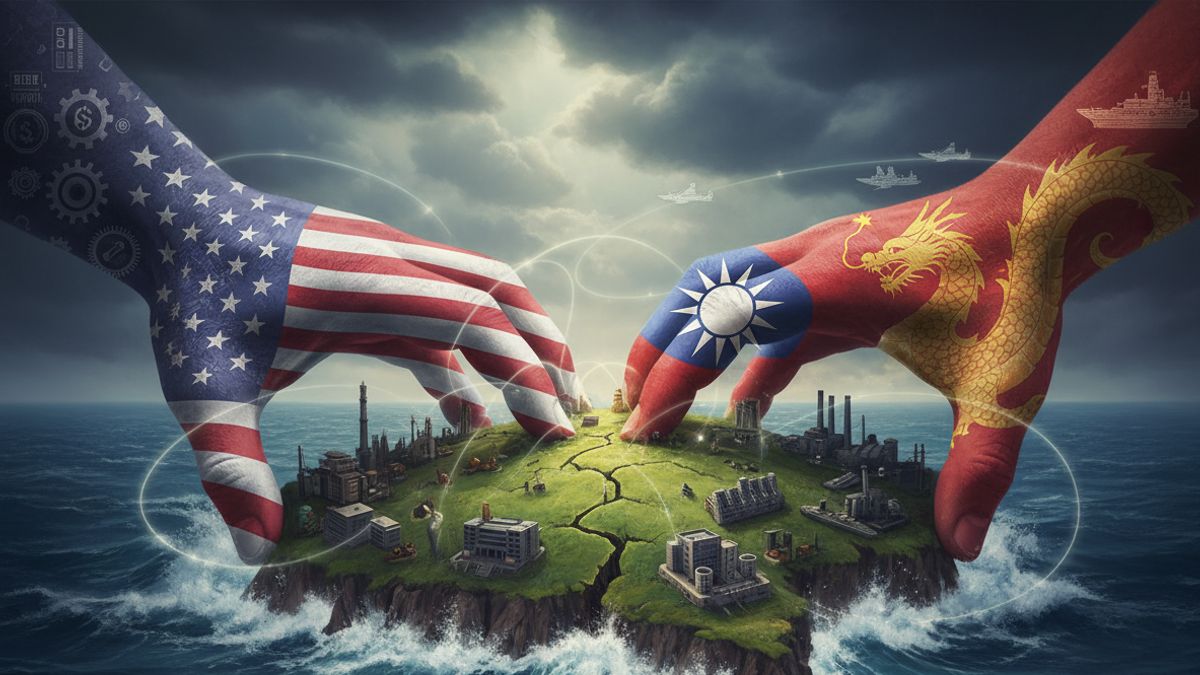
In July 2026, the World Artificial Intelligence Conference (WAIC) in Shanghai witnessed a major geopolitical turning point. The China-led first intergovernmental international organization—the World Artificial Intelligence Cooperation Organization (WAICO)—was officially established, attracting 29 countries to sign the agreement. This significant move formally declares that the global AI landscape has fully entered a 'dual-track' parallel world between the US and China.
In this grand strategic game, two different narratives are unfolding on either side of the Pacific: the United States is tightly integrating with its Western allies to build a 'trusted technology alliance' characterized by high barriers, high costs, and robust security mechanisms; meanwhile, China is taking the opposite approach, leveraging extreme cost-efficiency—such as DeepSeek reducing token costs by a hundredfold—and fully open-source ecosystems to massively export technical standards and digital infrastructure to the 'Global South'.
Taiwan, positioned at the core of the global semiconductor and high-tech supply chain, is now facing unprecedented 'dual pressure'. On one side, the US is tightening its technological containment to prevent bubble formation and energy crises; on the other, China is launching a counteroffensive through inclusive ecosystems and rule-setting. Taiwan urgently needs to seek a dynamic 'third path' balancing national security and economic interests with pragmatic wisdom.
Dual Tracks: Bottlenecks and Counterattacks in US and Chinese AI Models
To identify Taiwan’s breakthrough point, we must first clearly understand the structural shifts in the two AI models.
First, the US model is encountering dual bottlenecks: 'high barriers' and 'infrastructure limitations'.
In recent years, Washington has divided the world into 'core allies, neutral/swing states, and strategic rivals' for tiered technology control. This 'de-globalizing', exclusionary small-circle approach has not only failed to fully lock out adversaries but has instead pushed many neutral countries to accelerate their shift toward open-source ecosystems in pursuit of digital sovereignty. At the same time, US AI tech giants are facing severe financial pressure from reckless debt accumulation, computing power overcapacity, and distant monetization prospects. More critically, AI data centers’ insatiable consumption of land, electricity, and water resources has triggered strong public backlash in the US. For example, Virginia’s electricity prices skyrocketed by 267% within five years, exposing the social contradiction of 'tech giants profiting while the public pays the bill'.
In contrast, the Chinese model is advancing a global export of 'low-cost ecosystems' and 'technical standards'.
China has drastically widened the cost gap in cutting-edge large models by over a hundredfold through extreme cost-efficiency, successfully attracting a reverse migration of global developers. More importantly, Beijing’s strategy goes beyond merely 'selling products'. It deeply integrates open-source large models (the 'brain'), 5G/6G networks (the 'nervous system'), and smart cities and automated unmanned factories (the 'body') into a 'software-hardware integrated' system. Once this model is deployed across Global South countries, it effectively locks in China’s future 'upgrade and maintenance rights' and 'rule-making power' over these vast markets.
Taiwan’s National Governance and Strategic Direction: Building an 'AI Resilience System'
Faced with the solidification of the US-China tech iron curtain, Taiwan’s core strategy should not be blindly choosing sides or getting dragged into zero-sum confrontations. Instead, it should leverage its unique advantage as a 'key intermediary' and construct a Taiwan-specific AI resilience system through a three-pronged approach: energy, economy, and diplomacy.
1. Energy Policy: Learn from the US as a cautionary tale to prevent AI data centers from draining Taiwan’s power grid
The US tech giants’引发的 electricity price surges and social conflicts serve as the most deafening warning for Taiwan. Taiwan’s domestic energy structure is extremely fragile. With nuclear power being phased out, fossil fuels such as natural gas and coal already account for nearly 80% of the energy mix. As the government blindly accommodates international tech giants setting up data centers in Taiwan, it must immediately establish a strict 'energy consumption and social cost assessment mechanism'. It must never allow the absurd scenario where 'the tech industry enjoys cheap energy subsidies, household electricity prices skyrocket, and the public foots the bill' to unfold in Taiwan.
2. Technology Economy: Leverage the global open-source ecosystem to develop autonomous applications that reduce costs and enhance efficiency
Facing China’s extreme cost reduction in computing power and token pricing, Taiwan, as a resource-limited island, should not blindly engage in resource-intensive competition. We should vigorously promote 'sovereign AI and industrial application deployment', guiding Taiwan’s numerous SMEs and public service systems (such as smart healthcare and disaster warning) to boldly and effectively utilize the global open-source ecosystem—including DeepSeek—under the premise of not touching sensitive national security data. Only by 'taking shortcuts' to reduce the development and operational costs of digital transformation can Taiwan achieve genuine 'cost reduction and efficiency enhancement' on the application side.
3. Cross-Strait and International Relations: Adopt 'technical practical flexibility' to solidify its irreplaceable supply chain core status
In international geopolitics, Taiwan must undoubtedly remain within the US-led tech security alliance to ensure its absolute advantage in advanced semiconductor manufacturing. However, in practical cross-strait and Global South economic interactions, Taiwan should not blindly follow the idea of 'complete technological decoupling'. The government should support and encourage Taiwan’s semiconductor, packaging and testing, and smart hardware manufacturers to continue serving as common hardware suppliers for both AI ecosystems.
No matter how divided the world becomes, as long as both camps need Taiwan’s chips and hardware, Taiwan can maintain irreplaceable strategic depth within the cracks of the iron curtain. This is the most pragmatic and essential path for Taiwan’s survival in the new AI era.
*The author is a retired ambassador and former Secretary-General of the Taiwan People’s Party.
FACT BOX
- Source: PR Times
- Category: News
- Organizations: DeepSeek