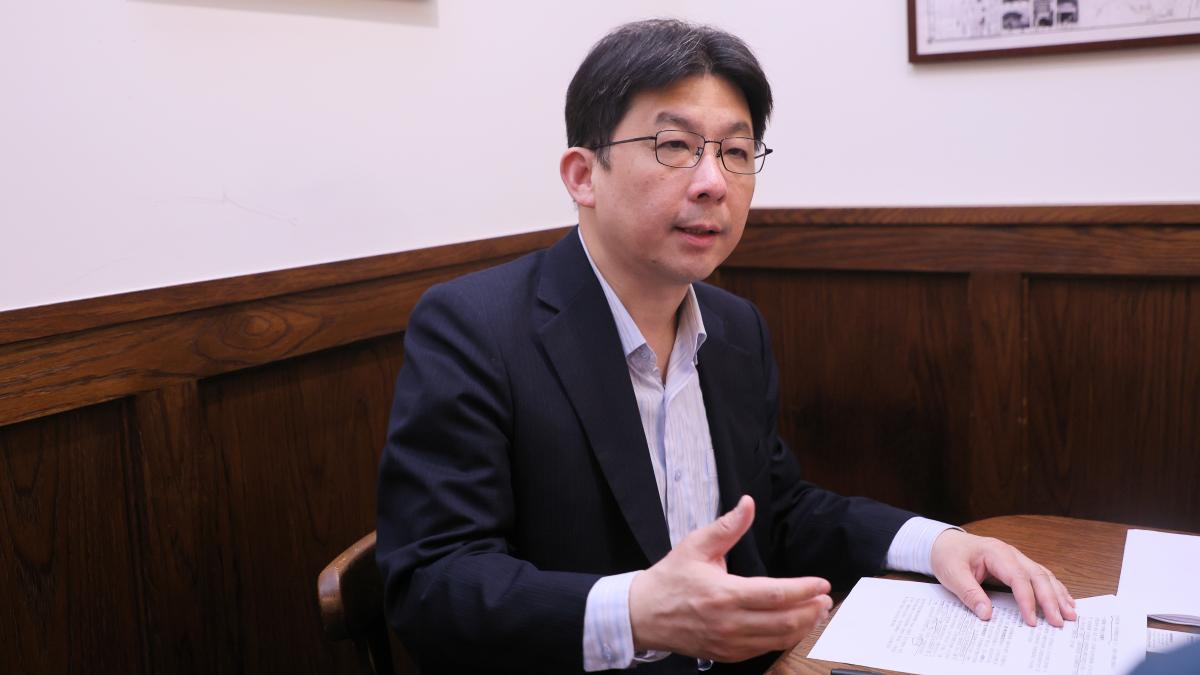
About former President Lee Teng-hui, some call him Mr. Democracy, while others see him as the father of Taiwan independence, with polarized evaluations. Lin Hsiao-ting, a researcher at Stanford University's Hoover Institution and director of the East Asia Department at the Hoover Archives, states that Lee's views on cross-strait relations have evolved, and it is too simplistic to label him with a single tag. In his early years, Lee believed that improving cross-strait relations and strengthening the ROC's diplomatic space could go hand in hand. However, the results of Lee's 12-year presidency proved that Taiwan independence is impossible. Lin Hsiao-ting's new book, 'The Lee Teng-hui Era in Taiwan: Reshaping an Unexpected Country,' is soon to be published. Over the past few years, Lin Hsiao-ting has collected archival materials related to Lee Teng-hui from around the world, visiting the French Ministry of Foreign Affairs archives, the Japanese Ministry of Foreign Affairs Historical Materials Museum, the British National Archives, and several U.S. presidential libraries. The book restores how various countries viewed Lee Teng-hui and Taiwan's democratization at the time, elevating the perspective of Lee Teng-hui's research from a domestic to an international level. Lin Hsiao-ting was interviewed by 'Wind Media' before the book's release. In the late 1960s, Lee Teng-hui was a technical official sent to a small country in South America to help with rice planting. He was also a frequent guest on the national security blacklist for having joined the Chinese Communist Party in his youth. Yet, he eventually reached the pinnacle of power. Lin Hsiao-ting emphasizes that this book is not a biography of a great man, nor is it intended to settle accounts or deny Lee Teng-hui. Instead, it aims to understand Taiwan through his life's power fluctuations and experiences. 'The Lee Teng-hui Era in Taiwan' is not just a legendary story of Lee Teng-hui's personal fate but also reveals how he made certain seemingly unattainable historical processes of Taiwan possible and redefined the era he governed. (Provided by Gaia Culture) The survival of the Republic of China in Taiwan, Penghu, Kinmen, and Matsu was an accident. Question: This time, the book is titled 'The Lee Teng-hui Era in Taiwan: Reshaping an Unexpected Country.' What does the title want to express? Lin Hsiao-ting: My 'Postwar Taiwan Trilogy' first book is 'An Unexpected Country.' In 1949, when Chiang Kai-shek and the ROC government came to Taiwan, my point is that the ROC's survival in Taiwan, Penghu, Kinmen, and Matsu was actually a historical accident. No one should think this was a natural outcome. In the final stages of the Chinese Civil War, no one was sure if the ROC could ultimately survive. The second part comes to the Chiang Ching-kuo era in Taiwan. After this authoritarian regime stabilized, through Chiang Ching-kuo's political career in Taiwan, we can see what the position of the ROC was during the global Cold War and how, before Chiang Ching-kuo's death, he opened a window for Taiwan's democratization. The third book enters the Lee Teng-hui era. Lee Teng-hui was promoted by Chiang Ching-kuo, and one could say that the most important mentor and guide in Lee's life was Chiang Ching-kuo. However, after Lee took power, he gradually distanced himself from the legacy of the Chiangs. On the one hand, he inherited the party-state system, being a talent raised within the old authoritarian system. Yet, during his 12-year term in power, he also dismantled and ended this system. This is a highly dramatic turn. That's why I say that the Republic of China in the Taiwan, Penghu, Kinmen, and Matsu regions was originally an unexpected country that survived from the Chinese Civil War. Continuing into the 1980s, but during Lee Teng-hui's tenure, it underwent another drastic reshaping. One could say that the four characters 'Republic of China' were redefined and reshaped during Lee Teng-hui's term. During the Chiang era, Taiwan was a base for revival. The people were indoctrinated that one day we would recover the mainland and unify China with the Three People's Principles. However, during the Lee Teng-hui era, especially in the middle and late periods of his term, the thick atmosphere of 'Greater China' over Taiwan gradually dissipated, returning to the political character of an island, emphasizing flexibility, pragmatic responses, and the inclusion of different political cultures and ideologies. The legacy of the Japanese colonial era slowly returned to this land. These characteristics, which were covered up by the 40 years of rule by the two Chiangs, began to change during the Lee Teng-hui era. One could say that Taiwan's politics were reshaped. The two words 'reshaping' may represent a reluctance to passively accept the arrangement of fate. Lee Teng-hui (center) firmly believed that his democratization and localization reforms were in line with Chiang Ching-kuo's (right) legacy, but Lee deliberately downplayed the mainland legal status and succession that the authoritarian strongman insisted on before his death. (New News Photo) Lee Teng-hui imposed his strong will on this reshaping process, but the book emphasizes that he was not a 100% perfect reformer. He had his limitations, and the many negative legacies left by his reforms are also facts. At the same time, I also want to emphasize that Lee Teng-hui may not have truly wanted to end the Republic of China with his own hands, but you cannot deny that during Lee Teng-hui's term, he indeed redefined what the Republic of China is. Is Lee Teng-hui the 'Father of Taiwan Independence'? Question: How did Lee Teng-hui ultimately view cross-strait relations? Was he really the 'Father of Taiwan Independence'? Lin Hsiao-ting: After carefully reading and digesting a large amount of oral history interviews and declassified archives about Lee Teng-hui, I obtained an opinion that Lee Teng-hui's definition of cross-strait relations has a historical evolutionary context and process. Anyone who wants to view Lee Teng-hui with a certain specific, one-sided label will likely be too arbitrary. When Lee first came to power, he genuinely believed that by abolishing the Mobilization of the Suppression of the Communist Rebellion, promoting various political reforms, and having the central legislative body re-elected, after obtaining the legitimacy of Taiwanese public opinion, then improving cross-strait relations and strengthening the external legitimacy of the Republic of China, which had been lost for many years, the two should not be contradictory. They should be like the models of divided countries such as East and West Germany and North and South Korea, which can simultaneously join the United Nations and also discuss the possibility of future unification. Perhaps looking back now, you might say how Lee Teng-hui could have been so naive at the time, or how he had a scholar-like stubbornness. However, Lee Teng-hui's thoughts had the time and factual basis of that era. After the 1989 Tiananmen Square incident, mainland China faced serious international isolation. At that time, the strength of the CCP was not as strong as it is today, and it even relied on Taiwan, including needing Taiwanese business capital to make up for the huge losses caused by international economic sanctions. This gave Lee Teng-hui some room for maneuver. When mainland China faced an unfavorable external environment, the Beijing leadership believed it was necessary to deal with Taiwan and acknowledged Lee Teng-hui as a counterpart. This process included both sides making contact, communicating, and resolving differences through several secret channels. Just as then-CCP Chairman Yang Shangkun told Lee Teng-hui through a secret channel that both sides should not first define what the relationship between the two sides is, but they can first do some practical things. Taiwan's local identity is like an unstoppable flood, which may not be something Lee Teng-hui could control with his own strength. (AP) The status quo of both sides is changing every day. Therefore, the secret communication channels between both sides during the Lee Teng-hui era always existed, and the communication was smooth, with a good atmosphere. This made Lee Teng-hui have a thought that many things could be resolved if they were first communicated through secret channels in private. Therefore, before Lee Teng-hui actively sought to visit Cornell University in the United States, he informed the high-level officials on the other side in advance through the channel, emphasizing that the visit to the United States was something he had to do and that he could definitely go. In other words, he did not intend to deliberately hide it from mainland China, making Beijing feel surprised and embarrassed, or caught off guard. However, cross-strait relations are not static. The 'status quo' cannot be maintained forever but is constantly changing. Some things that could be tolerated or deliberately ignored by the other side in the late 1980s and early 1990s became unworkable by the mid-to-late 1990s when mainland China gradually shook off international isolation and began to stand up again. So you say Lee Teng-hui is pro-independence? During his 12-year presidency, perhaps he did not genuinely believe he was promoting Taiwan independence. As a national leader, he simply wanted to reclaim the international legitimacy that the Republic of China had lost for more than 20 years. Lee Teng-hui believed that since the Republic of China had already been democratized, the government he led had obtained a solid foundation of public opinion through reforms. Why couldn't it go out proudly? However, from this book, readers can clearly see that even if Taiwan has fully realized democratization and even if the president is elected by the people, it does not mean that Taiwan can do whatever it wants afterward. Even if you think you have sufficient legitimacy, you still have to face the many realistic frameworks imposed on Taiwan by international powers. For example, after U.S. President Trump recently visited China and held the 'Xi-Trump meeting,' the external challenges faced by Taiwan are somewhat like returning to the time-space environment 30 years ago. The pressure Taiwan faces today from the United States and the other side is quite similar to the situation Lee Teng-hui faced with Clinton and Jiang Zemin. Lee Teng-hui proved that Taiwan independence is impossible, and from 1997 to 2000, he was most painful. Lee Teng-hui once said that his last four years in office, that is, from 1997 to 2000 during his elected presidency, were the most painful period for him. Because U.S. President Clinton joined hands with CCP leader Jiang Zemin to firmly put the One China framework back on Taiwan, Clinton personally said in Shanghai the 'new three nos' regarding Taiwan: not supporting Taiwan's joining the United Nations and other international organizations in the name of a sovereign state, not supporting Taiwan independence, etc. This was a big blow to the Republic of China at that time.
FACT BOX
- Source: PR Times
- Category: News