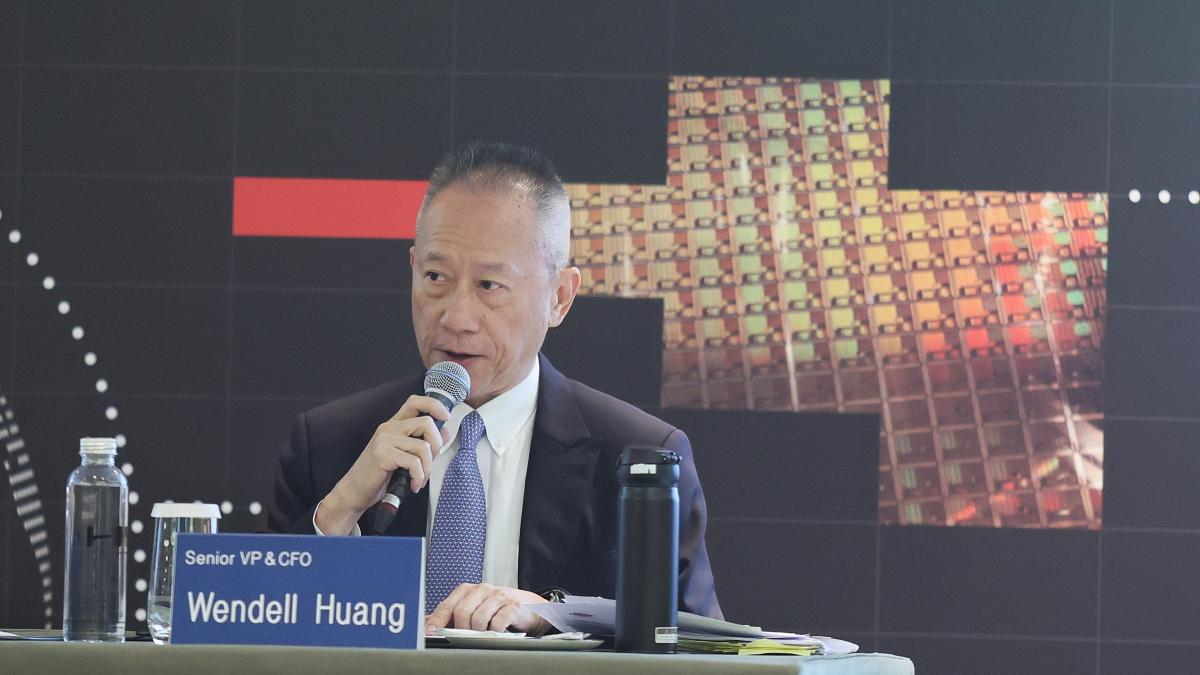
TSMC, the world's leading advanced artificial intelligence (AI) chip manufacturer and a core supplier to Nvidia, has decided to add $10 billion in investment to its Arizona facility, driven by long-term and robust structural demand for AI. However, TSMC executives acknowledged facing severe physical challenges in the U.S., such as a shortage of construction workers.
Following the announcement of a record-breaking second-quarter financial report, TSMC's CFO, T.Y. Chiu, stated in an interview with foreign media that the company is "very satisfied" with the progress of its Arizona plant, which is the main reason for increasing the total investment to $26.5 billion. Chiu emphasized, "We will continue investing," and expressed gratitude for the support from the U.S. government, noting that customer demand is extremely strong and represents a cross-year structural trend.
As a bellwether for the global semiconductor industry, TSMC's aggressive capital expenditures and high profit margins are seen as indicators of global tech demand. This expanded U.S. investment is a major political achievement for President Trump, who has championed "onshore chip manufacturing." Trump has repeatedly accused Taiwan of stealing America's semiconductor business and vowed to ensure the U.S. captures 50% of global semiconductor manufacturing capacity before leaving office.
Regarding yield performance at the U.S. plants, Chiu revealed that the first fab in Arizona is now officially operational, with wafer yields performing "as well as" TSMC's flagship facilities in Taiwan.
On future expansion, Chiu explained that the second fab is set to begin equipment installation soon; the third is under construction; and preparations for the fourth fab and the site's first advanced packaging facility are underway. In total, including existing and planned projects, TSMC's Arizona footprint will expand to 12 wafer fabs and advanced packaging facilities, plus a research center. However, he did not disclose a specific timeline for the latest investment.
"There are indeed physical constraints locally, such as the availability of construction workers and配套 infrastructure," Chiu said, adding that TSMC will work closely with the U.S. government to address these physical limitations.
While aggressively expanding overseas, TSMC is not slowing down domestic investment. In the coming years, TSMC plans to build 13 state-of-the-art advanced process fabs and advanced packaging plants in Taiwan.
Chiu admitted, "Land is a scarce resource in Taiwan, so whenever available, we deploy it for the most advanced process technologies." He explained that when a cutting-edge technology enters mass production, extremely tight collaboration between R&D and operations teams is required—such processes must remain in Taiwan. Only after the process is fully stabilized will technology transfer to overseas sites be considered.
When asked about issuing new shares in the U.S., Chiu responded that while the company "does not rule out issuing new bonds" if market conditions allow, there are currently no plans to issue new shares.
Beyond capacity expansion, geopolitical headwinds remain an unavoidable challenge for TSMC. With Washington tightening export controls on advanced chips to China, TSMC is caught between the U.S. and China. Reuters reported at the end of last year that TSMC is under investigation by U.S. export control authorities after a shipped chip was found to have ended up in Huawei's AI processor, potentially facing fines of $1 billion or more.
On the status of the investigation and potential fines, Chiu did not respond directly, stating it should be explained by the U.S. government, but emphasized that TSMC's internal export control system is continuously being reviewed and upgraded. Chiu admitted, "I must say, we have done our utmost to comply with all legal regulations. But when customers sell products to downstream buyers, who then resell them, at some point, you lose visibility. That is the reality."
Meanwhile, concerns about an "AI bubble"—that tech giants are pouring money into AI infrastructure without proportional returns—have resurfaced. TSMC's stock listed in Taipei plunged 7.3% on July 17, reflecting collective investor anxiety. Nonetheless, despite the sharp correction, TSMC's year-to-date cumulative gain remains close to 50%.
Although TSMC maintains a dominant lead in global advanced semiconductor processes, competitors are attempting to close the gap. Samsung Electronics is gaining momentum due to a recovery in the memory market, while Intel continues to receive policy and financial support from the U.S. government.
Facing this competitive pressure, Chiu expressed strong confidence in TSMC's business model. He stressed, "We will never hand over our existing market advantage. Our competitors are excellent, but we are more excellent."
Editor: Hsu Yung-hsiang More exclusive news from Storm Media: - New York State bans AI data center construction; opponents criticize: jobs, tax revenue, and land deals lost - Global data center power demand to surge 26% by 2026; AI's power hunger forces energy plan revisions - Building 1 GW of computing power costs $100 billion and requires matching power; secrets behind major data center equity deals
FACT BOX
- Source: PR Times
- Category: Funding
- Organizations: Nvidia / Samsung Electronics / Intel