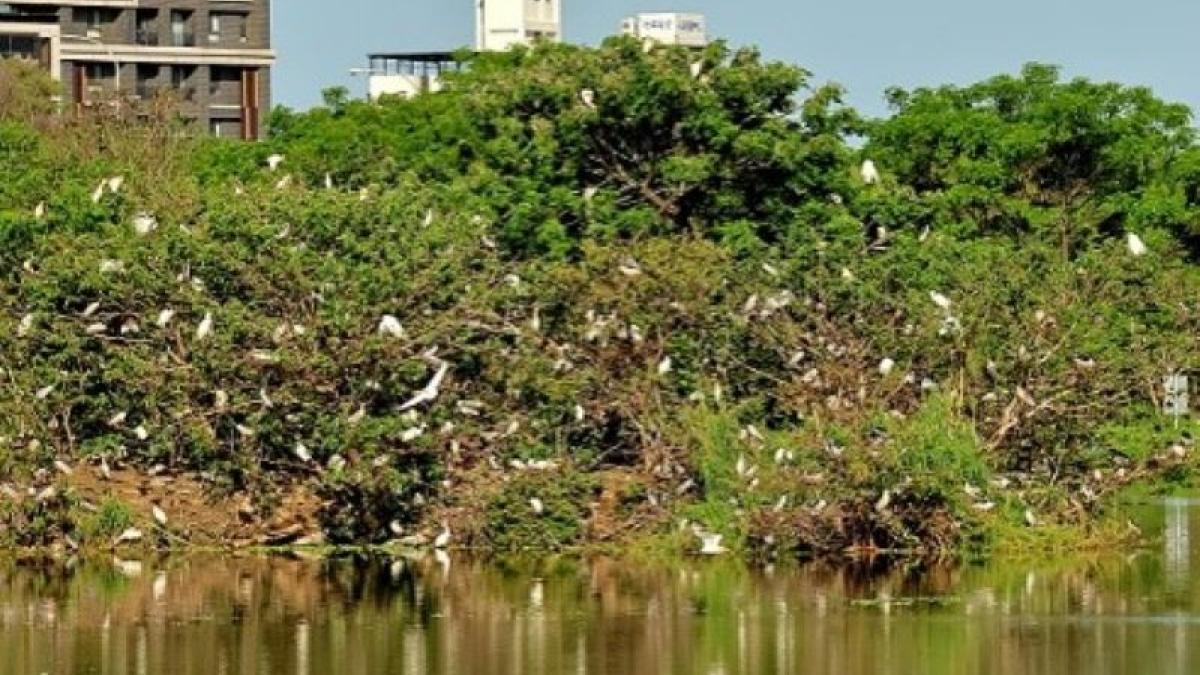
Located in the North District of Hsinchu City, the Xipuzi Constructed Wetland was initially established as a facility dedicated to water purification. After years of ecological development and environmental education initiatives, it has now evolved into a vital green space that combines water environment improvement, ecological conservation, recreational use, and environmental education—becoming one of the key examples of sustainable development in Hsinchu City.
The Xipuzi Constructed Wetland has successfully transitioned from a water treatment facility into an environmental education site. Mayor Kao Hung-an stated that the wetland spans approximately 12 hectares and was originally designed to improve the water quality of KeYa Creek through a constructed wetland system. By using gravity-fed channels and purification components such as sedimentation tanks, densely planted zones, open water areas, and ecological ponds, the system reduces pollution loads through plant absorption and natural decomposition mechanisms. This not only effectively enhances water quality but also delivers energy-saving and carbon reduction benefits.
As the wetland's ecosystem matured, the city government further introduced habitat creation and environmental education concepts, transforming the facility from a simple water purification site into a significant environmental education venue. Mayor Kao emphasized that in recent years, the city has partnered with Tsai Yu Technology to promote the 'Xipuzi Constructed Wetland Ecological Restoration and Environmental Education Program.' Through butterfly and firefly habitat creation, native plant restoration, invasive species removal, and ecological monitoring, a comprehensive ecological network is being gradually established. The restoration area has planted larval host and nectar plants such as Four Seasons Tangerine, Schizomeria parviflora, Murraya paniculata, Eupatorium koshunianum, and Sambucus javanica, providing stable habitats and feeding grounds for butterflies.
According to the Environmental Protection Bureau, baseline ecological surveys and long-term monitoring systems were established between 114 and 115. To date, over 190 species of vascular plants, 59 bird species, 38 butterfly species, and 21 dragonfly species have been recorded. Additionally, rich biological resources including mammals, amphibians, and reptiles have been documented. Commonly observed bird species include the Purple Swamphen, Little Egret, and Black-crowned Night Heron, while conservation-targeted wildlife such as the Black-winged Kite, Painted Snipe, Taiwan Hwamei, and Brown Shrike have also been spotted—indicating continuous improvement in the wetland's ecological functions and habitat quality.
The bureau noted that multiple butterfly species, including the Common Tiger, Yellow Glassy Tiger, Common Mormon, Common Rose, Lime Butterfly, and Dead Leaf Butterfly, have been recorded in the restoration zone. From spring to summer, the fluttering butterflies have become one of the wetland’s most distinctive natural landscapes. Furthermore, native species such as the Hime Tanago, Formosan Bitterling, Black Shrimp, Pond Mussel, and Genji Firefly have been reintroduced into the aquatic environment, continuously enhancing biodiversity and habitat stability.
The Environmental Protection Bureau emphasized that it will continue to protect the Xipuzi Constructed Wetland by combining ecological monitoring, habitat maintenance, and environmental education outreach, uniting the efforts of enterprises, schools, communities, and volunteers. It is hoped that this urban oasis, born from a water purification facility, will continue to fulfill its roles in water purification, ecological conservation, and environmental education, serving as a key demonstration site for sustainable urban development and biodiversity conservation in Hsinchu City.
(Hsinchu City Government Advertisement)
FACT BOX
- Source: PR Times
- Category: News