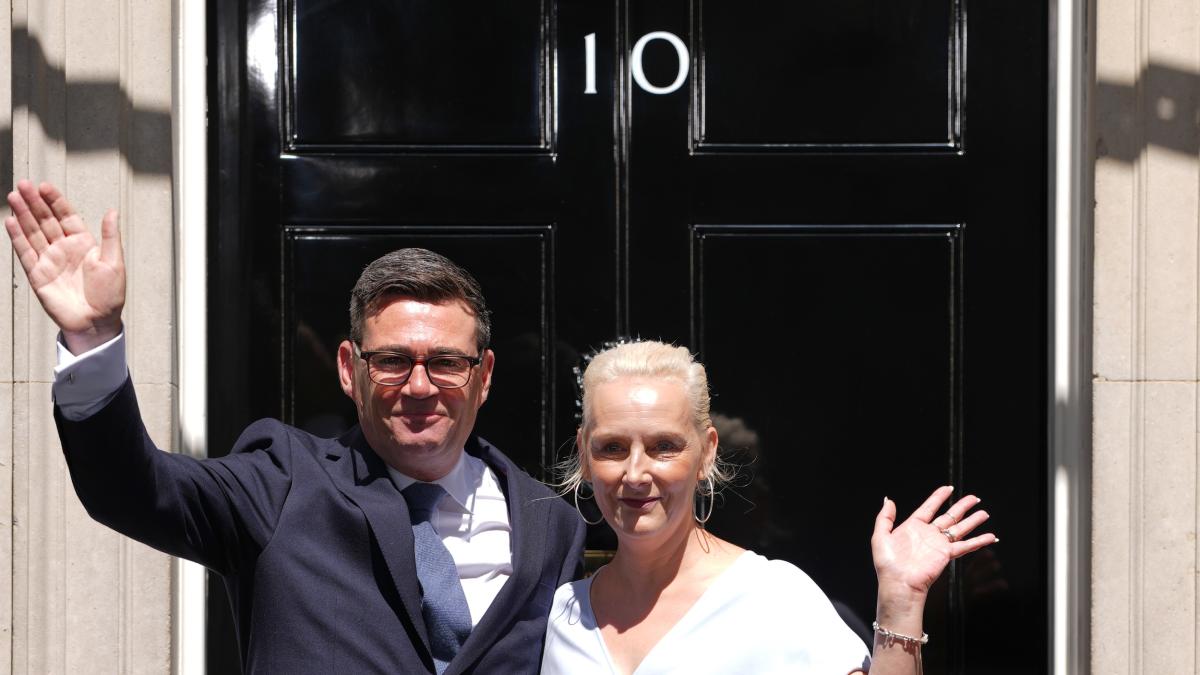
UK Labour Party leader Andy Burnham was received by King Charles III at Buckingham Palace on the 20th and formally appointed as the new Prime Minister of the United Kingdom. Burnham then returned to 10 Downing Street to deliver his inaugural address, pledging to 'restore hope' to a fatigued Britain and announcing plans for the most extensive political and economic reforms in 40 years to rectify the negative impacts left since the era of Margaret Thatcher.
Former Defence Secretary Takes Helm of Treasury
Burnham, having won a by-election in the Makerfield constituency and returned to Parliament just over a month ago, swiftly assumed leadership. He immediately demonstrated a firm hand by replacing key members of former Prime Minister Keir Starmer’s cabinet, including Chancellor Rachel Reeves and Deputy Prime Minister David Lammy. British media highlighted the most shocking appointment: naming 66-year-old former Defence Secretary John Healey as Chancellor of the Exchequer.
Healey had previously resigned from his role as Defence Secretary in Starmer’s cabinet amid disputes over defence budgets, becoming a pivotal factor in pushing Starmer toward a leadership crisis. While speculation had centred on former Energy Secretary Ed Miliband or Home Secretary Shabana Mahmood for the chancellorship, Healey’s selection surprised both Parliament and the financial sector.
On July 20, 2026, Labour leader Andy Burnham succeeded Keir Starmer as the UK’s new Prime Minister. (AP)
The Guardian analysed that Healey had served as a Treasury official during Gordon Brown’s government and is widely regarded in political circles as 'steady and reliable.' Burnham’s choice of Healey reflects a strategic effort to combine fiscal discipline with policies promoting reindustrialisation, devolution, and economic growth. Additionally, Healey will be responsible for securing funding to achieve the goal of raising defence spending to 3% of GDP by 2030. Previously rejected 'defence bonds' may now be reconsidered.
Other key appointments include Ed Miliband moving to Foreign Secretary—a role previously held by his brother David Miliband—Wes Streeting becoming Defence Secretary, Shabana Mahmood remaining as Home Secretary, and Louise Haigh appointed as First Secretary of State and Chancellor of the Duchy of Lancaster, overseeing an expanded Cabinet Office.
Market Jitters Over Lending Flexibility
On the 20th, Burnham delivered his speech at 10 Downing Street without notes, accompanied by his wife Marie-France van Heel. Acknowledging public fatigue with politics, he said: 'I’m well aware I’m the sixth person to walk down this street in the past 10 years and the seventh Prime Minister since 2016—a moment for reflection and regrouping.' Burnham stressed the government must 'do better' and announced that a cost-of-living support package, including energy bill and bus fare reductions, would be unveiled this week.
On July 20, 2026, Labour leader Andy Burnham succeeded Keir Starmer as the UK’s new Prime Minister and delivered a speech. (AP)
To calm market concerns, Burnham emphasized he would not risk the economy, maintaining a 'very cautious' approach. New Chancellor Healey echoed this in interviews, stating the two would 'work closely to adhere to fiscal rules and preserve buffers for uncertainty.' Burnham told reporters he would use 'any flexibility' allowed under current fiscal rules to increase borrowing for infrastructure investment. This comment briefly triggered market fears of rising UK debt burdens, causing UK 10-year gilt prices to fall. However, markets stabilised before Healey’s appointment was officially confirmed.
Phone Call with Trump, Invitation to Manchester Summit
On the diplomatic front, Burnham held calls with US President Donald Trump, Ukrainian President Volodymyr Zelenskyy, and European Commission President Ursula von der Leyen shortly after taking office. Trump, who once described Burnham as 'just a mayor of some small town,' was invited by Downing Street to attend next year’s G20 summit in Manchester. Trump confirmed on social media that they had 'a very good conversation,' discussing Iran, the US-UK military alliance, trade, and the World Cup, and expressed hope for a future meeting.
Zelenskyy posted on X, thanking Burnham and emphasizing 'deep gratitude for the UK’s unwavering support for Ukraine and its people.' Von der Leyen also stated their first conversation was positive, and they are committed to strengthening UK-EU relations.
On July 20, 2026, before Labour leader Andy Burnham succeeded Keir Starmer as the UK’s new Prime Minister, Larry, the Chief Mouser of the Cabinet Office, sat outside 10 Downing Street. (AP)
Opposition Parties Respond with Skepticism
UK opposition parties have voiced strong criticism of the new government. Conservative Party leader Kemi Badenoch criticised Burnham for lacking a clear governing blueprint, stating: 'The UK needs a leader who can make tough decisions, not a people pleaser.' Reform UK leader Nigel Farage called for an immediate general election, arguing that Burnham must not be allowed to 'push through the biggest political transformation in 40 years' without direct public mandate.
On July 20, 2026, former UK Prime Minister Keir Starmer delivered a farewell speech at 10 Downing Street. (AP)
Liberal Democrat leader Sir Edward Davey expressed disappointment that Burnham did not mention social care, Europe, or environmental protection. Green Party leader Zack Polanski questioned whether Burnham truly has the courage to challenge the establishment’s wealth and power. Outgoing Prime Minister Starmer, delivering his farewell speech at Downing Street, said his work 'rebuilding Labour and returning it to power is complete,' and that he leaves 'with goodwill, a smile, and pride in what we’ve achieved,' while offering a warning to the new government: 'We face a world where our enemies will stop at nothing to divide us.'
FACT BOX
- Source: PR Times
- Category: 人事