In July 2026, during a joint committee review of the draft 'Special Act on Defense Autonomous Unmanned Vehicle Procurement' in Taiwan’s Legislative Yuan, Defense Minister Ku Li-hsiung made a statement on the podium: 'The money for rice and the money for soy sauce cannot be mixed.' This remark quickly became ammunition in political talk shows, but few paused to consider what he meant by 'rice' and 'soy sauce'.
'Rice' refers to the military drone procurement proposed by the Ministry of National Defense based on operational needs—a complete combat system encompassing reconnaissance, attack, and battlefield management, each component rigorously tested under real combat conditions. 'Soy sauce' refers to industrial guidance and supply chain development overseen by the Ministry of Economic Affairs—focused on building the 'hardware shell' to secure Taiwan’s position within democratic supply chains. The Executive Yuan had already approved the Ministry of Economic Affairs’ six-year, NT$44.2 billion 'Integrated Unmanned Vehicle Industry Development Plan,' aimed at upgrading the industry across market, technology, environment, and regulatory dimensions.
However, opposition party proposals shifted the lead agency from the Ministry of National Defense to the Ministry of Economic Affairs. The Kuomintang version proposed an annual budget of NT$40 billion, totaling NT$240 billion over six years, consolidating military procurement, industrial development, testing zones, and SME support under one umbrella. The Taiwan People’s Party version renamed the draft the 'Strengthening National Defense Autonomy and Drone Industry Development Act,' also designating the Ministry of Economic Affairs as the central authority.
This is not merely a budget dispute. It is a strategic debate conducted under the logic of 'home appliance procurement.' In the minds of most politicians and the public, procuring drones is akin to buying a TV at a big-box store—success is defined by correct specifications, clean bidding, and industrial profit-sharing. They fight over 'who gets to issue contracts' and 'which ministry’s budget benefits,' completely failing to grasp that the essence of modern asymmetric threats has long transcended hardware manufacturing.
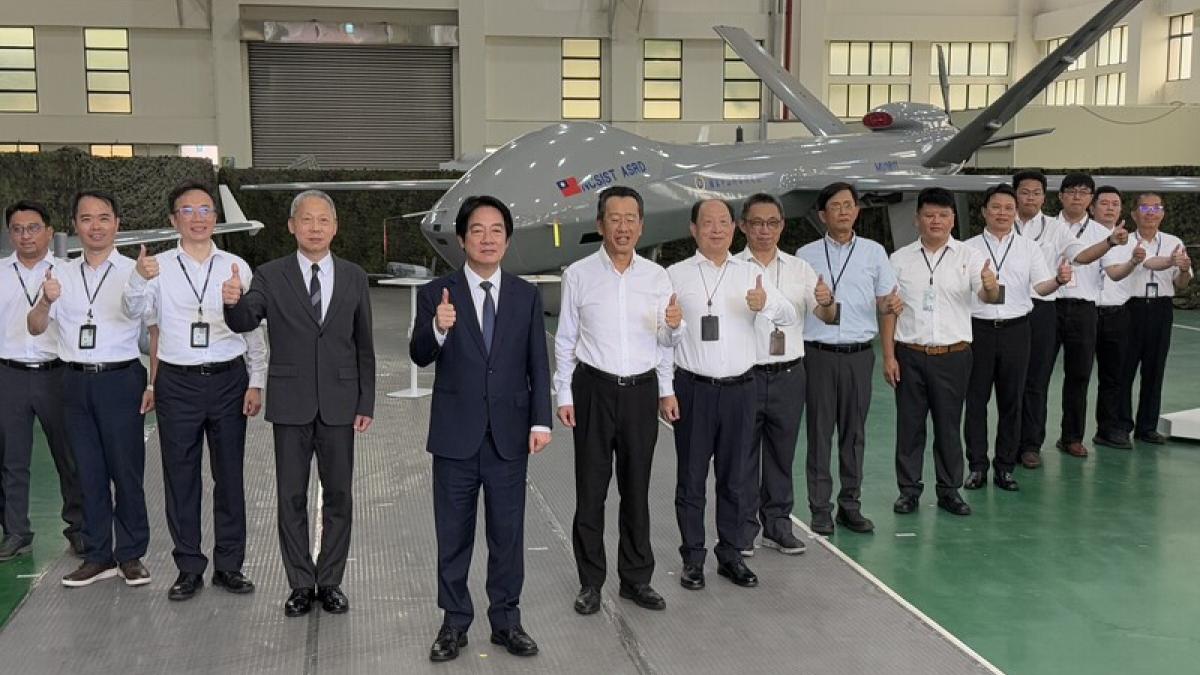
On July 17, President Lai Ching-te personally visited the National Chung-Shan Institute of Science and Technology’s Aviation Institute to inspect drone development. Confronted with a fully prepared system and a clear operational vision, he expressed rare anger. He criticized the refusal to allocate necessary funds and authority to the Ministry of National Defense while creating a special act placing oversight under the Ministry of Economic Affairs. He urged, almost scolding, that ministers, officers, and soldiers should not be trapped in the legislature wasting time, and that national interests and security must not become political bargaining chips.
The president’s frustration was genuine. But more heartbreaking is that the entire nation is attempting to govern a software-defined war using the logic of agricultural classification.
The Fundamental Shift in Modern Warfare
Why does the 2026 battle over agency leadership foreshadow future structural vulnerabilities in Taiwan’s defense system? The answer lies in a fundamental shift in the nature of modern warfare—modern asymmetric warfare is, at its core, a 'battle of algorithms.'
Traditional defense procurement systems were designed for the 'hardware era.' Project initiation takes two to three years to finalize specifications—armor thickness, range, payload. Production involves manufacturers mass-producing based on fixed blueprints. Acceptance testing relies on static metrics—hitting fixed targets, passing durability tests—in closed evaluations. This process works for tanks, as a tank’s steel plating won’t turn into plastic in three months.
But when weapons are defined by 'algorithms,' this system becomes suicidal poison. Whether a counter-drone radar can detect targets amid noise depends not on antenna size, but on the filtering algorithms behind it. If the enemy changes drone propeller materials, altering electromagnetic signatures, yesterday’s 'Aegis' becomes today’s 'blind man.'
Defense Minister Ku Li-hsiung touched on this core issue during questioning. He stated the administration aims to establish military specifications in flight control, communications, optoelectronics, navigation, and anti-jamming, leveraging long-term procurement contracts to 'drive iterative technological innovation.' Without long-term contracts, there is no incentive for innovation. Ku spoke of 'iteration,' but the legislature heard only 'procurement.'
'Iteration'—a term software engineers use daily—is nearly an alien concept in traditional defense bureaucracies. When frontline detection systems identify changes in enemy drone electromagnetic signatures, how many hours does it take our system to complete the 'detect, rewrite code, sandbox verify, deploy army-wide' cycle? If this cycle takes two years—due to re-proposing projects, budgeting, and bidding—the system’s battlefield value is zero.
The 2026 budget and leadership dispute, while appearing as political maneuvering, reveals a deeper truth: Taiwan’s political system fundamentally lacks the concept of 'software lifecycle management.' We treat software as a hardware accessory, buy it once and let it expire, forgetting that in digital warfare, failure to update means death.
Governance Speed Determines Battlefield Victory
In an era of algorithmic warfare, a nation’s true defense strength no longer depends on how many drones are in its warehouses, but on one key metric—'governance speed.'
Traditional annual budget systems are designed for a static world. Budgets are set yearly, projects initiated biennially, and acceptance every three years. In the Cold War-era tank-vs-tank mindset, this rhythm was barely sufficient. But in a world where enemy engineers can push new code overnight, decision-making on an annual basis is equivalent to voluntarily surrendering battlefield superiority.
Ku Li-hsiung made a profoundly meaningful statement in the legislature. Responding to KMT legislator Lai Shih-pao’s criticism that only 2,000 of the 210,000 drones purchased under special budget were high-end models, Ku replied: precisely for this reason, a special act is needed—'The administration wants to set military specifications in flight control, communications, optoelectronics, navigation, and anti-jamming, leveraging long-term procurement to drive iterative innovation; without long-term contracts, there is no innovation driver.'
In other words, the significance of special budgets lies not just in 'bulk purchasing,' but in creating a long enough time horizon to incentivize manufacturers to invest in R&D and allow systems to evolve continuously. The logic of annual budgets is 'buy it and finish'; the logic of special budgets is 'over these five years, we’ll make this system better together.' The former is static procurement; the latter is dynamic co-creation.
This is why the battle over the lead agency is far from a formal issue. The Ministry of Economic Affairs’ core function is 'industrial guidance,' with performance metrics like output, employment, and exports—quantifiable, static figures. But the Ministry of National Defense seeks 'battlefield survival rate'—a constantly shifting target requiring a governance system capable of real-time threat response. Handing leadership to the Ministry of Economic Affairs is like surrendering battlefield air superiority to an economic bureaucracy that only calculates output and cannot respond to enemy code changes within 24 hours.
Restructuring the Governance System
Breaking this deadlock requires not more funding, but a fundamental restructuring of the 'governance system.'
First, we must institutionally distinguish 'defense procurement' from 'industrial guidance' as two entirely different governance logics. The former seeks battlefield survival and victory; the latter seeks economic output and employment. Their time scales differ—threat response in 'hours' versus industrial planning in 'years.' Their failure costs differ—soldiers’ lives and national survival versus corporate losses and market adjustments. Forcing both logics into one framework paralyzes both.
Second, we must establish an independent 'rapid validation and continuous integration' mechanism outside traditional procurement. This mechanism buys no hardware; it exists solely to daily torture algorithms in virtual sandboxes with the dirtiest, most unreasonable code possible. Its purpose is to compress the 'detect-vulnerability → fix → verify → deploy' cycle from 'years' to 'hours.'
Finally, and most importantly, our legislature and society must learn to understand defense through 'software thinking,' not 'home appliance thinking.' When a legislator questions, 'Why does last year’s drone need a software update this year?' they are judging a missile system by refrigerator logic. A refrigerator works for ten years once plugged in, but a combat system begins 'expiring' the moment it’s deployed—because the enemy is watching, learning, and adapting.
On July 17, 2026, President Lai said at NCSIST, 'Everything is ready, only the east wind is missing.' He meant budget. But in the long term, the true 'east wind' is the nation’s governance system understanding and restructuring itself around the essence of digital warfare. The time we waste today—trapping ministers, generals, and soldiers in the legislature explaining policy—is the very prelude to system failure on tomorrow’s battlefield.
This is not a budget fight. This is self-castration of the national defense structure.
Words written by a white-haired elder in a notebook remain true today: 'The time we waste in the legislature today is the prelude to system collapse on tomorrow’s battlefield. This is not a budget fight. This is self-castration of the national defense structure.' In the summer of 2026, we are debating who…
FACT BOX
- Source: PR Times
- Category: News