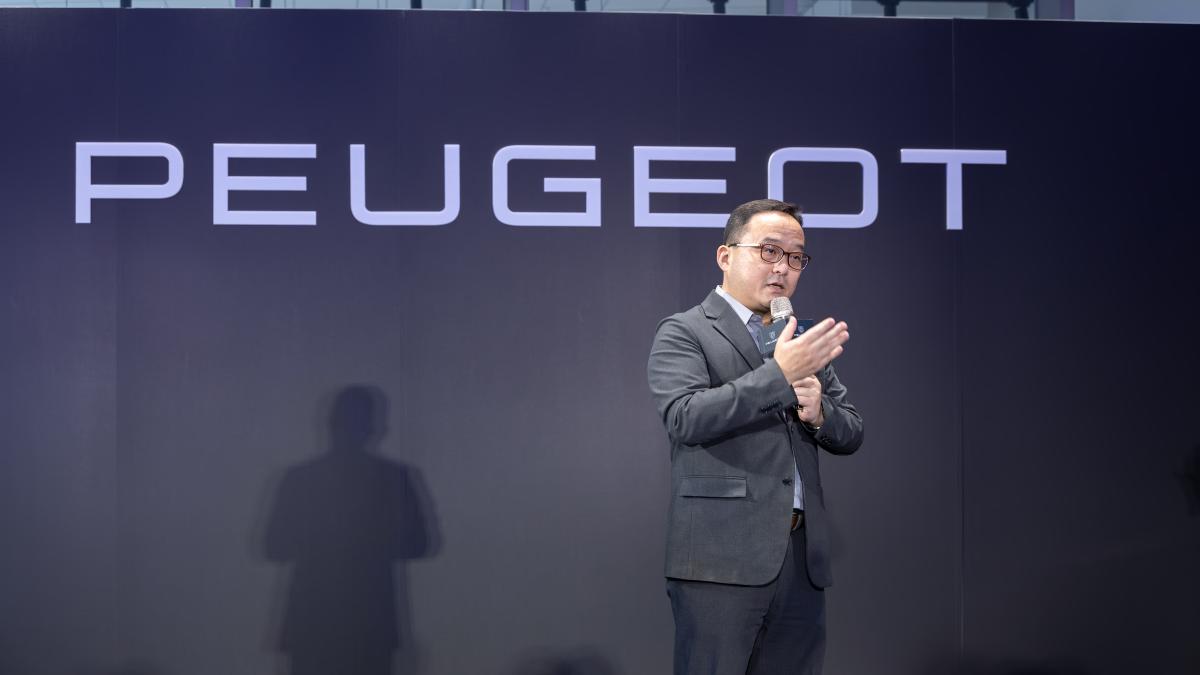
"It's not that there's no demand—it's that consumers haven't decided yet." This is BAO JIA UNITED's Executive Director Wu Jui-Hung's most direct observation of Taiwan's automotive market in the second half of 2026. Yesterday (20th), at the launch event for the new Peugeot 208, Wu replaced the commonly used corporate phrase "cautiously optimistic" with "cautious, not optimistic," frankly admitting that the first half of this year's car market performance fell short of expectations. The market has entered a phase of slight contraction, consumer decision-making timelines have lengthened, and with U.S.-Taiwan tariff negotiations still unclear and numerous policy variables, the second half of the year remains highly uncertain.
Nevertheless, despite these headwinds, BAO JIA UNITED has chosen to launch the new Peugeot 208, hoping to stimulate market demand through new products—an indication that Taiwan's auto market is entering a new competitive phase where success hinges on product strength.
Why has BAO JIA UNITED adopted a "cautious, not optimistic" stance?
Wu, who has led BAO JIA UNITED for a year and a half, stated that order intake across its brands has gradually stabilized. However, the market performance in the first half of 2026 has not been as optimistic as anticipated at the end of last year and the beginning of this year. He believes the overall automotive market has entered a state of "slight contraction."
Therefore, while the general consensus describes the second-half outlook as "cautiously optimistic," Wu frankly stated he prefers to say "cautious, not optimistic." He emphasized, "Companies must maintain a strong sense of crisis. If the final outcome exceeds expectations, I'm happy to be proven wrong by the market."
In his estimation, Taiwan's total new car market size for this year will remain roughly flat compared to last year—around 410,000 units.
What exactly are consumers hesitating about?
Beyond economic factors, Wu believes "how consumers think" is the key factor influencing the market. He pointed out that in the past, car buyers primarily chose between brands and models. Today, however, consumers first face a decision on "powertrain type," with the market now at a "three-way crossroads" where gasoline, hybrid, and fully electric vehicles coexist.
He analyzed that when consumers repeatedly ask themselves, "Should I buy a gasoline car, a hybrid, or go straight to an EV?" the entire car-buying decision cycle naturally lengthens. "It's not that the market lacks demand—it's that people haven't found the answer yet."
Additionally, global oil price fluctuations, geopolitical risks, and adjustments to EV subsidy policies in various countries continue to influence consumer evaluations of different powertrain systems. He also believes that if the government wishes to accelerate the transition from gasoline to electric vehicles, EV subsidy policies still play a crucial role. The clearer the policy direction, the shorter the consumer's waiting period; if policies remain ambiguous, market decision-making will only take longer.
Besides the market, what other variables could affect the second-half auto market?
Policy uncertainty also impacts market development. Wu frankly admitted that the market continues to closely monitor the outcome of U.S.-Taiwan tariff negotiations. If related legislation fails to pass in a timely manner and the region enters an election cycle, policy implementation could become even more difficult. He warned that if market confidence in policy direction weakens, not only will consumers delay purchases, but corporate advertising spending and brand marketing budgets may also become more conservative, further dampening overall market demand.
Therefore, his greatest hope is that no new negative factors emerge in the second half. "Otherwise, falling below 400,000 units is entirely possible."
What are the product highlights of the Peugeot 208?
Despite the conservative market atmosphere, BAO JIA UNITED has chosen to launch the new Peugeot 208 to kick off its second-half product offensive. Wu stated that the most effective way to stimulate the market remains launching new products that the market truly needs. Therefore, the company will continue to introduce new models in the second half, aiming to stabilize market momentum through product strength.
The new Peugeot 208 has officially launched in Taiwan, with only 208 units available nationwide. (Provided by BAO JIA UNITED)
The new Peugeot 208 launched in Taiwan features the brand's latest P2 Hybrid powertrain across all variants, combining a third-generation 1.2-liter PureTech turbocharged engine with an e-DCS6 six-speed dual-clutch transmission integrated with an electric motor. It delivers a combined output of 145 horsepower and 230Nm of maximum torque, achieving an average fuel efficiency of 24.6km/L.
In addition to the power upgrade, the new model introduces the latest generation of the Peugeot i-Cockpit cabin, including a 10-inch digital touchscreen, wireless Apple CarPlay and Android Auto, e-Toggle shift-by-wire, a small-diameter steering wheel, and a floating instrument display.
On the safety front, the Peugeot 208 is equipped with a Level 2 driving assistance system, integrating ACC active cruise control, LKA lane-keeping assist, AEB automatic emergency braking, blind-spot detection, and a 360-degree surround-view camera. Combined with a minimum turning radius of 5.2 meters, it emphasizes agile urban handling.
The recommended retail price is NT$948,000 (including cargo tax subsidy). The first 208 limited-edition owners will receive a launch gift package worth NT$60,000, along with a 5-year or 150,000-kilometer factory extended warranty and full-body ceramic heat-insulating film. Since the French manufacturer has allocated only 208 units for this launch, Wu admitted the company has not set a sales target. "After all, there are only 208 units."
However, he expressed strong confidence in market response, expecting the initial allocation to sell out quickly.
In this "cautious, not optimistic" environment, whether automakers can reawaken consumer demand through product strength will be the biggest point of observation for Taiwan's auto market in the second half of 2026.
FACT BOX
- Source: PR Times
- Category: New Product
- Organizations: Peugeot
- Products / services: Peugeot 208