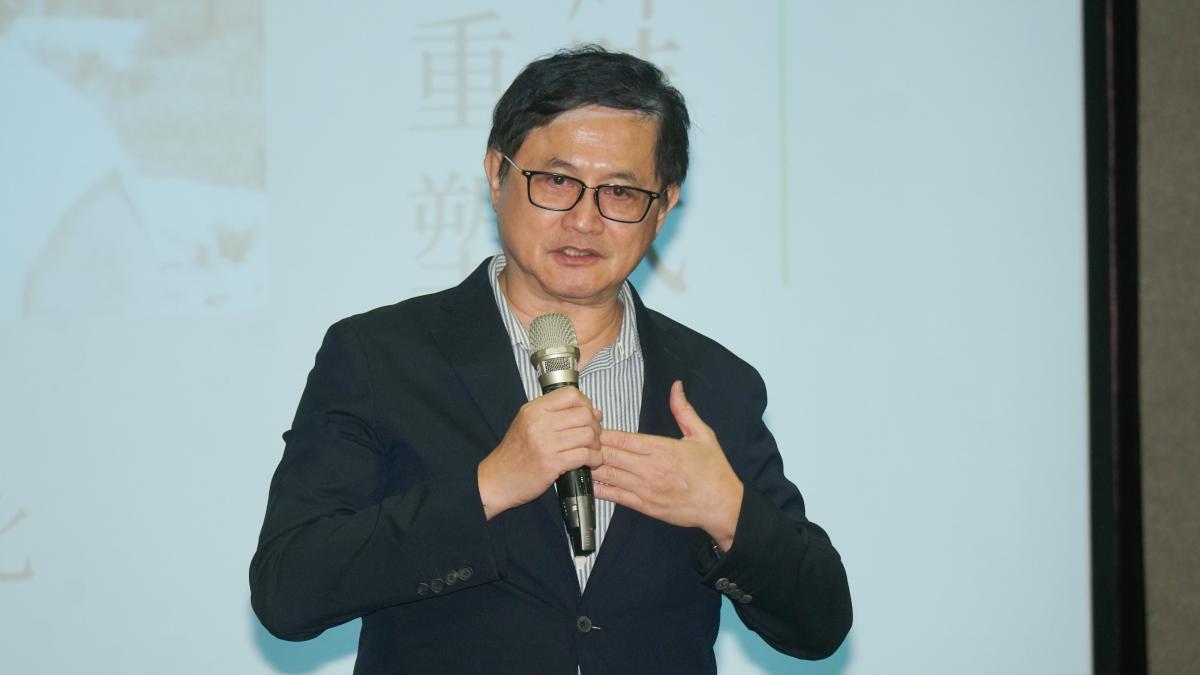
Pegatron Chairman Tung Chi-hsien said on July 22 that through history, we can find abundant big data and algorithms that help predict the next steps. The Earth rotates on its axis, yet it never escapes the orbit of the solar system. Wales and Scotland may not wish to unify with England, but they remain entangled by historical factors—these are physical relationships akin to those between Earth and the solar system. He expressed hope that Taiwan’s next steps will preserve the values we cherish, including democratic freedom and economic prosperity.
A book launch event was held on July 22 for "Lee Teng-hui's Era of Taiwan: Remaking an Accidental Nation," a new book by Lin Hsiao-t’ing, Research Fellow at Stanford University’s Hoover Institution and Director of the East Asian Section at the Hoover Archives. Attendees included Foreign Minister Joseph Wu, former DPP Chairperson Hsu Hsin-liang, former Taipei County Magistrate Yu Ching, National History Museum Director Chen I-shen, and Pegatron Chairman Tung Chi-hsien.
Tung delivered remarks during the opening ceremony. From right: Foreign Minister Joseph Wu, former DPP Chairperson Hsu Hsin-liang, former Taipei County Magistrate Yu Ching, and National History Museum Director Chen I-shen attended the book launch. (Photo by Tsai Chin-chieh)
Historical Big Data and Algorithms Can Predict the Future
Tung stated: History is not merely a collection of stories. Viewed through today’s popular AI lens, historical materials contain vast amounts of big data and algorithms. By analyzing this data and these algorithms, we can actually predict future developments—this is precisely what AI efforts aim to achieve. History evolves organically. In 1996, we were proud and joyful that Taiwan held its first direct election to choose its leader. Yet at the same time, missiles flew over Taiwan’s skies, and we had to rely on two U.S. aircraft carriers sent to the Taiwan Strait to stabilize the situation.
In 1996, China’s per capita GDP was $705; today, it has reached $14,000. The leap from $700 to $14,000 is incomparable. This transformation involves both quantitative and qualitative changes, and qualitative shifts in turn drive further quantitative changes. How will China move forward? As its once-dominant proletariat fades, how will it confront its own transformation? How can its doctrine and constitution, which define the Communist Party as the vanguard of the proletariat, adapt to new historical trajectories? These are challenges China must face.
In 1996, Taiwan’s per capita GDP was over $13,000—19 times that of China. By 2025, Taiwan’s per capita GDP is projected to reach $39,900, while China’s will be around $13,000—narrowing the gap to roughly 4.5 times, far from the previous 19-fold difference. Yet Taiwan’s international standing has also evolved. In 1996, and even during former President Chen Shui-bian’s 'diplomatic firefighting' era around 2000, the 'big brother' United States would tap our heads and tell us not to cause trouble, and we had to comply. That was the reality of international politics.
President Lai Ching-te (left) and Tung Chi-hsien (right) are close. Tung once revealed that Lai invited him to join the cabinet, but after 24 hours of consideration, he politely declined. (Photo by Liu Wei-hung)
Trump Envious of Taiwan’s Semiconductor Success
Starting in 2025, certain aspects of Taiwan have made former U.S. President Trump both envious and jealous, repeatedly claiming that Taiwan has 'stolen' their semiconductor industry. I believe Taiwan’s voice today carries more weight than it did in 1996—30 years ago. This reflects Taiwan’s evolving agency.
Over the past 30 years, from the first presidential election to today, Taiwan and South Korea—two nations in Northeast Asia—have been particularly fortunate. They experienced the Gwangju Uprising, and we had the Kaohsiung Incident. Yet compared to Thailand, where the military and monarchy remain locked in stalemate, or Myanmar, which attempted democratization in 2010 only to see it quickly extinguished, or Singapore, which has achieved high economic success but under a caged, controlled form of democracy, Taiwan’s path is distinct.
Taiwan’s democratization, which we cherish and take pride in, along with the growth of human rights awareness and civic consciousness, is incomparable to what existed 30 or 40 years ago. I believe this is now the greatest common denominator among Taiwan’s 23 million people—everyone values this economic achievement, democratic progress, and social advancement.
Historian Lin Hsiao-t’ing launches his new book, "Lee Teng-hui's Era of Taiwan: Remaking an Accidental Nation." (Photo by Tsai Chin-chieh)
Taiwan Is Pulled by External Forces
But I constantly remind myself: Taiwan does not exist in isolation, either in the universe or on Earth. We are subject to external forces. While we can assert our own positions, we must not forget that we live within an international environment. We must carefully safeguard our capabilities and foster our growth—this is extremely important.
Do not overlook the powerful external forces pulling at us. If you only focus on doing your best internally while ignoring external pressures, neglecting either condition will lead to poor decision-making.
Earth Cannot Escape the Solar System’s Orbit
Earth can rotate independently, but it cannot escape the solar system’s orbit—this is beyond individual will. Even the Moon, so close, affects our tides; Jupiter, far in the distance, influences Earth’s orbital path, which may not always be stable.
This analogy reminds us that besides our own efforts, we must carefully observe the external environment. Taiwan is not like Switzerland, which, due to various international factors centuries ago, happily declared neutrality and has maintained it ever since.
Finland borders Russia—that cannot be changed. Historically, Wales and Scotland did not want to unify with England, yet they remain entangled by historical ties. These are physical relationships within the Earth-solar system framework.
As Taiwan reaches this stage, we hope to predict our next steps. But we also hope that these steps will preserve the values we cherish—democratic progress, economic prosperity, social freedom, and the protection of human rights, press freedom, and all aspects we hold dear.
FACT BOX
- Source: PR Times
- Category: News