Foreign Minister Joseph Wu stated on July 22 that former President Lee Teng-hui carried out a 'threefold reshaping' of Taiwan: first, the reshaping of its power base; second, the reshaping of national identity; and third, the reshaping of its international status. Taiwan was once a pawn in the Cold War, but Lee Teng-hui established that governing legitimacy should come from the people, not from Cold War powers or international recognition.
A book launch event was held on July 22 for Lin Hsiao-t'ing, a research fellow at Stanford University's Hoover Institution and Director of the East Asian Division at the Hoover Archives, for his new book 'The Era of Lee Teng-hui in Taiwan: Reshaping an Accidental Nation.' Attendees included Foreign Minister Joseph Wu, former DPP Chairperson Hsu Hsin-liang, former Taipei County Magistrate Yu Ching, Director of the National History Museum Chen I-shen, and Chairman of Pegatron Corporation Tung Tzu-hsien.
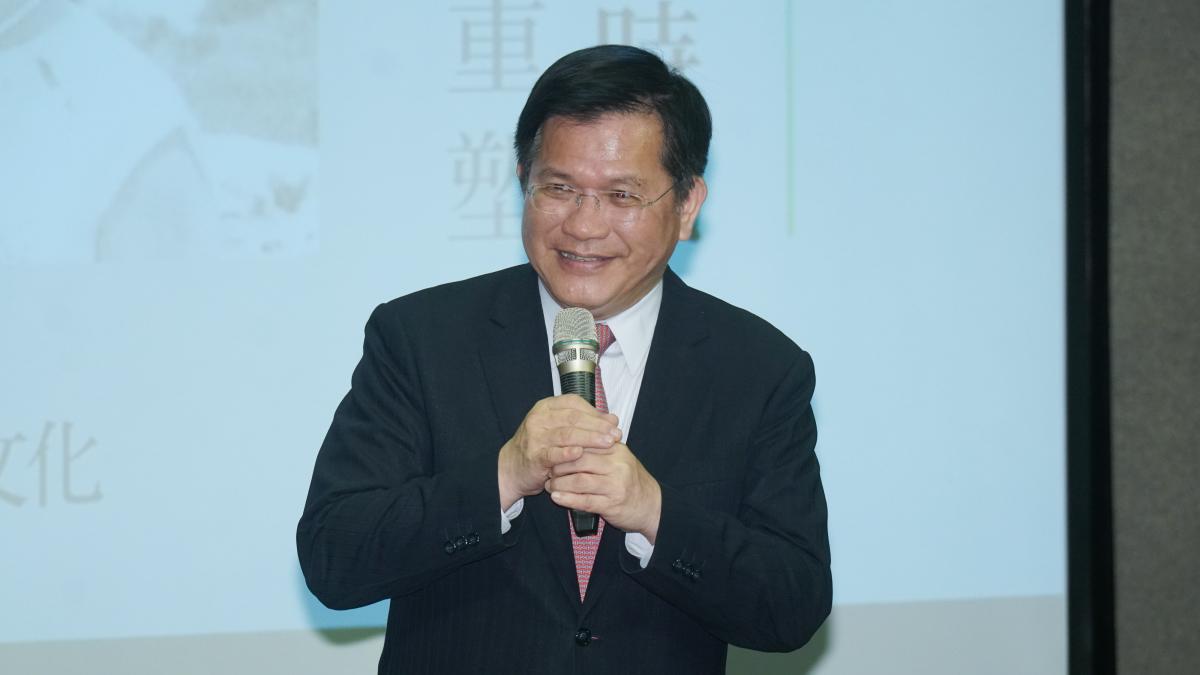
Joseph Wu delivered the opening remarks at the event.
Lee Teng-hui reshaped Taiwan on three levels
Joseph Wu asked, 'What difference does it make whether Taiwan had Lee Teng-hui or not?' He noted that for those studying history or engaged in politics, this is a necessary question. He believes most would agree that Lee's presence made a significant difference. At a critical moment, a national leader must balance internal and external factors, as this role sits at the intersection of domestic and foreign policy. Thus, examining Taiwan's postwar political history through Lee Teng-hui is highly appropriate, though also challenging.
Historian Lin Hsiao-t'ing holds the book launch for 'The Era of Lee Teng-hui in Taiwan: Reshaping an Accidental Nation.' (Photo by Tsai Chin-chieh)
This book helps us understand how Taiwan became what it is today. We must also examine what kind of Taiwan exists today, where it came from, and where it is headed. Through this book, I tried to immerse myself in the context of Lee Teng-hui's era, his historical coordinates, and consider what Taiwan should have done at that time. By viewing Taiwan's institutional changes, historical significance, and spirit of the age through Lee's perspective, we realize that Lee Teng-hui fundamentally reshaped Taiwan.
This reshaping occurred on three levels: first, the reshaping of Taiwan's power base; second, the reshaping of national identity; and third, the reshaping of Taiwan's international status.
As the saying goes, the times create heroes, and heroes create the times. At a pivotal moment, a leader's decisions are crucial. Today, many are concerned about Taiwan's future. Our national train is approaching the station with great momentum, but which direction should it take next? As Max Weber said, the leader is the switchman directing the course of history—not a question of strength, but of who is steering.
Governing legitimacy comes from the people
The first reshaping brought by Lee Teng-hui was establishing 'popular sovereignty' as the foundation for Taiwan's government to gain power. This sounds simple, but in Chinese societies and Taiwan's history, facing numerous external regimes, the Taiwanese people were often unable to determine their own fate. Lee Teng-hui changed this by rooting legitimacy in the people.
Former President Lee Teng-hui promoted direct presidential elections and became the first president elected by popular vote. (Photo from New Talk)
This year also marks the 30th anniversary of Taiwan's presidential direct elections. At this moment, we might ask: after Lee Teng-hui was elected in 1996 as the first democratically elected president, and after constitutional amendments, could he run again in the 2000 election? Previously, the president was elected by delegates of the National Assembly, but Lee chose not to interpret whether he could run again.
Exercising restraint over power is harder than acquiring it. Even George Washington, the first U.S. president, was urged by many to become king—only called 'president' in title. In the end, Washington refused. These are key demonstrations of leadership.
Taiwan developed its own identity
The second reshaping brought by Lee Teng-hui was the 'reshaping of national identity.' The previous 'Greater China' ideology, enforced through legal traditions and the Five-Power Constitution, weighed heavily like Mount Tai, preventing Taiwan from developing its own identity. This went beyond national identity—individual and diverse identities in Taiwan could now be respected, with fertile ground for beautiful flowers to bloom.
Taiwan has gained subjectivity internationally
The third reshaping was the redefinition of Taiwan's international position. Taiwan was once seen as a 'pawn,' constantly questioned as to 'who owns Taiwan?' From the Cold War to U.S.-China relations, cross-strait issues were treated as 'pawns' or 'objects to be decided.' But once Lee Teng-hui's eight words—'The people's desires, always in my heart'—emerged, I believe Taiwan gained 'subjectivity' in international politics, especially in diplomacy. Because through the 'reshaping of the power base,' our legitimacy no longer stems from Cold War powers or international recognition.
Thus, Taiwan's forced exit from the United Nations was not Taiwan being expelled, but the Chiang Kai-shek regime being ousted. UN Resolution 2758, with its 150 words, does not mention Taiwan even once—this is the current official interpretation by the U.S. State Department.
Lee Teng-hui's second daughter, Lee An-nyi, her husband Lai Kuo-chou, and former Taiwan Solidarity Union Chairperson Huang Kun-hui attend the book launch of 'The Era of Lee Teng-hui in Taiwan: Reshaping an Accidental Nation.' (Photo by Tsai Chin-chieh)
Therefore, regardless of one's opinion of Trump, when he said 'Taiwan is Taiwan' on a plane during APEC last year, we expanded it into 'Taiwan is Taiwan,' 'Taiwan is the Taiwanese people's Taiwan,' and 'Taiwan is the world's Taiwan.' I believe we should evolve to the next stage—from 'Taiwan is Taiwan's Taiwan' to 'Taiwan is the world's Taiwan.'
Our universal values of democracy, freedom, and human rights can walk hand in hand with the world. Even as the Chinese Communist Party continues to suppress us, they lack confidence—hence, in joint declarations with other countries, they always insist on including the 'One China Principle.' The reason behind this is precisely because we can reach out globally. It's not because of me or Lee Teng-hui, but because our Taiwan has already become a nation respected and beloved by the world.
FACT BOX
- Source: PR Times
- Category: News