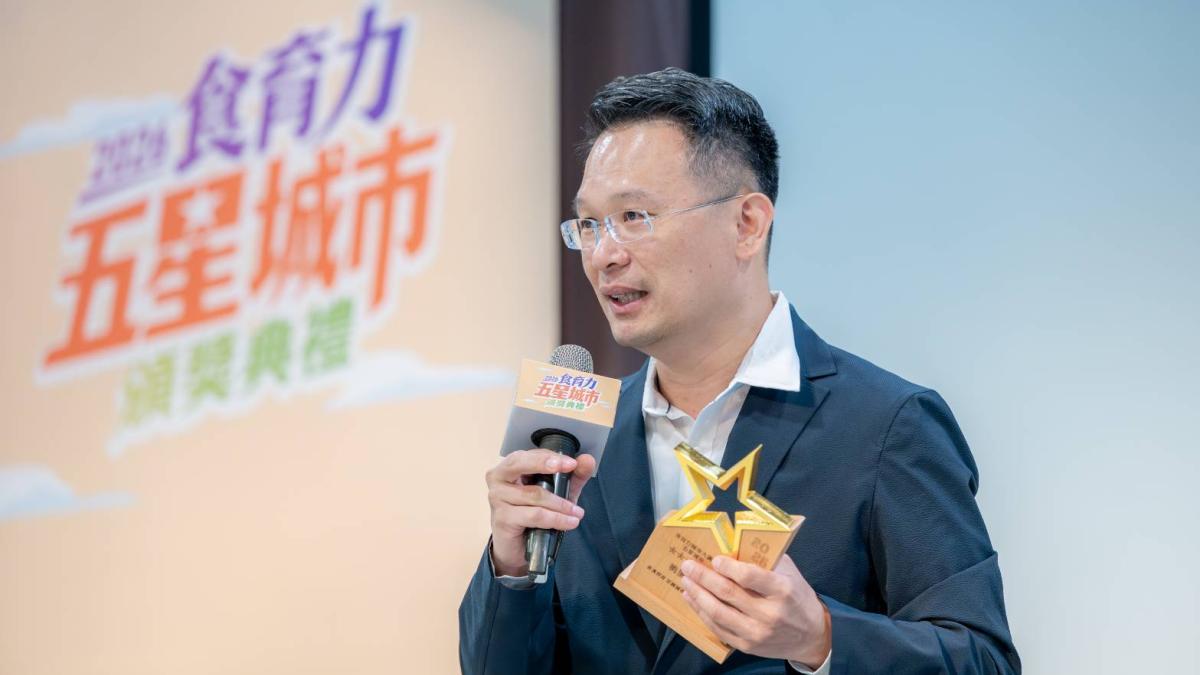
Taoyuan City received the prestigious 'Five-Star City for Food Education 2026' award today (22nd) at Taipei's Huashan Park, marking its second consecutive win and making it one of the few industrial and technological hubs in Taiwan to achieve this back-to-back honor. Deputy Mayor Su Chun-Pin attended the ceremony, emphasizing that it is particularly challenging for a traditional industrial city to gain recognition in ecological, agricultural, and environmental fields. He stated that the city government has transformed farmers, enterprises, fishing associations, and schools into sustainable partners, not only expanding organic farmland to over 557 hectares but also integrating conservation education into school nutrition lunches, allowing children to learn about environmental protection while enjoying 'Red Frog Mesona.'
While pursuing industrial and economic development, Taoyuan continues to deepen food and agriculture education and cross-departmental resource integration. In green agriculture, the city government encourages farmers to adopt eco-friendly farming practices through agricultural guidance, policy incentives, and support for organic market channels, driving steady annual growth in organic farmland area.
Moreover, the public-private 'partnership mechanism' extends to marine and coastal conservation. Fourteen local enterprises have actively adopted a total of 26 kilometers of coastline, regularly organizing beach cleanups. Fishermen from the Taoyuan and Zhongli fishing associations have formed a 134-vessel 'eco-fleet' that simultaneously collects marine debris during fishing trips, transforming from marine resource users into ecological stewards.
To turn sustainability concepts into tangible urban highlights, Taoyuan integrates environmental education into cultural events. This year’s Taoyuan Landscape Art Festival featured 'Rebirth: Light Collectors,' a piece honoring beach cleanup volunteers, and for the first time collaborated with fishing associations and the renowned aquarium Xpark to project imagery of wild sea turtle conservation and rescue onto the Yongan Fishing Port market building via light projection. This initiative successfully transformed a traditional fish market into a unique marine environmental education venue, allowing the public to intuitively experience the city’s efforts in ecological conservation, food safety, and urban governance while shopping or visiting.
Addressing the modern challenge of increasing distance between 'farm and table,' Taoyuan emphasizes rooting food and agriculture education in schools. In the Yangmei area, the city introduced locally grown Yangmei Mesona into school lunches. To reduce waste and carbon emissions, traditional plastic agricultural films have been completely replaced with eco-friendly, biodegradable alternatives. As the Gaorong area in Yangmei is also a key habitat for the endangered Taipei tree frog, this sustainably cultivated Mesona has been named 'Red Frog Mesona.' Deputy Mayor Su emphasized that by linking local agriculture and ecology through engaging stories, students can deeply understand the close relationship between people and the land, fostering attitudes of food appreciation and environmental care.
The Taoyuan City Agriculture Bureau stressed that the key to winning the Five-Star City for Food Education title for two consecutive years lies in successfully breaking down traditional bureaucratic silos. Moving forward, the city will continue to integrate resources across departments such as Health, Environmental Protection, and Education to deepen its locally distinctive food and agriculture education model. Through diverse campus experience programs and local 'produce for local consumption' mechanisms, more families and children will develop healthy eating habits, building a city model that combines economic vitality with green sustainability.
FACT BOX
- Source: PR Times
- Category: Survey