"If there were a bridge to Xiamen, our land and property prices would double, benefiting everyone living on this island," Li Zhongling, a Kinmen merchant, told BBC Chinese. The bridge he speaks of does not yet exist, but it represents a future long imagined by him and many other Kinmen residents. Li recalls a time when Kinmen's streets were bustling with cross-strait tourism, tour buses shuttling groups, and large duty-free malls introducing luxury brands. In recent years, however, the tourism industry and local businesses have suffered clear setbacks due to the pandemic and rising cross-strait tensions. "Kinmen relies on tourism and visitors. If there were a bridge to Xiamen, I believe local residents would overwhelmingly support it—after all, it would be convenient, perhaps allowing people to drive across."
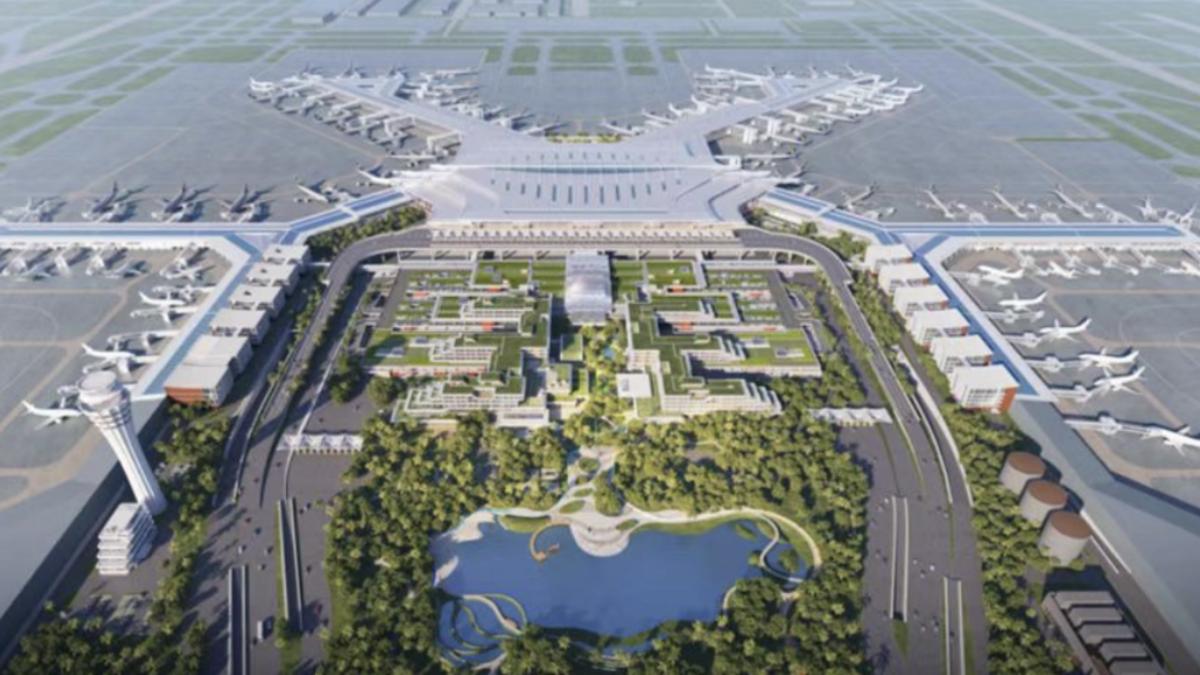
This vision aligns with Beijing's own future blueprint. The Chinese government is building a new airport—Xiamen Xiang'an International Airport—just under three kilometers from Kinmen across the sea, with an opening expected this year. According to official Chinese plans, the Xiang'an Airport design includes multiple concepts for connecting with Kinmen: a "dedicated passage" for Kinmen travelers, reserved land for a "Kinmen terminal," and even plans for a cross-sea "Xiamen-Kinmen Bridge" linking Xiamen, Dadeng Island, and Kinmen, advancing toward "integration."
This new airport reflects the internal contradictions felt by Kinmen residents. Some worry about noise, air pollution, and ecological impacts, fearing that deeper cross-strait exchanges could disrupt the island’s peaceful lifestyle and draw it into greater political maneuvering and national security risks. Another Kinmen resident, Mr. Song, told BBC Chinese that the Xiang'an Airport would bring convenience for his work and travel, but he remains cautious about plans like the Xiamen-Kinmen Bridge. "Xiamen has developed rapidly in recent years, but we are two separate countries, with different systems, cultures, and living standards."
How will the new airport 'extend' to Kinmen?
Kinmen is a Taiwanese island located about 10 kilometers from the Chinese mainland, facing Xiamen across the sea. Today, from Kinmen’s northwestern coast, the vast site of the Xiang'an Airport—its control tower, terminals, and runways—is already taking shape, becoming a visible part of daily life for many residents. Since 2013, China has carried out large-scale land reclamation between Dadeng and Xiaodeng islands, nearly doubling Dadeng’s size, with its closest point to Kinmen now only about 3 kilometers away.
Official plans position Xiang'an Airport as a major aviation hub in southern China, also tasked with connecting to Kinmen. In June, Ge Hongbin, deputy general manager and chief engineer at Zhaotong Airport Construction Co., Ltd., the airport’s owner, revealed that a "dedicated passage" for Kinmen travelers has been planned within the terminal, and land has been reserved for a "Kinmen terminal." He noted that Taiwanese travelers could reach Xiamen’s Wutong Pier via the "Small Three Links," then take a direct shuttle to Xiang'an Airport.
Authorities are also planning to build the "Xiamen-Kinmen Bridge," potentially reducing travel time from Kinmen to the airport to just 10–15 minutes. The Chinese-designed bridge follows a "two-phase" structure, divided into a Xiamen section and a Kinmen section. The Xiamen section, linking Xiamen and Dadeng Island, is expected to open its main marine route by the end of 2026 and be fully operational by the end of 2027. The "Kinmen section" would extend from Dadeng Island’s Xiang'an Airport to Kinmen’s northwestern coast.
Wang Chao, Party secretary of the joint project branch of CCCC Second Harbor Engineering Bureau’s Xiamen-Kinmen Bridge project, recently stated that engineering interfaces have already been reserved for future extension toward Kinmen.
Taiwan has long rejected China’s proposed "bridge connection" plan. Chiu Chui-cheng, head of Taiwan’s Mainland Affairs Council, told BBC Chinese in an exclusive interview that while Xiamen and Xiang'an Airport have established connections, Taiwan has not formulated any corresponding bridge policy. He emphasized that Beijing is increasingly exerting comprehensive pressure on Taiwan, and bridge construction involves sensitive national security issues. "As long as such plans aim at 'unification promotion' or 'integrated development,' the Taiwanese government will not cooperate, nor do we have any related policies, preparations, or concepts."
Emotional Engineering: The Imagined 'Jin-Xia Integration'
Kinmen and Xiamen, geographically close, have historically maintained close ties, forming deep historical and cultural connections. However, after the division of the two sides, exchanges were restricted, and their development paths gradually diverged. Xiamen, one of China’s earliest special economic zones, has a population approaching four million and has recently focused on high-tech manufacturing and commercial trade. Kinmen, by contrast, has a resident population of only about 60,000–70,000, with industries centered on tourism and specialty agriculture.
For Kinmen residents, the development gap with Xiamen today feels like "two different worlds"—the towering buildings and prosperity across the strait are both impressive and alluring. Shen Xiuhua, associate professor at Tsinghua University’s Department of Sociology and a long-time researcher on Kinmen, analyzed for BBC Chinese that infrastructure is not merely a transportation or economic project; it often "touches hearts," carrying emotional projections from residents. On one hand, it symbolizes convenience, economic prosperity, and future possibilities; on the other, if plans fail to materialize or spark political controversy, they may bring disappointment and frustration.
She pointed out that the planning of Xiang'an Airport and the "Xiamen-Kinmen Bridge" is concretizing long-held local development aspirations among some Kinmen residents, forming part of China’s united front strategy toward Taiwan. "Beijing uses transportation infrastructure to extend into social exchange and interaction, influencing Taiwan’s social identity through 'emotional engineering' and further promoting cross-strait integration."
Since the 1980s, some Chinese scholars have proposed cross-border transportation projects linking Taiwan and Fujian, attempting to blur the boundaries between the two sides through bridges or tunnels and redefine territorial relations. Over the years, certain local political figures in Kinmen have actively advocated for infrastructure linking Kinmen and Xiamen, such as a "bridge connection." Supporters argue that a bridge based on economic and livelihood goals could not only connect the "mini-cross-strait" of Jin-Xia but also build an "invisible emotional link" to Taiwan. Former Taiwan People’s Party chair Ko Wen-je once bluntly stated during a campaign in Kinmen: "Once this bridge is built, half of Kinmen’s problems will be solved."
In April this year, the Kinmen County Council speaker and deputy county magistrate visited the Wulongshan area in northwestern Kinmen to inspect the planned site for the Kinmen end of the "Xiamen-Kinmen Bridge," publicly urging the local government to adopt a proactive stance.
Lu Zhengfeng, professor at the Department of International and Mainland Affairs at Kinmen University, told BBC Chinese that under the backdrop of cross-strait "integrated development" policies, the completion and opening of Xiang'an Airport are shaping a vision of "Jin-Xia integration" among Kinmen residents. Moreover, before official or third-party tourism associations can negotiate, this serves as a form of political propaganda and a "gesture of goodwill."
In 2023, China’s State Council designated Fujian as a "Demonstration Zone for Cross-Strait Integrated Development," introducing preferential measures such as residence permits, employment, and entrepreneurship incentives, gradually incorporating certain segments of Taiwan’s population into China’s economic and social system. In April 2026, after Zheng Liwen, chair of Taiwan’s opposition Kuomintang party, met with Chinese leader Xi Jinping in Beijing, Beijing promptly announced its "Ten Measures toward Taiwan," including support for Kinmen to share Xiamen’s new airport and promoting the "New Four Connects" policy—covering bridge, electricity, gas, and the already implemented water connection between Kinmen and Xiamen. China’s Taiwan Affairs Office stated that supporting Kinmen’s shared use of Xiamen’s new airport is "responding to the expectations of our Kinmen and Matsu compatriots."
Professor Shen Xiuhua pointed out that China, through discourse and propaganda around the "Xiamen-Kinmen Bridge," is portraying a non-existent project as an established fact. Although the project does not yet connect to Taiwan’s territory, it is deliberately named to create the impression that "construction is complete and waiting for Kinmen to join."
In 2025, the Fujian Kinmen Compatriots Association invited a delegation led by a former Kinmen county magistrate to visit the construction site of the Xiamen section of the "Xiamen-Kinmen Bridge," allowing them to witness the progress firsthand. In November of the same year, Taiwanese entertainer Ou Yang Didie also visited the bridge construction site in Xiamen, donning a work uniform to experience painting the bridge surface, and expressed on camera her hope to travel back and forth to her "hometown" via the bridge in the future.
Shen noted that Beijing’s approach to the "Xiamen-Kinmen Bridge" aligns with its recent frequent incursions into Taiwan’s airspace and territorial waters: by continuously entering Taiwan’s sovereign space, it aims to create the impression that "facts on the ground" already exist. This strategy not only pressures local societies in Kinmen, forcing local leaders to take positions, but may also further influence the policy stance of Taiwan’s central government in Taipei.
In 2023, a former Kinmen county councilor proposed a public referendum on the "Jin-Xia Bridge," collecting 734 signatures. However, Taiwan’s Ministry of the Interior ruled the issue as "non-local citizen referendum" and ultimately rejected the application.
Divergent Local Opinions
In Kinmen, several residents told BBC Chinese that the opening of Xiang'an Airport will offer another flight option and bring transportation convenience, though this anticipation is accompanied by underlying concerns. Mr. Song said he frequently needs to fly back to Taiwan’s main island for work but often faces difficulties such as sold-out tickets or flight delays and cancellations during fog season. "The opening of Xiang'an Airport means another option, which will improve our quality of life."
He explained that Xiang'an Airport is close, offers many "Small Three Links" ferry options, and has relatively cheaper fares than flights to Taiwan’s main island. For Kinmen residents, it could be a convenient choice for international travel. Currently, Kinmen residents typically fly from Kinmen’s Shangyi Airport to Taiwan’s Taoyuan or Taichung Ching Chuan Kang International Airports for international connections, or take a ferry via the "Small Three Links" to Xiamen and transfer from Xiamen Gaoqi International Airport.
However, Mr. Song remains reserved about the Xiamen-Kinmen Bridge plan. He believes the issues involved are too complex, involving not only differences in systems but also practical matters like toll management and judicial jurisdiction—for example, if a fugitive escapes across the bridge, it could trigger legal and security disputes. "Xiamen has developed rapidly in recent years, but we are two separate countries, with different systems, cultures, and living standards," he said. He believes the Xiang'an Airport and cross-sea bridge could
FACT BOX
- Source: PR Times
- Category: News