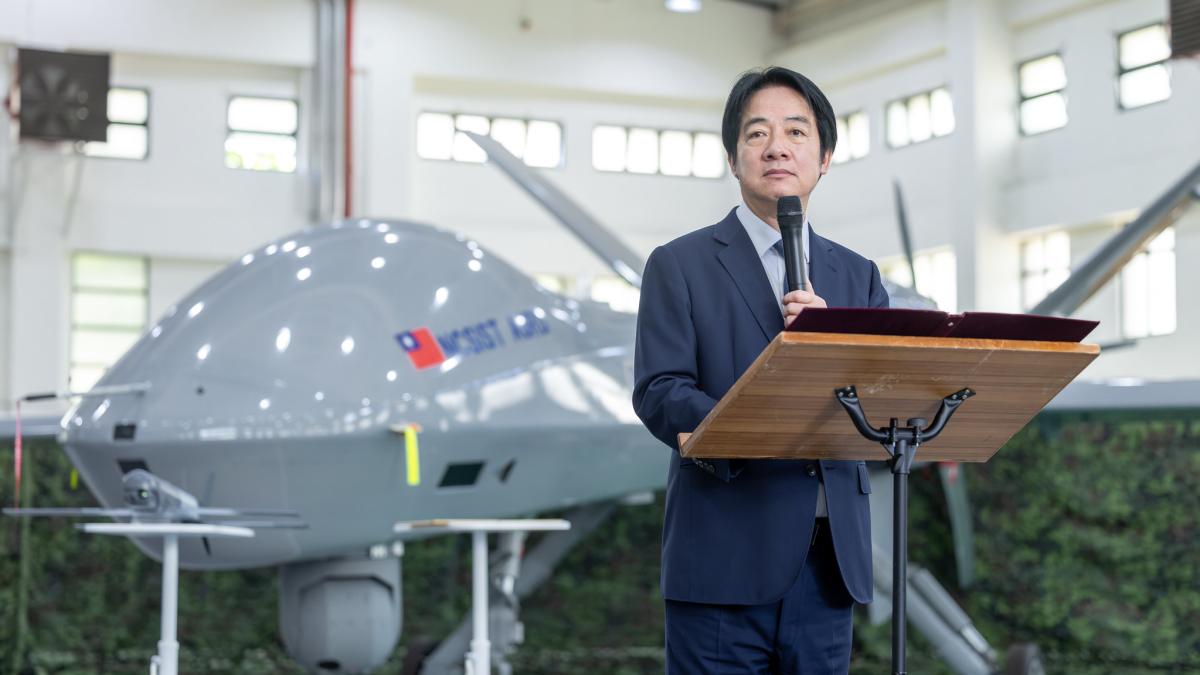
President Lai Qingde recently inspected the development of drones at the National Chung-Shan Institute of Science and Technology and expressed strong dissatisfaction with the Legislative Yuan's deletion of the 'Special Defense Budget' and the opposition's proposal of a separate 'Drone Special Act.' He explicitly urged the legislature to support national defense funding so that every officer and soldier in the Ministry of National Defense can continue their duties without being 'trapped in the legislature, wasting their time.'
Lai echoed Defense Minister Koo Ji-hung's statement that 'money for rice and money for soy sauce should not be mixed,' emphasizing that the opposition's drone bill places economic authorities—not defense—as the lead agency. This would restrict drones produced under such regulations to commercial and civilian use, failing to meet military requirements. Yet Lai also claimed that the government has allocated over NT$44 billion to the Ministry of Economic Affairs to 'build an industrial chain' and 'assist in manufacturing drones needed by the Ministry of National Defense.' This contradiction—drones that don't meet military specs somehow fulfilling defense needs—raises serious questions about coherence.
Ironically, shortly after Lai's remarks, opposition lawmakers exposed that three consecutive military procurement contracts had been canceled within three months due to non-performance, mocking Koo as the 'Minister of Cancellations.' These three contracts were previously challenged by legislators and vehemently defended by Koo as 'green-friendly' (politically connected) bids. One of them was the 'anti-drone system,' which failed three rounds of testing and is now being terminated. The company responsible? Chuang Wei Lai (Institute for the Future), referred by the Ministry of Economic Affairs.
If the Ministry of Economic Affairs, as the regulatory body for drones, cannot ensure that commercially produced drones meet military specifications, how can it refer 'commercial-grade' firms to the Ministry of National Defense, which requires 'military-grade' equipment? Legislator Wang Hung-wei pointed out that Chuang Wei Lai's shareholders include the Ta Ya Group, closely linked to Lai Qingde, suggesting it is a 'green-friendly' firm. Moreover, it was Koo Ji-hung’s wife, Wang Mei-hua, who, as Minister of Economic Affairs, referred Chuang Wei Lai to the defense ministry.
Koo dismissed these allegations as 'baseless accusations,' claiming lawmakers confused two separate cases: one a 'commissioned project' terminated in 2023, the other a public procurement project where, if testing fails, 'no payment is made.' Thus, he implied, there would be no financial loss.
However, this rebuttal lacks credibility. First, the Control Yuan's investigation revealed that in August 2022, a Chinese drone intruded into a Kinmen outpost, prompting ROC soldiers to chase it away with stones—an embarrassing incident. In September, the National Security Council convened a 'Drone Defense System Meeting,' directing the Armaments Bureau to seek suppliers through the Ministry of Economic Affairs. By March 2023, four companies were recommended, but none met combat requirements (radar detection range of 5 km).
Notably, Chuang Wei Lai had already tested with CSIST in Lieyu, Kinmen, in September 2022—before the other three—and failed. On March 14, 2023, all four companies demonstrated their systems at the Dafu Military Test Site in Yilan, but all failed. Despite this, the Ministry of National Defense (Army) awarded a 'commissioned project' contract, allowing Chuang Wei Lai to secure funding and requiring it to integrate another company’s solution. Ultimately, integration failed, and the contract was terminated.
Second, after the commissioned project was canceled in 2023, the Ministry of National Defense (Army) announced in 2024 a procurement of 26 drone systems—the NT$980 million 'Anti-Drone System' contract, which again was awarded to Chuang Wei Lai. In January 2025, they won the bid; in February, President Lai awarded Chuang Wei Lai’s chairman, Wang Yu-chu, the 'Outstanding Information Talent Award.' In March, Vice President Hsiao Bi-khim attended a Chuang Wei Lai event; in May, Wang was invited to a 'National Defense Application Symposium' hosted by DPP legislators.
If Chuang Wei Lai is not a 'green-friendly' firm, how does Koo explain awarding both a commissioned project (when he was National Security Council Secretary-General) and a procurement contract (as Defense Minister) to a company that failed tests and failed to integrate solutions? Labeling it merely 'green-friendly' is unfair. Wang Yu-chu, a Caltech PhD in electrical engineering and former professor at NCTU for 11 years, is a classic academic-turned-entrepreneur. He founded Chuang Wei Lai in 2018, partnered with CSIST in 2019, but the collaboration ended poorly.
Before winning the NT$980 million contract, Chuang Wei Lai secured over NT$900 million in Series A funding in May 2024—effectively guaranteeing investor returns. Besides Ta Ya, lead investors included Tai Sang Investment, Hwa Wei Investment, and ITRI’s tech transfer subsidiary. Tai Sang is part of the 'National Team funding chain' established under the Tsai administration outside the National Development Fund. Chuang Wei Lai’s connections extend far beyond Koo and Wang’s personal ties—its network is more sophisticated than lawmakers realize.
Regrettably, the term 'National Team' has become tainted by scandals involving masks, rapid tests, and vaccines. Now, Chuang Wei Lai adds 'military-industrial National Team' to the list. Yet among such cases, Chuang Wei Lai is still one of the better ones. Consider two other failed contracts: Fu Mai, an interior design firm with NT$10 million capital, won a NT$590 million RDX (sea mine clearance) explosive material procurement contract but failed to obtain export permission from India, leading to cancellation. The military, capable of producing 105mm artillery shells domestically, shut down its production line and now awaits South Korean export approval—still pending.
The Ministry of National Defense has failed to explain any of these failures. How can the public trust defense spending? How can lawmakers be expected to approve budgets? Defense budgets now exceed trillions. For drones alone, the ruling party proposes NT$210 billion over five years, the KMT NT$240 billion over six years (annual budgeting), and the TPP sets no cap. Opposition bills include both economic and defense ministries, differing only in lead/co-lead roles. But as the Chuang Wei Lai case shows, lead or co-lead is irrelevant. If economic agencies invest and defense agencies procure, firms can draw funds from both. Being 'green-friendly' matters, but being part of the 'National Team' matters more. The key is: no failures. Otherwise, one company—Chuang Wei Lai—with three canceled contracts, will give the opposition all the justification it needs to slash defense and overall budgets.
FACT BOX
- Source: PR Times
- Category: News