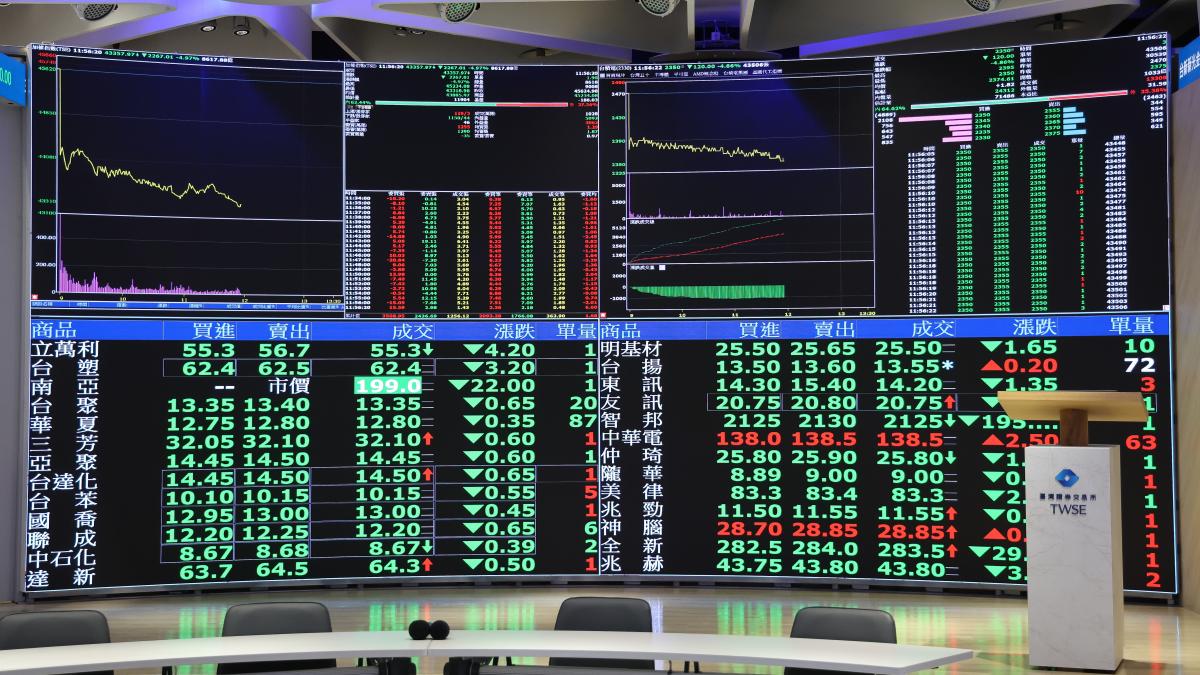
Taiwan's stock market has recently resembled a rollercoaster, leaving investors shaken by a historic correction last week. Many rushed to cut losses, only to witness a dramatic rebound on the 21st—emotions swinging like a sauna. Financial expert Ruan Mu-Hua posted on Facebook, analyzing July’s pullback as a precise 'semiconductor and memory' sector-specific crash, not a broad bear market. He recommends three ETFs as a ready-made, balanced investment formula for both defense and offense.
### Was July’s Sell-Off a Bear Market Signal? Ruan: It Was a Semiconductor-Only Collapse
Regarding recent volatility in both Taiwan and U.S. markets, Ruan emphasizes: 'In upswings, momentum matters; in downturns, quality prevails.' The recent semiconductor selloff clearly separated momentum from quality. Many misinterpret July’s U.S. market dip as a 'market crash,' but the data reveals it was a targeted collapse in semiconductors and memory stocks—not a full market meltdown.
Ruan points out that the Philadelphia Semiconductor Index plunged 23.6% from its 2024 peak to its July low, officially entering bear market territory. In contrast, the S&P 500 only retreated 2.6%, and the Nasdaq Composite fell just 7.1%. Why such a gap? The answer lies in eight characters: 'Momentum in rallies, quality in falls.'
### How to Navigate Taiwan’s Market Swings? Ruan: Balance Momentum and Quality
'Rallies favor momentum,' Ruan explains. During bull runs, markets chase themes, momentum, and growth potential. In the first half of 2024, AI hardware and memory stocks held the 'hottest momentum.' Stocks with high elasticity saw the steepest gains. Two actively managed ETFs focused on Asia’s semiconductor supply chain and memory—00988A and 00990A—rode this wave to deliver near-doubling returns, even hitting new highs in late June.
Momentum is powerful, but its essence is 'emotional leverage.' It accelerates gains in bull markets but amplifies losses when sentiment shifts.
'In downturns, only quality holds firm,' Ruan notes. July’s shift made this clear. The most momentum-driven sectors fell hardest: 00988A dropped 32.0% from its peak, and 00990A fell 29.4%—steeper than the Philadelphia Semiconductor Index itself. This is because both ETFs have highly overlapping top 10 holdings, heavily weighted in memory and equipment stocks like Micron, Kioxia, Western Digital, and Samsung Electro-Mechanics. Limited diversification means they effectively doubled down on the same bet.
In contrast, the 'quality' leaders—the U.S. 'Magnificent 7'—performed in a different league. During the same selloff, Apple rose 5.9%, and Meta surged 8.1%, limiting the Magnificent 7 index’s decline to just 3.3%.
Ruan attributes the Magnificent 7’s resilience to one word: 'quality.' Stable free cash flows, wide economic moats, clean balance sheets, and real pricing power. These traits may not shine brightest in bull markets, but when panic hits and capital seeks shelter, they become the wall. This capital shift moved from high-volatility AI hardware to large-cap platform stocks with stable cash flows.
### The 3-ETF Strategy: A Ready-Made Balanced Portfolio
'These three ETFs form a ready-made, balanced portfolio,' Ruan states. The third ETF, 00402A (Allianz Active U.S. Tech), takes a different path. Its top 10 holdings include five Magnificent 7 stocks—NVIDIA, Apple, Amazon, Microsoft, and Alphabet—with over 31% combined weight in the MAG7 and low memory exposure. As a result, during the same selloff, it only fell 7.1%—about one-fourth of the other two ETFs. This demonstrates the defensive strength of 'quality.'
Thus, a core-satellite portfolio emerges:
- Core (Quality): 00402A. Anchored by large-cap Magnificent 7 stocks, it offers low volatility and downside protection, keeping the portfolio stable through market winters. - Satellite (Momentum): 00988A and 00990A. High-beta and elastic, they capture explosive rebounds when AI hardware and memory stocks recover.
Ruan stresses that allocation can be adjusted based on risk tolerance. For peace of mind, overweight the core; to chase rebounds, boost the satellites. The key is not to treat momentum as the entire portfolio, nor to abandon quality after one selloff. Momentum takes you up the mountain; quality gets you through the winter. A truly sustainable portfolio doesn’t choose one over the other—it assigns each its role: use momentum to attack, quality to defend.
FACT BOX
- Source: PR Times
- Category: News
- Products / services: 00988A / 00990A