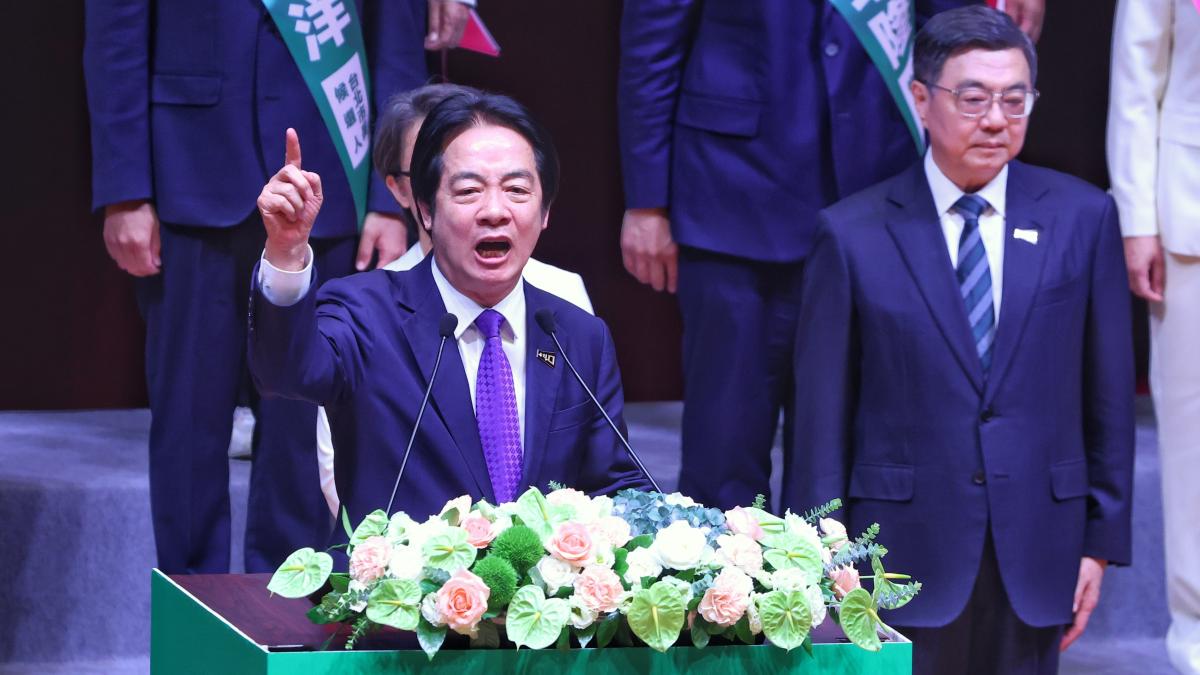
On the 40th anniversary of the Democratic Progressive Party's founding, President Lai, who concurrently serves as party chair, once again declared that 'Taiwan is a sovereign and independent country, with the constitutional name being the Republic of China,' and stated that democratic Taiwan must never regress into becoming 'China's Taiwan.' This statement raises several critical questions for public reflection: As President Lai took office under oath to uphold the Constitution of the Republic of China, should he refer to his nation using the official state name as defined by the Constitution? Should the term 'China' be understood within the constitutional context, rather than equating it entirely with the People's Republic of China? And is he, without constitutional procedures, effectively steering toward the establishment of a 'Taiwan State'?
First, he separates 'Taiwan' and the 'Republic of China' into two distinct concepts. According to the Constitution of the Republic of China, the official name of the state is 'Republic of China.' There is currently no legally independent entity named 'Taiwan' separate from the Republic of China. Referring to 'Taiwan as a sovereign and independent country' treats 'Taiwan' as a state name, followed by the clarification that 'the constitutional name is the Republic of China,' effectively creating the framework: state entity = Taiwan; constitutional name = Republic of China. This positions 'Taiwan' as the true national subject while reducing 'Republic of China' to a shell or constitutional label.
Second, the Constitution encompasses more than just a 'name'—it defines the nation's territorial scope and sovereignty structure. President Lai's statement deliberately narrows the Constitution down to a 'naming issue,' but the Constitution regulates far more than just nomenclature. Both the Preamble and the Additional Articles of the Constitution recognize the 'Republic of China' as the national entity. The Act Governing Relations between the People of the Taiwan Area and the Mainland Area explicitly states that the Mainland Area and the Taiwan Area belong to different regions within the same country. The Additional Articles address the distinction in governing authority ('jurisdiction') between the 'free area' and the 'mainland area,' not a split in sovereignty. Therefore, it is insufficient to merely state that 'the constitutional name is the Republic of China' while ignoring the comprehensive national framework established by the Constitution.
Third, the DPP has long claimed that 'Taiwan is already a sovereign and independent country and does not need to declare independence again.' However, if adhering strictly to constitutional narrative, one should say: 'The Republic of China is a sovereign and independent country, currently governing Taiwan, Penghu, Kinmen, and Matsu.' President Lai instead states: 'Taiwan is a sovereign and independent country, with the constitutional name being the Republic of China.' The difference lies in this: under the constitutional narrative, the Republic of China is the state, and Taiwan is its governed territory; under Lai's narrative, Taiwan is the state, and the Republic of China is merely its constitutional name. This approach does not legally declare a 'Republic of Taiwan,' but politically equates 'Taiwan' with statehood, leading to criticism that it represents 'using the shell of the Republic of China to substantively create a Taiwan State.'
Fourth, from the perspective of the international order, the United Nations resolved only the issue of 'representation of China,' not the归属 of China's national sovereignty. Before 1949, the government of the Republic of China represented 'China' in joining the United Nations, serving as a founding member and a permanent member of the Security Council. After the founding of the People's Republic of China in 1949, two governments emerged on both sides of the strait, each claiming to represent 'China.' The 1971 UN General Assembly Resolution 2758 addressed which government—the ROC or the PRC—would represent 'China' in the UN, ultimately deciding in favor of the PRC. The UN resolved the 'representation' of China, settling the seat allocation, but did not determine the归属 of China's national sovereignty.
Fifth, constitutional amendments in the Republic of China after 1991 were made to respond to the reality of cross-strait division, but they did not explicitly renounce sovereignty claims over 'China.' The amendments use legal concepts such as 'free area' and 'mainland area' to distinguish the governance jurisdictions of the two governments across the strait, allowing each to exercise governing authority separately under divided rule. While there is a gap between international political realities and the ROC's constitutional legal status, the ROC's constitutional system still preserves a unique historical and legal conception of 'China' through the Constitution and the Act Governing Relations between the People of the Taiwan Area and the Mainland Area. Currently, no ROC law equates 'China' entirely with the People's Republic of China. However, President Lai accepts Beijing's political claim that 'China' is entirely synonymous with the PRC, directing the term 'China' exclusively toward the PRC and effectively acknowledging Beijing's monopoly over the concept of 'China,' thereby diluting the ROC's original positioning on 'China.'
As head of state, President Lai has a duty to abide by constitutional procedures, uphold the Constitution, and maintain national and social unity. Instead, he consistently uses political rhetoric to replace constitutional processes, catering to specific supporters and pursuing personal and party ideologies. By 'using the shell of the Republic of China to substantively create a Taiwan State,' he risks deepening social divisions and endangering national security.
*The author is a university professor.
FACT BOX
- Source: PR Times
- Category: News