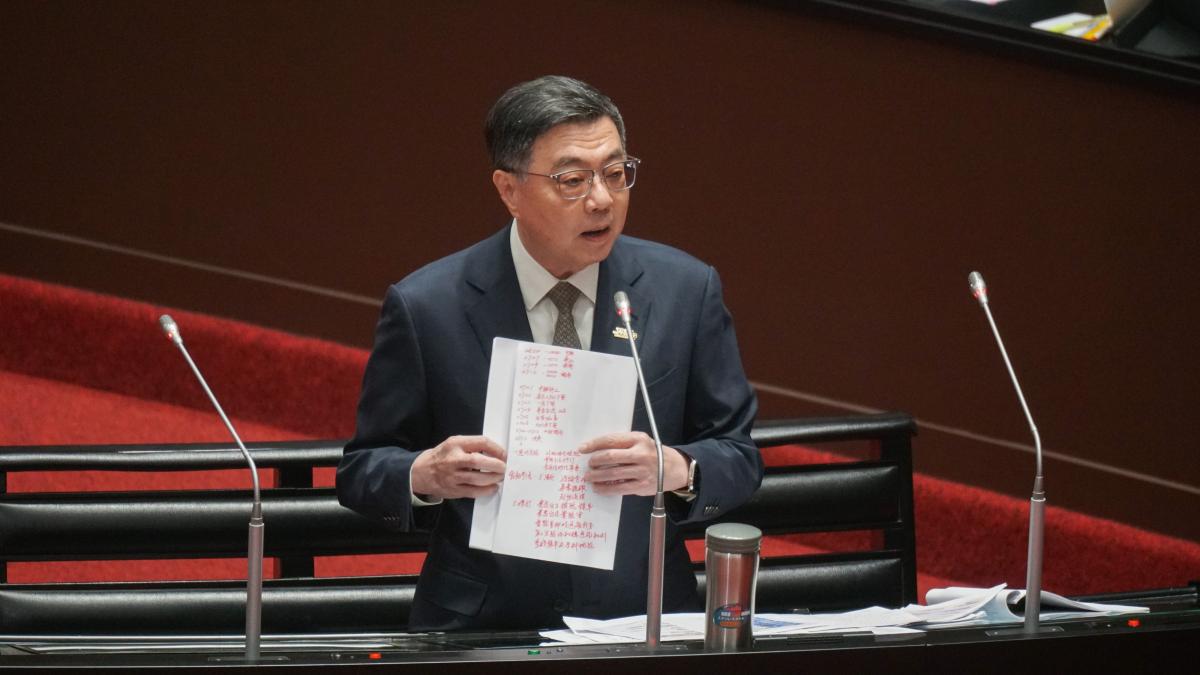
The Executive Yuan's cabinet meeting on the 23rd passed the draft amendment to the Food Safety and Hygiene Management Act, which will now be sent to the Legislative Yuan for review. The amendment includes requirements for food businesses of certain categories and scales to submit food safety monitoring plans for central government approval, and to report any potential food safety hazards within 24 hours.
Food businesses that violate self-testing regulations or fail to establish laboratories will face immediate fines ranging from NT$30,000 to NT$3 million. Violations of production suspension or reporting obligations when potential hazards are detected could result in fines of up to NT$30 million.
Premier Cho Jung-tai stated that regarding the case where certain salad oils from Chung Lien Oils were found to violate standards, the Ministry of Health and Welfare (MOHW) had already announced the test results of oil products produced from April to June on July 20, and convened a 'Food Risk Assessment Consultative Meeting' on July 21 to announce post-inspection handling principles.
The current Food Safety and Hygiene Management Act has room for improvement in areas such as self-inspection by food businesses, laboratory management, reporting of food safety anomalies, and third-party verification.
Regarding the direction of the Food Safety Act amendment, Premier Cho noted that the MOHW has already begun drafting the revision, and on the 21st, Minister without Portfolio Chen Shih-chung convened a legislative meeting, inviting representatives from the six major cities, aiming to establish a more robust food safety management system.
The draft amendment to the Food Safety and Hygiene Management Act centers on five core directions: strengthening source management, strengthening process management, strengthening anomaly reporting, strengthening quality management, and strengthening digital governance. A total of 17 articles are proposed for revision.
Key points of the amendment as outlined by Premier Cho include:
- In the event of a major food safety incident, the central government may establish a command center. Local competent authorities are responsible for mobilization, reporting to the central government, and following the command center’s instructions, enabling integrated resource allocation and effective coordination. - Food businesses meeting certain categories and scales must submit food safety monitoring plans for central approval and report any potential food hazards within 24 hours. - To strengthen secondary verification, certification bodies may conduct on-site sampling and require businesses to provide samples and self-inspection reports. - To clarify supervision responsibilities, local competent authorities must conduct inspections. The central competent authority may also conduct inspections for major, sudden, or other food safety incidents, and local authorities must cooperate. - Authority is granted to establish regulations on recall measures and follow-up actions. The Food Safety Protection Fund may subsidize non-violating food businesses for related costs incurred due to recalls ordered by the central food safety incident command center or announced by the central competent authority. - Violations of self-testing submission requirements or failure to establish laboratories will incur immediate fines of NT$30,000 to NT$3 million. Violations of production suspension or reporting obligations when hazards are suspected will incur fines of up to NT$30 million. A property preservation mechanism will also be added to prevent offenders from concealing, transferring assets, or evading enforcement. - To strengthen online food management, the management obligations and risk control responsibilities of internet service providers are clearly defined.
Premier Cho urged the MOHW to strengthen communication with all sectors of society, widely solicit opinions from various ministries and local governments, and build consensus on the draft amendment. He also instructed the MOHW to immediately review and draft relevant subordinate regulations and implement them to enhance the food safety protection system.
FACT BOX
- Source: PR Times
- Category: News