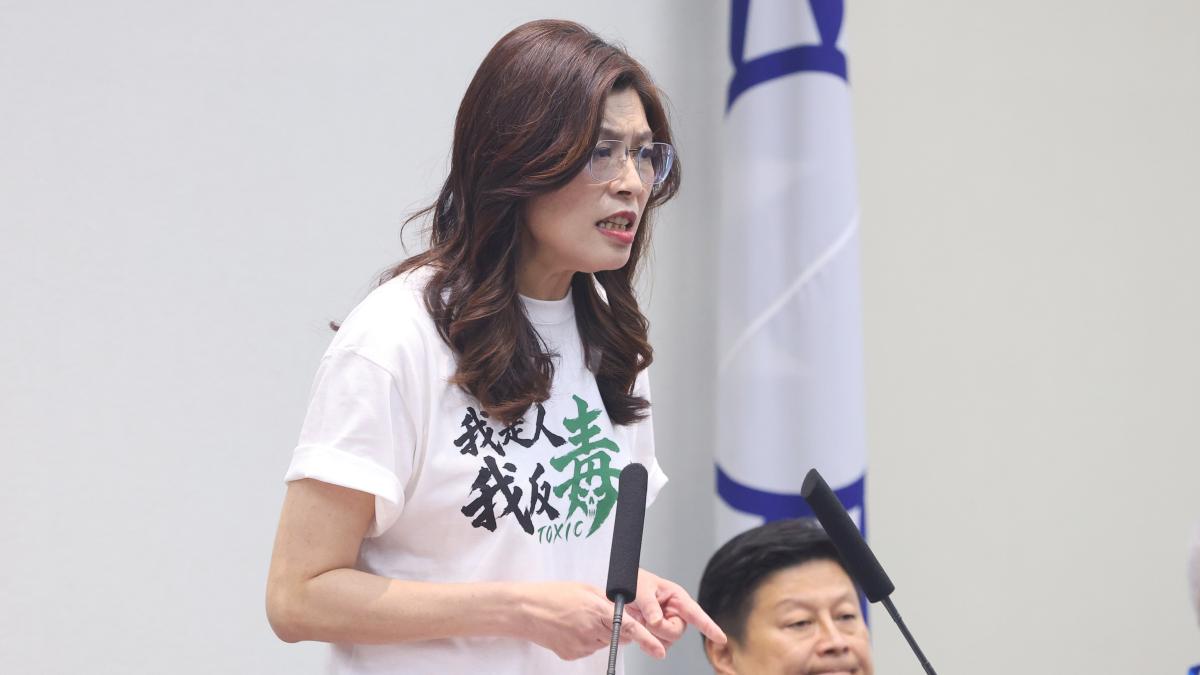
KMT Chairperson Cheng Li-chun spent 16 days in the United States in June and, during her stay in Boston, the major East Coast city, gave an exclusive English interview to the American podcast 'WorldViews.' In the interview, she stated that if the KMT has the fortune to win the 2028 presidential election, 'Taiwan will be completely renewed, and the landscape of cross-strait relations will change,' and that the future dynamics among the U.S., China, and Taiwan will also shift accordingly.
The English interview has now been fully released. During her June visit to the U.S., Cheng accepted an in-depth interview from Li Hansong, the Chinese-American host of 'WorldViews,' speaking in English about her vision for Taiwan's future development, cross-strait relations, and the international order. This has sparked public interest in how she will lead the party in the upcoming 'nine-in-one' elections and the 2028 presidential race. The full video of the interview was finally made public on YouTube this week.
Cheng stated in the interview that under the DPP's decade-long rule, Taiwanese society has become severely divided, and the party has essentially stopped discussing 'progressive' issues. Currently, the wealth gap in Taiwan has widened, most industries are stagnant, the judicial system has become unfair, Taiwan has lost many 'diplomatic allies,' and its international visibility and participation are severely inadequate. Therefore, she pledged that once the Blue Camp returns to power, it will carry out 'thorough transformation' and build Taiwan into a nation of shared prosperity: 'a more inclusive, just, and equitable society.'
Cheng said that as KMT chairperson, she promotes a highly democratic decision-making process and actively recruits young people who care about Taiwan's democratic cause. Hope stems from the vision of the KMT's return to power and the determination to reform Taiwan's long-standing social problems. Confidence, she added, comes from the KMT's commitment to contribute to the international community by 'leveraging economic trends and technological innovation to benefit developing countries.'
She also noted that with the global rise of the artificial intelligence (AI) industry, Taiwan is at the 'forefront' of this wave. Over the past few decades, Taiwan's industries have gradually transformed from traditional manufacturing to high-tech industries, blending the essence of Chinese culture with Western innovative spirit, thus nurturing a unique Taiwanese character.
When discussing the development of Taiwan's high-tech industries, Cheng emphasized that it currently faces some pressing 'real-world issues.' First, there is an imbalance between Taiwan's tech and non-tech sectors: 'The AI industry continues to grow, while most other industries are essentially stagnant.' Second, this imbalance has led to increasingly unequal wealth distribution.
She explained that currently, only about 10% of Taiwan's population directly benefits from the AI industry, while the majority of Taiwanese people do not truly enjoy the 'dividends' brought by the AI era. Taiwan's high-end wealth is highly concentrated in real estate and the stock market, which may inflate the country's overall wealth on paper, but in reality, leaves more people vulnerable to inequality. Moreover, the development of Taiwan's high-tech industries consumes vast resources, especially water and electricity, inevitably affecting future environmental protection.
Regarding the KMT's approach, Cheng analyzed that Taiwan's current priority is to consider how to extend AI applications to other fields, especially traditional industries, so that more businesses and individuals can truly share the opportunities brought by AI. At the same time, she hopes to summarize the valuable experience accumulated by Taiwan in the high-tech field and share it with other countries and peoples. Ultimately, the core of resource allocation lies in human capital, as talent is the key to driving all these initiatives. 'This leads us to the issue of talent. Taiwan's economic development relies on a stable supply of talent, and we must commit to talent cultivation, motivation, and retention.'
On the most watched issues of cross-strait and U.S.-Taiwan relations, Cheng reiterated in the program that since World War II, the U.S. and the Republic of China have fought side by side and jointly built a framework to maintain regional stability. Therefore, the U.S.'s cross-generational support for Taiwan 'is never taken for granted.'
She also reiterated, 'The U.S. is our benefactor, and we are deeply grateful.' However, Cheng believes the current world needs a new way of thinking, and the old zero-sum game framework where 'one side must lose for the other to win' is no longer applicable to anyone.
Cheng stated, 'The U.S. is our benefactor, and mainland China is our neighbor.' Therefore, Taiwan's new generation must find a path toward harmony, mutual support, and cooperation. 'If we can achieve this, I believe it will have profound significance for the entire world.'
On cross-strait relations, Cheng said that from a negative perspective, both sides must avoid war. But positively, the people on both sides are hardworking and capable, each possessing strong technological capabilities. 'If we can coexist peacefully or even cooperate, it will drive sustained economic growth on both sides and generally improve people's lives.' Once a stable environment is established between the two sides, the risk of conflict will decrease.
Cheng analyzed that cross-strait relations naturally involve economic and trade ties. Therefore, the KMT's view is that after a long period of isolation, both sides need to truly understand and respect each other to achieve peaceful coexistence and shared prosperity. 'Both sides should be mutually inclusive, learn from each other, grow together, and use these complementary qualities as a foundation to contribute to other regions and countries around the world.'
FACT BOX
- Source: PR Times
- Category: News