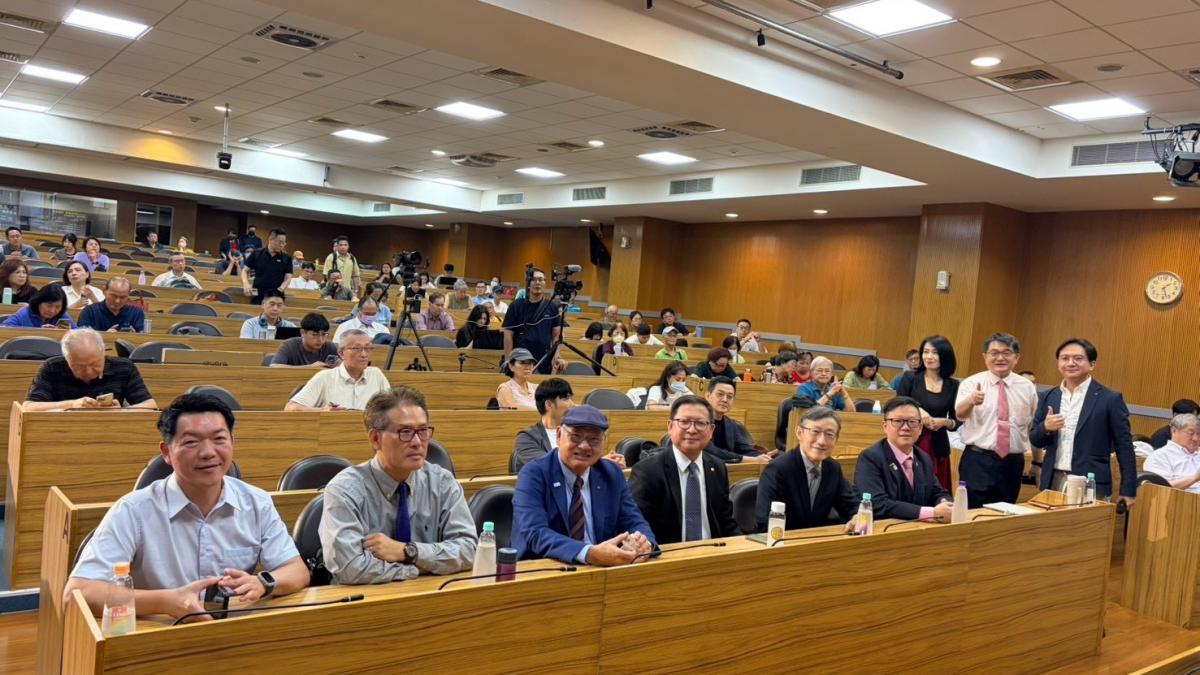
As the housing market cools from a boom to volume contraction, the construction industry faces not just declining transaction numbers, but a structural test encompassing capital, policy, population, carbon emissions, and management efficiency. The Taipei Architectural Exchange Association hosted the 115th Golden Brick Forum, themed 'Solutions to the Housing Market Chaos,' gathering around 200 professionals from architecture, real estate, and academia at the National Taiwan University of Science and Technology's International Building. The forum sought to answer a shared industry question: with policy regulation becoming the norm and construction costs continuously rising, what should be the construction industry’s next move? The forum’s comprehensive panel brought together academic and industry representatives to propose strategies for the housing market and construction sector from perspectives such as policy regulation, supply-demand shifts, and technology application. (Photo/Courtesy of Taipei Architectural Exchange Association)
After the Market Cools: Businesses Must Understand Structural Changes
The forum was introduced by Zhang Yuqi, Secretary-General of the Taipei Architectural Exchange Association, who outlined the agenda and hosted three keynote speeches. Professor Lin Tso-yu from National Chengchi University analyzed the driving forces behind housing prices and transaction volumes from macroeconomic, policy systems, demographic structure, regional development, and market capital perspectives.
The housing market has never been explainable by a single policy or data point. Interest rates, credit controls, and tax systems directly affect capital flows, while population and household structures determine housing demand. Regional industrial development further influences employment and purchasing power. When these variables shift simultaneously, the market’s entry into a volume-contraction consolidation phase reflects not just an economic cycle, but potentially a fundamental restructuring of supply and demand conditions.
Fang Kao-chen, Chairman of the Taipei Architectural Exchange Association, stated that the industry does not welcome sharp price fluctuations but desires long-term market stability. In recent years, the government has implemented measures such as integrated real estate taxation, credit controls, and vacant property taxes to curb overheating and prevent rapid market corrections from impacting the financial system and overall economy. However, policies must continuously adapt to different regional and market conditions.
Fang Kao-chen emphasized that during economic adjustments, the construction industry should strengthen product differentiation and accelerate the adoption of net-zero and AI technologies. (Photo/Courtesy of Taipei Architectural Exchange Association)
Net-Zero Is Not Just a Cost—It’s the Next Competitive Threshold
As market growth slows, companies can no longer rely solely on land and sales profits to maintain competitiveness. Dr. Yang Chien-jou from National Taiwan University of Science and Technology discussed the future transformation of the construction industry from the perspectives of renewable energy, energy-efficient design, low-carbon materials, and the circular economy.
For the construction industry, net-zero is not merely about adding equipment or replacing materials—it requires re-examining the entire life cycle of buildings, from design and construction to usage and maintenance. In the future, developers will not only be asked whether a building is well-constructed, but also whether energy use is efficient, materials are recyclable, and carbon emissions are manageable.
This means sustainability will gradually shift from a branding tool to a fundamental requirement for companies to access markets, capital, and partnerships.
AI Enters the Construction Site—Management Capability Becomes the New Battlefield
Associate Professor Chiu Yung-piao from Chaoyang University of Technology focused on AI and construction management, exploring how digital technologies can improve construction accuracy, project quality, and operational efficiency.
Through Building Information Modeling (BIM), companies can integrate drawings, materials, and processes before construction begins, reducing design conflicts and on-site errors. After completion, equipment, maintenance, and operational data can be stored in cloud databases, transforming building management from a one-time project delivery into long-term asset management.
In an environment of labor shortages and rising costs, AI’s value lies not just in automation, but in reducing errors, shortening communication time, and enabling data-driven management decisions. The ability to truly integrate digital tools into construction sites and operational workflows will become the key differentiator among construction firms.
The 115th Golden Brick Forum was held at National Taiwan University of Science and Technology, with around 200 industry and academic professionals attending to jointly discuss stable housing market development and construction industry upgrading. (Photo/Courtesy of Taipei Architectural Exchange Association)
From Dialogue to Joint Problem-Solving: Industry, Government, and Academia
The forum’s panel discussion was moderated by Lan Wen-tsung, Deputy Editor-in-Chief of Juwai Magazine, with panelists including Lin Tso-yu, Yang Chien-jou, Chiu Yung-piao, Chairman Tsai Chin-hsun, Deputy General Manager Ko Teng-yao, and General Manager Wu Chia-yuan. They discussed policy, cost, and industry upgrading from research, market, and engineering practice perspectives.
Fang Kao-chen pointed out that the real estate market will continue to evolve with economic conditions, policies, and regional development. Governments, academia, and industry need to establish more regular communication mechanisms. Only when policymakers understand real market conditions and businesses grasp technological and institutional trends can the industry successfully transform amid volume contraction.
Market cooling is not necessarily just a crisis—it may force the industry to move beyond its past reliance on economic cycles and price growth. The next phase of competition will no longer be about who owns land, but who can more quickly integrate policy judgment, low-carbon technology, and digital management capabilities.
FACT BOX
- Source: PR Times
- Category: Event