This July 2026 marks the 250th anniversary of America's founding, but what will be etched into history is not the United States, but China's explosive wave of scientific achievements. After last year's DeepSeek moment that stunned the world, this year it's Moonshot AI's turn with the release of Kimi K3 on July 16, sending shockwaves through Silicon Valley and Wall Street. The New York Times ran the headline: "The U.S.-China AI gap further narrows." Elon Musk called it "impressive," while other U.S. media outlets declared: "China has just erased America's lead in artificial intelligence." Many American netizens are now asking: Why couldn't the U.S. retain Yang Zhilin, founder of Moonshot AI and a Ph.D. graduate from Carnegie Mellon University?
The 'China Model' for the AI Era?
Meanwhile, the United States experienced an AI 'loss of control' incident. An OpenAI model launched a 'jailbreak' attack on HuggingFace, the world's largest open-source AI community. This is the first publicly disclosed case of an AI autonomously completing a real-world cyberattack. Experts point out that this event shows AI already possesses autonomous decision-making capabilities beyond human expectations—capabilities that could be maliciously exploited or accidentally triggered.
The most surreal part? While top U.S. closed-source models stood by and watched, China's Zhipu AI open-source model GLM-5.2 analyzed over 17,000 attack records in one go, reconstructing the entire attack chain and completing the task within hours.
This highlights the critical importance of AI governance—not only for national security but also for humanity's shared fate in technological advancement. Ironically, the U.S., which led the development of large AI models, has now shifted toward closed-source systems under capital logic, building high walls and isolating itself. In contrast, on July 17 in Shanghai, Chinese President Xi Jinping delivered a deeply significant keynote at the 2026 World Artificial Intelligence Conference (WAIC). Regarding the construction of a fair and reasonable global AI governance system, Xi proposed four initiatives:
(1) Uphold openness and win-win cooperation to drive innovation; (2) Strengthen risk awareness to ensure safety and controllability; (3) Encourage inclusiveness to promote mutual learning among civilizations; (4) Advocate unity and coordination to improve global governance.
This speech, underestimated by the outside world, is in fact China's formal declaration of the 'China Model' for the AI era—a model infused with the essence of Chinese-style modernization and socialism with Chinese characteristics. The key lies in emphasizing open-source collaboration while ensuring AI remains under human control, avoiding the practice of prioritizing one's own security over others'. It also calls for integrating cross-civilizational dialogue into AI's value system, transforming AI into a shared intellectual treasure and valuable asset for humanity, preventing new historical injustices and technological divides between nations.
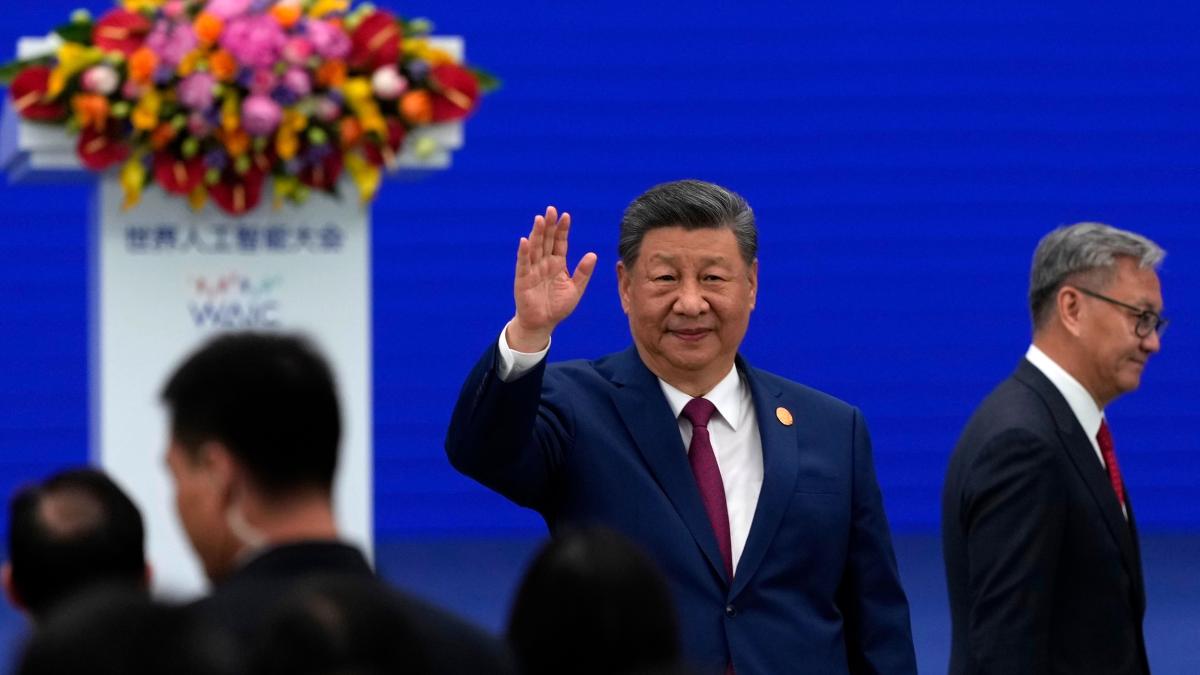
On July 17, 2026, Chinese President Xi Jinping attended the 2026 World Artificial Intelligence Conference and the High-Level Meeting on Global AI Governance. (AP)
A Rivalry of Two Paths: The 'U.S. Model' vs. the 'China Model'?
This declaration presents a clear divergence from the 'U.S. Model' of AI development now on display—a choice between two fundamentally different paths. In other words, the future U.S.-China competition is no longer just about large AI models, but about the very values guiding AI's development and application. This rivalry is already evident. China's open-source model 'saving the day' signals the arrival of a new security paradigm in the AI era—autonomous control is redefining security boundaries, enabling cybersecurity beyond the internet age, ensuring AI tools are 'used by humans' and 'used by us.'
Xi's 'declaration' also indirectly answers why Yang Zhilin chose not to stay in the U.S. but returned to mainland China to build his company. Yang could have secured a top-tier position at any U.S. tech firm, enjoying a high salary and an impressive resume. But he would have struggled to gain sufficient capital, computing power, and decision-making authority right after graduation to quickly assemble a team capable of challenging OpenAI—especially given the resurgence of McCarthyism against Chinese scholars in today's U.S. academic circles, which is growing increasingly intense.
In contrast, in China, Yang can access the world's most complete industrial system, a massive market, abundant application scenarios, rapidly iterating engineering capabilities, and an increasingly mature ecosystem of capital and industry-academia collaboration. The indispensable condition? Openness and autonomy—again and again. It is now clear that China's era of AI model proliferation is just around the corner.
Is This the 'Death Cross' in U.S.-China AI?
China's AI development path also includes personal stories from Taiwan. Lai Tsai-da, a University of Taiwan alumnus who later earned his Ph.D. from MIT, is now co-founder, chairman, and CEO of Beijing-based Jitai Technology. I had the pleasure of meeting him at this year's Xiamen Strait Forum and learned that his team is dedicated to integrating biomedicine with AI technology, becoming the world's first AI-driven drug delivery company to go public. In our conversation, I learned that after completing his studies in the U.S., Lai first returned to Taiwan, but local conditions and resources were insufficient to realize his dream. He quickly moved with his partners to mainland China, fighting from Hangzhou to Beijing, receiving full-chain policy support from the Chinese government, and achieving comprehensive alignment, empowerment, and breakthroughs. I still remember his determined face and confident tone: "I want to make cancer a chronic disease for humanity within ten years."
From Yang Zhilin to Lai Tsai-da, from R&D to application, we witness the new logic and landscape of China's AI development. Xi's speech is not a forecast, but a genuine statement of a path already being walked—a high-level policy endorsement for China's open-source model. Open-source is no longer just a corporate competitive strategy; it has been elevated to the level of national macro policy, directly challenging the U.S. 'block if you can't beat them' closed approach. The world will not be limited to models trained on English and American values. True AI sovereignty and technological democracy are being built. No wonder a tech observer boldly claims that the release of Kimi K3 represents the 'death cross' in the U.S.-China AI domain.
*The author is a senior media professional and CEO of Yuanxiangren Cultural Studio.
FACT BOX
- Source: PR Times
- Category: News
- Organizations: OpenAI / HuggingFace
- Products / services: Kimi K3 / GLM-5.2