"If my book is considered seditious material, then I suppose as its author, I would be considered a seditious person," said Emily Feng, an American-Chinese journalist. Her book, 'When Red Flowers Bloom: Identity and Belonging in the Era of Xi Jinping,' was reportedly among the titles seized by Hong Kong police's National Security Department during raids on two independent bookstores. The police have not disclosed the list of seized books, nor confirmed whether Feng's work is linked to the case. However, Feng told BBC's 'Weekend' radio program that the incident made her feel that traveling to Hong Kong now carries risks. "I haven't been able to return to mainland China for reporting for about four years, and now I feel that even going to Hong Kong might be a bit dangerous."
BBC has contacted the police to inquire whether Feng violated any laws or is banned from entering Hong Kong, and is awaiting a response. On July 15, Hong Kong police raided the independent bookstores 'Ling Haam Bookstore' and 'Tin Yuen Bookstore,' arresting five people on suspicion of violating the 'National Security Ordinance' by allegedly engaging in 'acts with seditious intent.' The suspects were released on bail two days later. During the operation, a batch of books and items were seized. Multiple media outlets, including Hong Kong's Ming Pao, reported that 'When Red Flowers Bloom' was among the suspected books. Police later stated that the seized publications contained content intended to incite hatred toward the Hong Kong Special Administrative Region government, the judiciary, and law enforcement agencies.
The day after the raid, Security Secretary Chris Tang was asked whether authorities would publish a banned book list so booksellers would know which titles they cannot sell. Tang replied that authorities target content, not titles, and that the law clearly defines seditious intent: "Breaking the law means crossing the red line. With evidence, we arrest; with sufficient evidence, we prosecute." He added, "Booksellers have a responsibility to ensure their books do not endanger national security, just as food sellers must ensure their products are not poisonous, won't cause stomachaches, or break the law." When asked if the police were targeting certain bookstores, Tang denied it, saying authorities would act against any shop or individual displaying or selling seditious materials.
Under the National Security Ordinance, anyone found guilty of "engaging in acts with seditious intent" could face up to seven years in prison. If the offense involves collusion with "external forces," the maximum sentence increases to ten years.
Feng is an international correspondent for NPR (National Public Radio) in the United States. Her book 'When Red Flowers Bloom' was published in April 2024 and documents the stories of 20 activists, including human rights lawyers and a diarist from Wuhan's COVID-19 lockdown. It was published by Taiwan's Weicheng Publishing. On the BBC program, Feng described the book as "quite mild." She said it "depicts ordinary people living in mainland China, their struggles with identity, and why controlling identity has become so important to the Chinese Communist Party."
"To me, this might just be a moderate, balanced journalistic investigation into how ordinary Chinese people live and struggle under government rule," she said. "But this is a sensitive topic in China."
Feng said she has long faced surveillance and obstruction while reporting in China, so she never expected her book to be published on the mainland. With Hong Kong's national security laws in place, she also did not anticipate it being sold there. A few weeks ago, she received a message suggesting her book might have been seized in the raid. "I was shocked," she said. "I was shocked that it was taken by authorities; and equally surprised that anyone in Hong Kong was importing and selling it."
Feng said she still does not know what triggered the raid. She has contacted Hong Kong journalists covering the arrests to learn what information they obtained from booksellers, but "the situation remains very unclear." "I still don't know what prompted the authorities to conduct the surprise raid and arrest these booksellers."
Hong Kong's 'gray zone' for publishing 'has changed'
Hong Kong was once a major hub for publishing and selling Chinese-language political books banned on the mainland. Titles unavailable in mainland China were openly sold in Hong Kong bookstores and attracted mainland tourists. Feng described Hong Kong as previously existing in a 'gray zone' outside mainland China's publishing censorship system. Books published on the mainland require an ISBN and official approval, but Hong Kong booksellers had more leeway to decide what to sell.
When Weicheng Publishing in Taiwan translated 'When Red Flowers Bloom' into Chinese, they did not apply for the ISBN required for mainland publication "because we knew it would never be approved." "But Hong Kong was in a gray zone. Strictly speaking, Hong Kong must follow the ISBN system, but in practice, no one seriously checked, and booksellers could basically decide for themselves."
"Clearly, the situation has changed."
In 2019, Hong Kong saw massive protests. A year later, Beijing imposed the Hong Kong National Security Law. In 2024, Hong Kong's Legislative Council passed the local National Security Ordinance, fulfilling Article 23 of the Basic Law. June 30, 2024, marked the sixth anniversary of the National Security Law's implementation. The Hong Kong government stated that both national security laws safeguard rights and freedoms, including speech, press, and publication, as protected under the Basic Law and applicable international treaties.
However, bookstore owners say authorities have not clarified which books are illegal, making it difficult for publishers and sellers to determine the boundaries. Hong Kong police have conducted multiple arrests involving independent bookstores since 2026, raising concerns about shrinking publishing space.
Feng mentioned the 2015 disappearance of five people linked to Causeway Bay Books, who were later confirmed to have been detained by mainland Chinese authorities. Causeway Bay Books and its parent company, Mighty Current Media, published works often focusing on the personal lives of Chinese leaders. Authorities accused them of 'illegal business operations' and selling 'banned books' on mainland politics.
Feng sees 'disturbing similarities' between that incident and the current bookstore raids. "They were taken to mainland China and detained for selling books disliked by Beijing's Communist Party—books that included political and historical works, and frankly, gossip novels."
She noted the difference now is that Hong Kong police can invoke national security laws with harsher penalties. "Hong Kong police now have the National Security Law as a basis. Frankly, people could face much longer sentences even for far less serious charges."
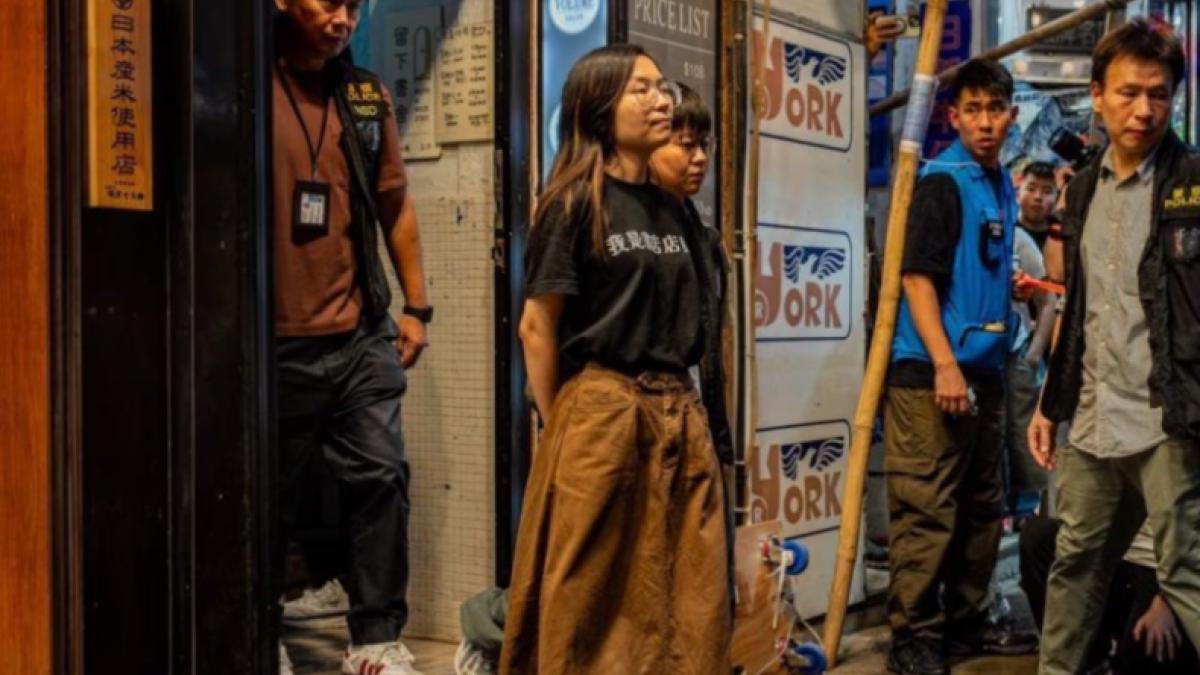
Feng also said a photo of a female bookstore clerk taken during the raid made her cry. The clerk, wearing a black T-shirt that read 'I am a bookstore clerk,' was seen with handcuffs on her wrists. The image spread widely on social media, and 'I am a bookstore clerk' became a slogan supporting Hong Kong's independent bookstores and freedom of expression.
"Seeing that photo made me cry," Feng said. "It's an extraordinary image. Not only is she wearing a shirt that says 'I am a bookstore clerk,' but even with handcuffs, she stands tall. She looks incredibly proud and dignified."
After the incident, she felt guilt for five or six days, even though rationally she knows she is not responsible for the arrests. "I know that's not logical," she admitted.
Feng pointed out that a pro-Beijing Hong Kong newspaper published a critical article about the two bookstores days before the raid, and the raid occurred during the week of the Hong Kong Book Fair, which the two stores were not allowed to join. She believes these are signs that authorities had already planned to shut them down.
For Feng, this is not just about whether one book can be sold in Hong Kong. "I'm not only surprised, but I've been grieving over this entire incident," she said.
FACT BOX
- Source: PR Times
- Category: News
- Organizations: NPR