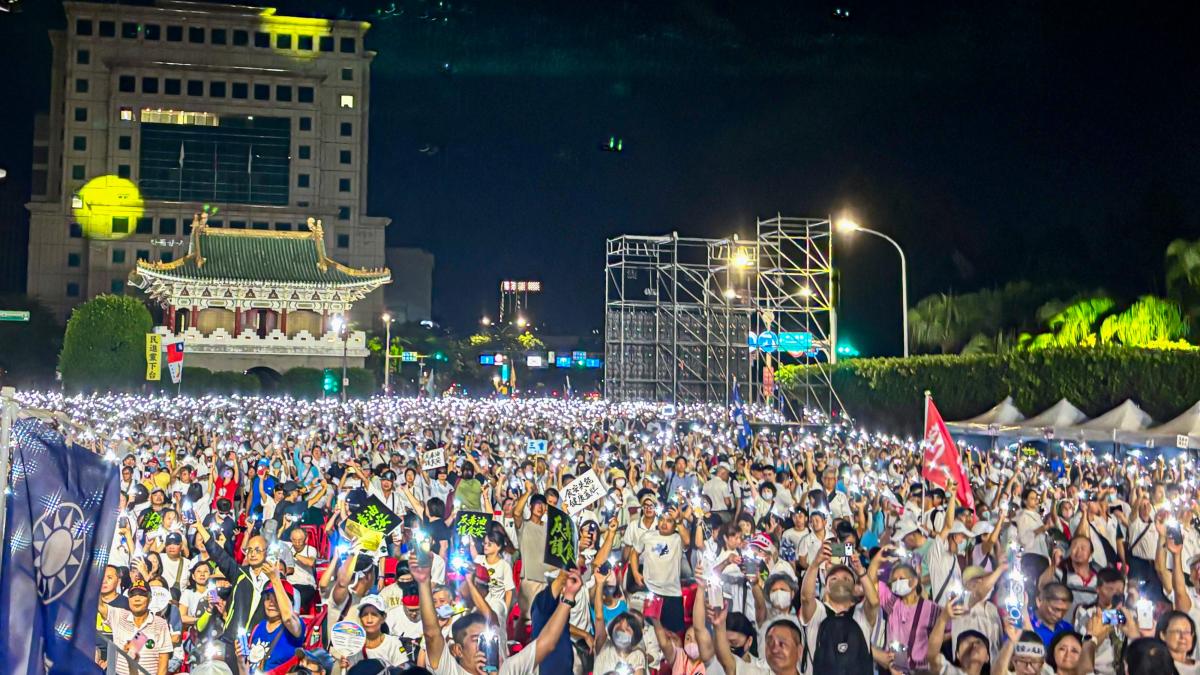
Taipei Mayor Chiang Wan-an expressed dissatisfaction with the central government's handling of the 'Zhonglian toxic oil case,' criticizing its rush to re-shelve contaminated oil products. This prompted him to launch the '725 Anti-Toxic Oil' protest, drawing an unprecedented crowd of tens of thousands to Ketagalan Boulevard in Taipei on Saturday. According to organizers, over 200,000 people attended, while conservative estimates still place the number at 70,000—surpassing many past political rallies and reflecting widespread public discontent with the DPP government's response to the toxic oil scandal.
The 'I Am Human, I Oppose Toxic Oil in Taiwan' rally, called by the Kuomintang (KMT), brought public anger over the oil scandal to a boiling point. Media reports noted that chants of 'Cho Jung-tai resign,' 'Shih Chong-liang resign,' and 'Lai Qing-te resign' echoed throughout the event. Yet, despite the overwhelming wave of protests, Premier Cho Jung-tai remains unmoved, Health Minister Shih Chong-liang holds firm, and only Food and Drug Administration (FDA) Director General Chiang Chih-kang has been rumored by People Power Party (PPP) Chairperson Huang Kuo-chang to be 'sacrificed' by the ruling Green camp to take responsibility.
Even more troubling, the author’s close friend of nearly 20 years, Wei Chun-yu, former head of the KMT's New Media Department, was visited by the Criminal Investigation Bureau after his pre-rally video 'You Bu De Ni' ('Oil Can't Be You') was reported for allegedly using 'deepfake' technology. This not only alarmed Wei’s family but also led the KMT to accuse the police of infringing on freedom of speech by 'suggesting' Wei 'voluntarily consider adjusting or removing' the video—a move seen as 'green terror.'
The author has known Wei Chun-yu since university and respects his integrity, courage, wit, and eloquence, despite differing political views. Wei’s 'Principal Lai' video series during last year’s 'Great Recall' campaign broke through ideological bubbles and made 'Principal Lai' a widely recognized figure.
Comparing Wei’s and his family’s ordeal this week with the ongoing toxic oil scandal, the author—whether as a journalist, a longtime friend, or an ordinary voter—asks: How is it possible that no high-ranking officials have taken responsibility for the toxic oil case, while a former KMT staffer is targeted simply for speaking out?
In the author’s view, based on democratic and responsible governance principles, after last year’s 'Great Recall' resulted in a 32-to-0 defeat, the premier should have resigned and the president should have apologized. Historically, political leaders who lose major elections take responsibility—be it Japan’s former Prime Minister Shigeru Ishiba or the recently resigned UK Prime Minister Keir Starmer. Why, then, can Cho Jung-tai remain in office?
On July 20, 2026, UK Prime Minister Keir Starmer and his wife Victoria left 10 Downing Street in London. (AP)
Why Won’t Cho Jung-tai Resign?
The truth is, Cho Jung-tai is a 'passive product' of the Green camp’s factional power-sharing system, and the president lacks a suitable replacement—revealing the DPP’s 'talent crisis.' Since the toxic oil scandal erupted, the opposition has labeled Cho as the 'three-no responsible person': no apology, no truth, no resignation. The Green camp dismisses the Ketagalan protest as mere 'emotional venting' and shifts blame to local governments.
Cho has confirmed he told Shih Chong-liang to 'reconsider' the scope of oil product removals, proving direct involvement in a major food safety decision. Under responsible governance, he should be the first to resign—but he is paradoxically the only one who cannot.
Within the DPP’s 'factional co-governance' structure, Cho is the 'greatest common denominator' acceptable to all factions. If Lai Qing-te replaces him, potential successors include Kaohsiung Mayor Chen Chi-mai and Vice Premier Cheng Li-chun. Yet Lai hesitates to make a mid-term change, fearing broken promises and loss of power ahead of the 2028 election. Cho’s survival depends not on performance but on factional balance. As long as the Green camp’s calculations remain unchanged, his position is secure.
For example, netizen historian 'History Bro' analyzed that Lai keeps Chen Chi-mai tied to Kaohsiung campaign duties, has anointed loyalist Lai Jui-lung as Kaohsiung’s successor, and fears empowering Cheng Li-chun, the 'Justice Alliance,' or 'Ying faction.' If Cho resigns, Chen might move north, jeopardizing Lai Jui-lung’s hold on Kaohsiung. Polls show southern Taiwan remains 'green,' but margins are narrowing.
Why Won’t Shih Chong-liang Resign?
Setting aside Cho’s role and his responsibility in the 'Great Recall,' the next person who should bear political responsibility for the toxic oil case is clearly Shih Chong-liang. Objectively, the Ministry of Health and Welfare (MOHW), under Shih, initially 'covered up' by refusing to disclose downstream manufacturers’ names, then blamed KMT-led local governments and distorted local leaders’ statements—even pro-Green commentators criticized the response. By any political logic, Shih cannot escape blame under responsible governance.
Yet, insider political circles suggest that while Cho relies on 'factional balance' to stay in power, Shih benefits from a personal bond with the president as former classmates and medical interns. Compared to former President Ma Ying-jeou’s 'separation of public and private,' Lai’s appointments appear based more on personal ties than performance.
Stepping back, the toxic oil scandal is not a one-off failure but a systemic, long-term issue—possibly over 13 years—long argued by the KMT. As Wei Chun-yu stated after being summoned: 'The system that hasn’t been fixed in 13 years needs repair, not anyone’s face.' Yet if Huang Kuo-chang’s leak is true, that 'face' may fall solely on the lower-ranking Chiang Chih-kang.
Regarding the FDA’s responsibility, assuming no political interference and decisions based purely on expertise, was the rush to re-shelve some oil products before the cause was identified appropriate? Or is this a double standard—applying 'innocent until proven guilty' to businesses but 'guilty until proven innocent' to the opposition?
KMT legislators accuse the FDA of 'covering up' and 'whitewashing' benzopyrene issues with 'five major charges,' urging prosecutors to investigate possible favoritism toward businesses. The opposition passed a motion on July 8—over two weeks before the rally—demanding the resignations of all three. Yet the DPP only now considers making Chiang Chih-kang the scapegoat, which is clearly too late.
More importantly, the FDA director is not a political appointee but a career civil servant (administrative officer) at the 13th rank. Under basic principles of responsible governance, the extent of a civil servant’s political accountability is debatable.
In the DPP’s logic, civil servants who 'lack factional ties, electoral value, or political protection' become ideal 'scapegoats.' When the power structure needs to diffuse social pressure, isolated technical bureaucrats are the easiest targets.
From a conspiracy theory perspective, did the FDA’s decision to re-shelve oil products spark outrage precisely to justify sacrificing Chiang Chih-kang and cover up deeper failures? As History Bro and netizen Huang Shih-hsiu suggest, after Huang Kuo-chang’s leak, news of the Green camp targeting Chiang 'died in the light,' ironically protecting him.
Yet, compared to former President Ma Ying-jeou’s era, when Premier Jiang Yi-huah voluntarily resigned during a 2013 food safety crisis, today’s 'sacrificial play' exposes a deeper failure of political accountability.
FACT BOX
- Source: PR Times
- Category: News