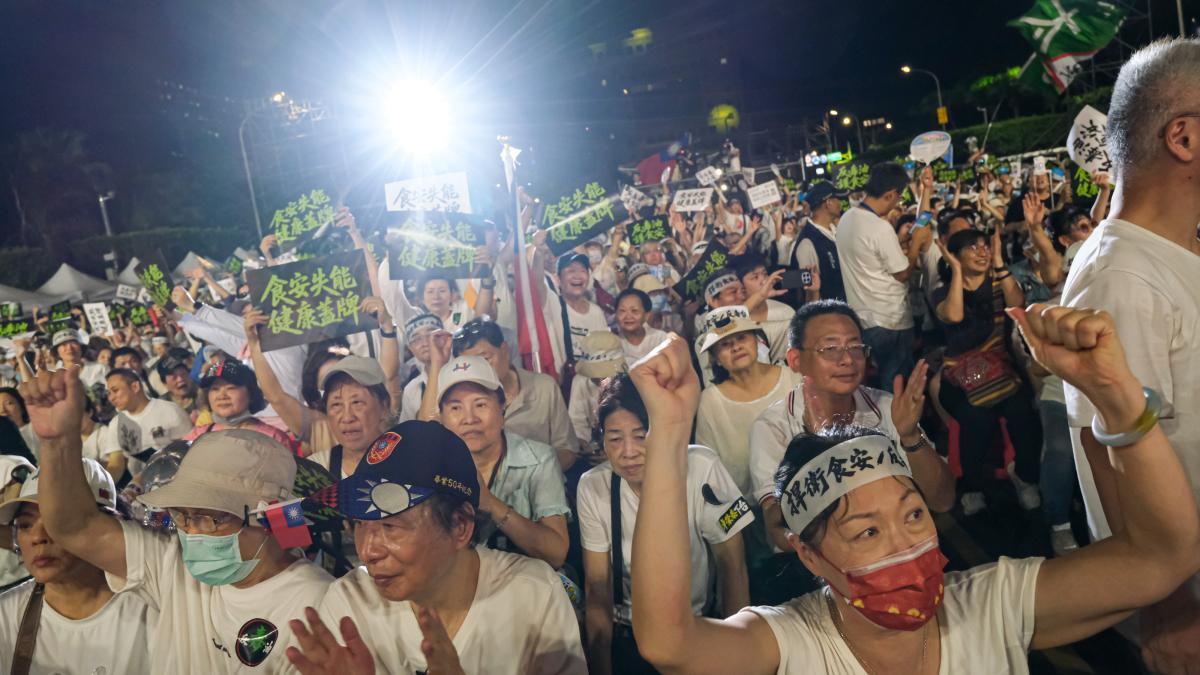
Public anger has erupted over Zhonglian's carcinogenic 'toxic oil' food safety scandal, prompting the Kuomintang (KMT) to rally 200,000 people on Ketagawa Avenue for a 'I Am a Person, I Oppose Poison Oil' protest on July 25. In response, writer Pinglang Daoyu analyzed the 2026 election outlook on Facebook, arguing that the Democratic Progressive Party (DPP) misjudged public sentiment. He believes Health Minister Shih Chong-liang and Food and Drug Administration (FDA) Director General Chiang Chih-kang may resign, President Lai Qingde will likely apologize to quell rising fury, but Premier Cho Jung-tai will not step down over the oil scandal and will remain in office to bear responsibility for election outcomes. As long as the DPP wins the 2028 presidential election, any current sacrifices or humiliations will be deemed insignificant.
Pinglang Daoyu stated that Chiang Wan-an's call for a street rally on July 25 marked a full-scale offensive against the green camp and served as a major test of mobilization capability. If turnout had been weak, it would have severely damaged the KMT's vote-attracting image; if numbers exceeded expectations, it would solidify the momentum of Chiang Wan-an's supporters. With crowds spilling beyond Ketagawa Avenue into the surrounding Jingfu Gate area, the KMT's claim of 200,000 attendees may be contested, but it clearly surpassed the dismissive predictions of pro-DPP 'Bluebird' allies, who mocked that the rally would merely be a political campaign with turnout barely filling Ketagawa Avenue.
Has the blue camp's anti-toxic oil momentum surged? Pinglang Daoyu argues that the rally established the KMT's 'New Four Pillars' leadership. He notes that Chiang Wan-an's initiative, supported by Lu Hsiu-yen, Han Kuo-yu, and Cheng Li-chen, created a powerful political wave, cementing the status of these four as the KMT's core anti-green forces — representing city, legislature, and party leadership. Regarding the massive public turnout, the green camp may claim it was merely 'mobilized,' but with years of street protest experience, they understand mobilization limits. Such a massive crowd reflects genuine public fury, making it impossible to dismiss as mere mobilization. They now fear this northern-majority turnout will severely damage their prospects in northern constituencies and could ripple into central and southern regions.
Especially striking is that despite prolonged low polls for the blue and white camps, constant criticism over pro-China perceptions, budget obstruction, and defense blocking — all of which should have made them politically toxic — such a massive crowd still emerged. This represents a major miscalculation of public sentiment for the green camp. In response to rising public anger, Chiang Chih-kang and Shih Chong-liang may resign, but the premier will remain unchanged for now. Replacing the premier under green and white demands at this moment would enrage DPP supporters, triggering massive backlash and creating a crisis of internal and external pressure.
Will Cho Jung-tai step down? Pinglang Daoyu believes he will not. Instead, he will stay to bear responsibility if the DPP suffers major defeats in the 2026 local elections. Just as Lai Qingde stepped down as premier in early 2019 after the DPP's devastating 2018 local election losses, a high-ranking official must take responsibility after a major defeat. Thus, Cho Jung-tai will not resign over the oil scandal but will remain to shoulder electoral accountability. Lai Qingde will apologize — failure to do so would fuel further outrage — though he will emphasize shared responsibility between central and local governments. With repeated failures on livelihood issues, the DPP will double down on its anti-China stance, believing that under China's threat, the 2028 presidential election will become a choice between 'surrender to China' or 'resist China,' and voters will ultimately return to the DPP.
Pinglang Daoyu emphasizes that the July 25 anti-toxic oil protest merely solidified the KMT's new leadership core but will not alter the green camp's strategy. Even if the DPP loses local elections repeatedly, as long as it wins the presidency and regains a legislative majority in 2028, all current sacrifices and humiliations will be deemed insignificant.
FACT BOX
- Source: PR Times
- Category: News