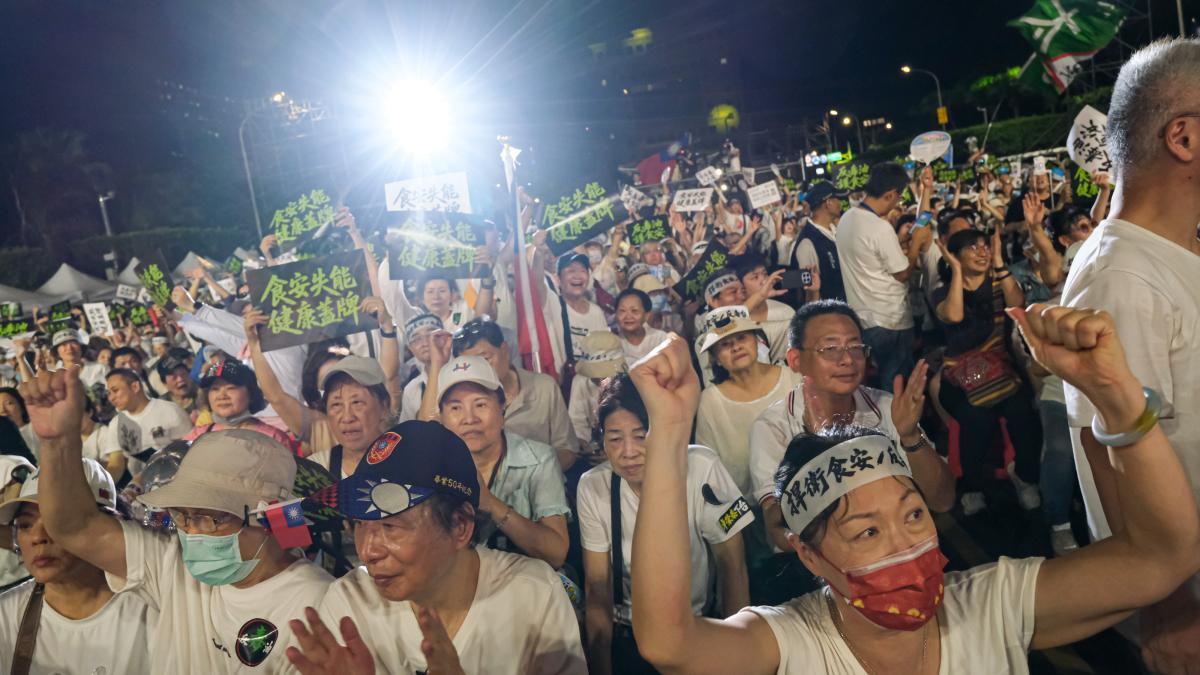
The food safety scandal involving carcinogenic oil from Zhonglian has sparked public outrage in Taiwan. The Kuomintang (KMT) called for a protest rally on Ketagalan Boulevard on July 25 under the slogan 'I Am Human, I Oppose Poisoned Taiwan,' drawing an estimated 200,000 participants. Psychiatrist Shen Cheng-nan posted on Facebook, analyzing this as the largest food safety protest in Taiwan's history. He stated that the protest's greatest political achievement was permanently affixing the label 'President of Carcinogenic Oil' onto President Lai Qingde's forehead, casting doubt on his 2028 re-election prospects.
Shen described the July 25 protest on Ketagalan Boulevard as unprecedented in scale. Despite the scorching July heat, the crowd overflowed the boulevard and circled around Jingfu Gate. He suggested that Lai Qingde must have been frightened by the sight. If Lai persists in his confrontational attitude and continues to resist, he will fail to recognize that the protest's most significant outcome was branding him with the five-character label 'President of Carcinogenic Oil.'
Shen noted that AI-generated videos have become a powerful tool for political messaging and mobilization. Several recent AI clips depict Lai Qingde wearing shorts and flip-flops, wandering among anti-government protesters on Ketagalan Boulevard. Shen predicted that these videos will now be permanently tagged with the label 'President of Carcinogenic Oil.'
Shen highlighted that Chiang Wan-an has recently emerged as a potential new unifying leader for the Blue-White alliance. Over the past one to two years, Chiang has consistently spoken out on major issues, and his leadership during this protest has strengthened his image as a common figurehead. Chiang effectively communicated public fear over carcinogenic oil, emphasizing how many schoolchildren have already consumed it, and strongly rebutted the central government's attempts to shift blame—resonating deeply with Blue and White supporters.
Shen argued that while Cheng Li-chen is too aggressive and Lu Hsiu-yen too mild, Chiang Wan-an has found the right leadership tone and communication style for the Blue-White camp. This is crucial for consolidating opposition energy and providing clear direction. However, Shen believes Chiang will not run in 2028 and will instead complete his second term as Taipei mayor.
The success of the July 25 anti-toxic oil protest was significantly aided by hunger strikes organized by young KMT supporters. In contrast, the Green camp foolishly mocked these actions, only pouring fuel on the fire. Shen criticized them: 'You can't even step out of your air-conditioned rooms for a few minutes or stop cursing on your phones, yet you mock others' hunger strikes for being 'improper.''
Shen mocked the Green camp, saying their circle is now trapped in a 'rhetoric-first atmosphere' (zuiqiu fenwei). He accused them of being desensitized and heartless, willing to say anything to protect their power. Whenever a crisis occurs, officials rush to shift blame, attack the opposition in media and online, yet no one resigns. Shen questioned who in the DPP government should step down, stating that Shi Jong-leong's resignation would be the bare minimum. However, he believes Lai Qingde has lost touch with public sentiment and may double down on confrontation: 'The more you demand my resignation, the less I will comply.'
Shen emphasized that the three words 'carcinogenic oil' now carry more political weight than the 'fear of national destruction.' This, he said, is a fascinating phenomenon in political psychology. Lai's 2028 re-election strategy, built on the ideological weapons inherited from Tsai Ing-wen, has now hit a wall. The current administration is enveloped in a 'rhetoric-first' culture—blaming others, attacking the opposition online and in media, yet no officials are held accountable. Opposition to carcinogenic oil and support for nuclear restart are, in fact, driven by the same fear: cancer. This reflects a powerful collective sentiment in Taiwanese society, where people exercise daily, eat health foods, and deeply value well-being—making them strongly oppose carcinogenic oil and air pollution.
FACT BOX
- Source: PR Times
- Category: News