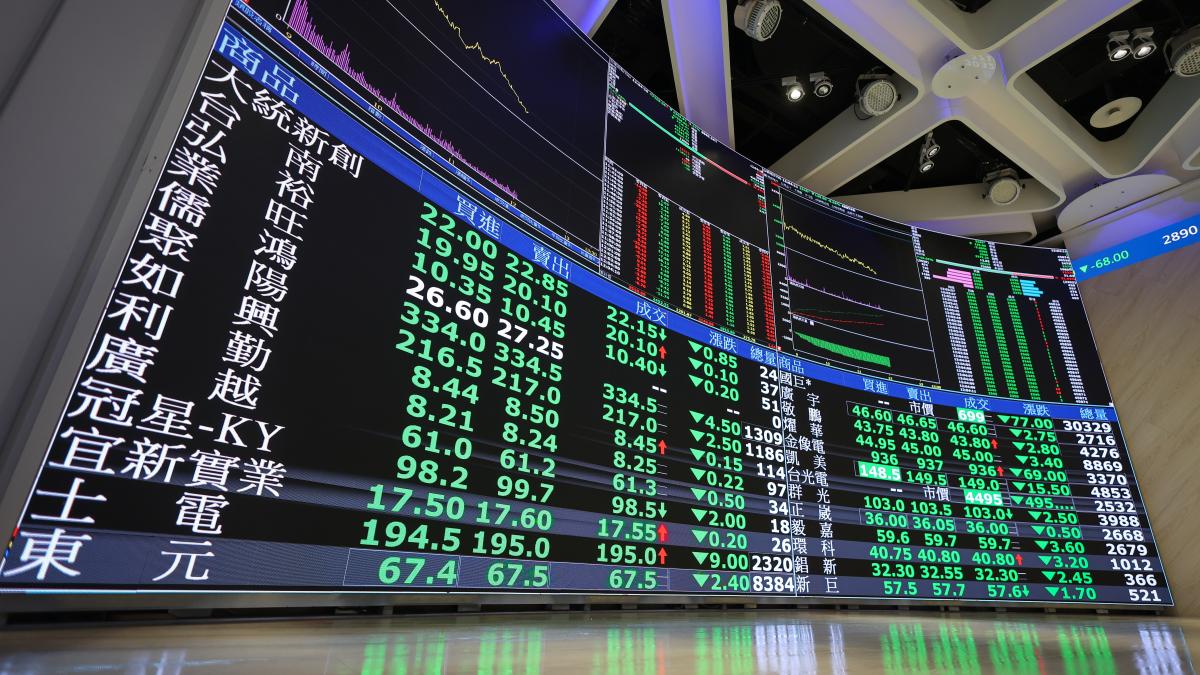
Taiwan's stock market has shown weak performance recently, with a historic single-day plunge on July 17—dubbed 'Black Friday'—shaking investor confidence and affecting the latest consumer sentiment survey. On July 27, the Taiwan Economic Development Research Center at Chung Yuan Christian University released the July Consumer Confidence Index (CCI), which dropped to 64.58 points, a 0.47-point decline from June, ending a streak of monthly gains. All six sub-indicators declined, with 'investment in stocks over the next six months' showing the sharpest drop.
According to the latest survey, the six sub-indicators—price levels, household financial conditions, domestic economic outlook, employment opportunities, stock investment timing, and durable goods purchases—all weakened. The 'investment in stocks over the next six months' indicator fell to 28.08 points, down 1.82 points from the previous month—the largest decline among all indicators.
Wu Ta-jen, Executive Director of the Center for Taiwan Economic Research at Chung Yuan Christian University, analyzed that the survey period (July 18–21) immediately followed the historic stock market plunge on July 17. Market sentiment deteriorated sharply, significantly damaging investor confidence in stocks, which in turn affected other indicators such as household finances and domestic economic outlook—highlighting the strong correlation between consumer confidence and stock market performance.
Wu pointed out that Taiwan has entered an era of 'nationwide stock trading,' where many citizens gauge economic conditions through stock market fluctuations. Even if macroeconomic indicators like exports remain stable, sharp corrections in the stock market can easily shake consumer confidence.
He noted that Taiwan's recent economic growth has largely been driven by the AI industry, but the benefits remain concentrated in the electronics and ICT sectors, with limited spillover to traditional industries and services. As a result, rising stock prices can boost consumer confidence, but when the market corrects—especially without solid economic fundamentals—consumer sentiment quickly weakens.
Wu also warned that the stock market rally this year has pushed day-trading volume to over 40% of total trading, increasing speculative behavior among retail investors. This could amplify market volatility and negatively impact young people's work ethics. If individuals perceive stock gains as far exceeding salary income, labor motivation may decline, and more may choose to become full-time investors—potentially undermining social values and equity.
On the real estate front, the 'timing of real estate purchases' index, jointly compiled by Chung Yuan Christian University and Taiwan House, stood at 90.13 in July, down 0.22 points from June but still above 90. The 'purchasing durable goods in the next six months' index was 93.43, down 0.12 points.
Wu noted that housing market activity showed signs of recovery in June. Besides some buyers rushing to take advantage of the final phase of the New Qingan policy, market volatility may have triggered a 'shift from stocks to real estate.' Many individuals had allocated home down payments to the stock market for higher returns, but with increased volatility, funds may now be flowing back into real estate. Meanwhile, the new Qingan 3.0 policy has caused some owner-occupiers to delay their purchase decisions.
Looking ahead, Wu believes that rising skepticism about AI investment returns, coupled with persistent U.S. inflation, could lead to further financial market volatility—especially if the Federal Reserve proceeds with balance sheet reduction. This could impact consumer confidence and capital allocation.
In absolute terms, all six sub-indicators remain below 100, indicating an overall pessimistic sentiment. However, excluding the highly volatile 'stock investment timing' indicator, the CCI has remained relatively stable around 65 points over the past year, with only minor fluctuations.
FACT BOX
- Source: PR Times
- Category: Survey