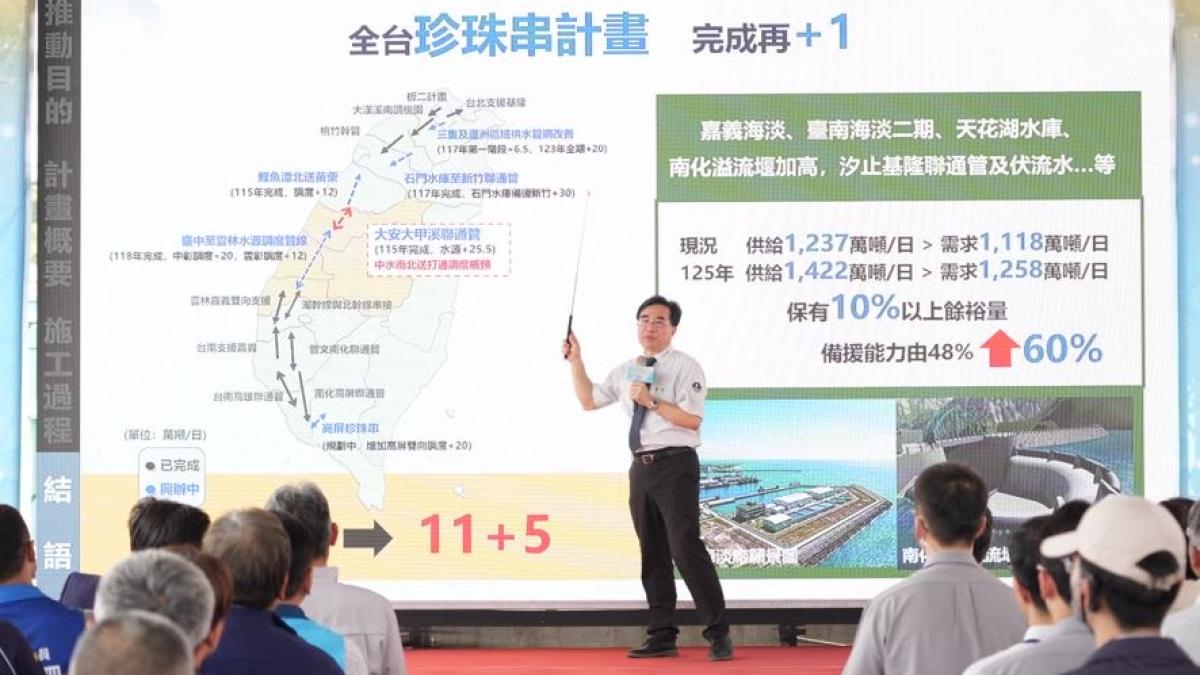
The 'Da'an-Dajia River Interconnection Pipeline Project,' connecting the Da'an and Dajia rivers, has finally held its water delivery inauguration ceremony after 18 years of twists and turns. Now serving as Taichung's most critical water supply hub, this project faced multiple threats of cancellation, with its journey resembling a difficult mountain trek. The deadlock was ultimately broken by Lai Chien-hsin, Deputy Minister of the Ministry of Economic Affairs, who chose to prioritize public sentiment over engineering expertise, demonstrating a model of how public infrastructure can harmonize with society.
Lai once stated: 'We didn’t abandon this project after more than a decade because we believed it was necessary. Without building new reservoirs, integrated water resource management and cross-regional support are vital options. Only by finding a solution that is environmentally sound, socially acceptable, and technically feasible can we achieve a successful outcome.'
The pipeline route crosses multiple fault lines, drawing criticism for 'disturbing the ground where the God of Age resides.' The Dajia and Da'an rivers are Taichung’s two lifelines for water supply, with the township of Houli situated between them. Taichung consumes 1.6 million tons of water daily—60% sourced from the Dajia River via the Shigang Dam, delivered to Fengyuan Water Treatment Plant, and 40% from the Da'an River via the Shilin Weir, routed through the Liyutan Reservoir before reaching treatment plants. Each system previously operated independently.
The 1999 movement of the Chelungpu Fault triggered the 921 earthquake, severely damaging the Shigang Dam. Upstream catchment areas of the Dajia River suffered landslides and severe riverbed siltation. Heavy rains frequently increased turbidity, making water extraction difficult. The Water Resources Agency then considered whether the cleaner Da'an River could support the Dajia River, giving rise to the interconnection concept. This would not only allow mutual support between the two rivers but also increase water supply by 250,000 tons.
Two initial water transmission routes were proposed. The first, the 'Dajia River Water Conduit,' planned a new intake on the right bank of the Shigang Dam, with a tunnel crossing Houli Hills westward into Houli township. However, this intake would be near the surface rupture of the Chelungpu Fault, and the tunnel would pass through the Dingpu, Pitou Mountain, and Sanyi faults.
The second route, the 'Liyutan Reservoir Second Raw Water Pipeline,' would draw water from the reservoir and tunnel through Zhentoushan in Sanyi Township. This route also approached the Zhentoushan and Tunzijiao faults. Excavating through such a seismically active region—especially so soon after the 921 earthquake—drew criticism for 'disturbing the God of Age.'
Despite this, the Water Resources Agency insisted the engineering was sound, and the initial environmental assessment passed quickly. However, before final approval, the 2009 Typhoon Morakot (88 Flood) disaster, which destroyed Xiaolin Village, prompted a re-evaluation of fault risks. The environmental review committee approved the project in 2010, but Houli farmers filed a lawsuit challenging the assessment’s validity. In 2013, the court annulled the approval, sending it to a second-stage review.
That same year, another event occurred: the Houb-Er Water Treatment Plant, developed by Taiwan Water Corporation, was rejected in environmental review due to the Sanyi active fault crossing its site. Review chair You Fan-chieh argued that while the company claimed to avoid the fault line, it failed to clarify the extent of the fault’s fractured zone. Risks such as plant rupture and catastrophic flooding in Houli during an earthquake were not adequately addressed, making it impossible to justify the site.
Feng Yong-huai, Houli’s Gongguan Village chief, emphasized that the plant was located southeast of Houli Station—directly above the township—so any rupture could cause massive flooding, endangering lives and property.
Prioritizing Public Interest Over Engineering Efficiency to Gain Community Support
Despite these controversies, the Water Resources Agency did not deeply reconsider its plans. In June 2014, during a second-stage environmental review meeting in Houli, the same proposal was presented, sparking protests: 'We already opposed this—why hold another meeting? The Houb-Er plant was rejected, and you still don’t know where to store the water.'
The project was then suspended until November 2016, when Lai Chien-hsin became Director-General of the Water Resources Agency, marking a turning point. Three months later, the agency revised the plan: the 'Dajia River Water Conduit' tunnel was canceled. Instead, water would be drawn from the left bank of the Shigang Dam and transported via a dedicated pipeline along the Dajia River’s left bank to the Houb-Yi Water Treatment Plant.
From an engineering standpoint, the shortest path between two points is a straight line—the original tunnel route. The revised route is longer and less efficient. However, Lai explained: 'People fear landslides from tunneling. We can’t simply dismiss concerns with the word “professional.” The most important thing is to make people feel safe.'
Another efficiency-defying decision involved the pipeline’s proximity to the Dongfeng Bike Path and Houfeng Iron Horse Trail. Construction would have destroyed these scenic spots. After an on-site inspection, Lai and his team decided to use shield tunneling—a rare method in water engineering. Naturally, this method is more complex and expensive.
The 'Liyutan Reservoir Second Raw Water Pipeline' retained its original route but adopted improved techniques. Director-General Lin Yuan-peng stated Taiwan’s water engineering used 'SPF flexible seismic-resistant steel pipes' for the first time. 'Nearly all of Taiwan’s strongest water construction companies participated across six bidding packages involving over 20 firms,' he said.
Ensuring Agricultural Water Supply for a Win-Win Outcome
Another major opposition stemmed from agricultural water rights. When the Central Taiwan Science Park Phase III expanded into Houli, promises were made to protect agricultural water, but in reality, more water was diverted, leaving farmers feeling betrayed. Thus, they were highly sensitive to the interconnection project. During environmental review, Houli farmer Liao Ming-tien demanded a dedicated pipeline to ensure sufficient water for the Neipu and Houli irrigation canals, but his plea was ignored. He lamented, 'The government shouldn’t treat farmers’ voices like barking dogs.'
The interconnection project finally passed environmental review in June 2021, with clear commitments to agricultural water: up to 600,000 tons daily to the Houli Canal and 200,000 tons to the Neipu Canal, depending on surplus water from the Dajia River. The final design included new discharge outlets mid-route for both canals, delivering water directly to irrigation zones.
Public infrastructure projects aim to improve people’s lives, but an engineering-first mindset can harm public interests. The Da'an-Dajia River Water Project leaves a powerful lesson: public works must integrate with public sentiment to succeed.
FACT BOX
- Source: PR Times
- Category: Event