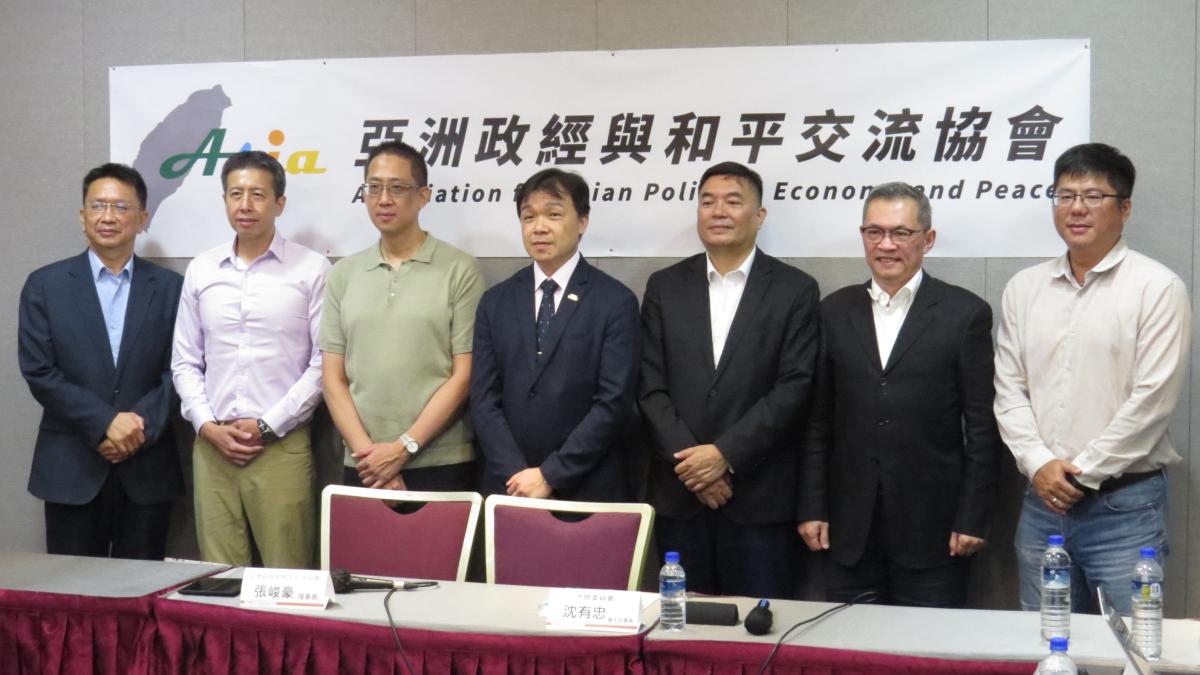
Mainland Affairs Council (MAC) Vice Chairperson Shen Youzhong stated on July 27 that China has continuously increased its hybrid pressure on Taiwan over the past six months, intensifying its efforts with increasingly intrusive methods to achieve the political objectives of 'governing before unification' and 'unification without formal unification.' These regional expansionist actions also threaten the entire First Island Chain, including the Senkaku and Ren'ai reefs, where tensions are even higher than in the Taiwan Strait.
Regarding gray-zone maritime conflicts, Shen noted that China has deployed government vessels and research ships in Taiwan's eastern waters under the guise of law enforcement. Such actions, which have never occurred before, clearly alter the status quo. These vessels harass passing ships by demanding inspections, using the opportunity to promote the 'One China Principle' and claiming Taiwan's eastern waters as their own. Through routine patrols and near-sea governance, China is effectively expanding its jurisdiction, blurring maritime boundaries, undermining the status quo in the Taiwan Strait, and threatening regional stability.
On diplomatic suppression and blockade, Shen highlighted that China has recently intensified its efforts. For example, Papua New Guinea’s foreign minister recently announced on social media the closure of Taiwan’s representative office—a matter still under negotiation. As a cabinet system country, policy should not be decided by one individual, and Taiwan will continue monitoring developments. Additionally, China has demanded Taiwan’s representative office in South Africa relocate from the capital. In April, three neighboring countries blocked Taiwan’s flight applications as President Lai Qingde prepared to visit the allied nation of Eswatini—actions unprecedented in the past.
According to national security intelligence, China has attempted similar actions in other democratic nations, but only succeeded in Global South countries, particularly in Africa, where it seeks to eliminate the Republic of China’s presence.
Taiwan is closely monitoring whether its rights and interests will be affected at the APEC summit to be held in Shenzhen later this year.
On legal warfare, Shen pointed out that China implemented the 'Law on Promoting National Unity and Progress' on July 1. Many countries have publicly expressed concern, unanimously urging China not to use this law to persecute ethnic minorities or alter cross-strait relations. Currently, China is soliciting public opinions on the 'Internet Information Services Management Measures,' a regulation targeting online speech, with the consultation period ending in August. This is essentially an online version of the 'National Unity Law,' aiming to enforce ideological conformity. Divergent opinions may be subject to criminal penalties under the Criminal Code. Both laws contain elements of coercive suppression.
China is expected to intensify its 'unification promotion' efforts in the second half of the year, including commemorating Sun Yat-sen in November and possibly inviting specific political parties to related events. Additionally, Xiamen Xiang’an Airport has officially opened, featuring a dedicated terminal and air corridor for Taiwanese travelers. The public must remain cognizant of such united front tactics.
Shen emphasized that the MAC does not block or oppose exchanges. However, for high-risk exchange activities that could compromise national sovereignty and democratic freedoms, the government has a duty to conduct risk management. National sovereignty and democratic freedoms remain a societal consensus that transcends party lines. Cross-strait exchanges must not sacrifice sovereignty—this is Taiwan’s unwavering stance.
'Just because we eat Chinese food and celebrate Chinese festivals doesn’t mean we must be one country. The Middle East isn’t one country, nor are the U.S. and the U.K. The real difference between the two sides lies in systems—democracy and authoritarianism are difficult to reconcile. The fact is, we are not subordinate to each other.' Shen called on China to abandon military intimidation, cease infiltration and sabotage of Taiwan’s democratic governance, stop setting preconditions for eliminating the Republic of China, refrain from engaging only with specific political parties, and instead dialogue with Taiwan’s democratically elected government to maintain the peaceful and stable status quo.
FACT BOX
- Source: PR Times
- Category: News