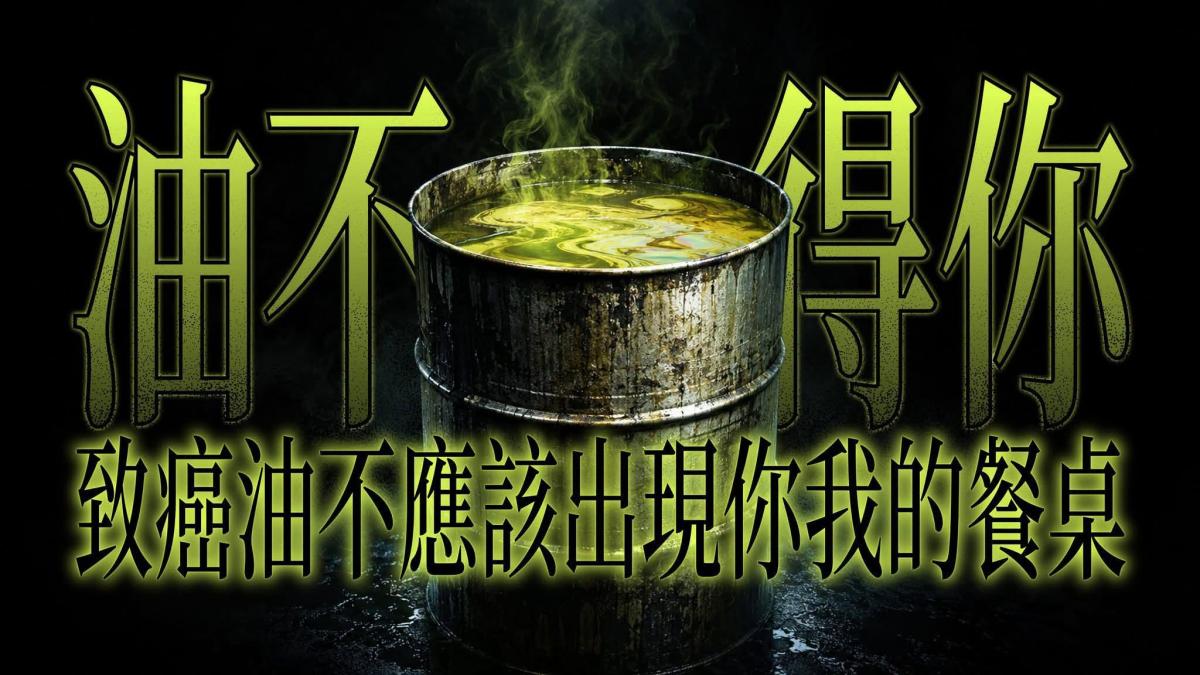
The DPP-led Lai administration has yet to resolve the carcinogenic oil incident, but has instead ignited a controversy over document forgery and freedom of speech by targeting a web video explaining the oil’s carcinogenic component, 'benzopyrene.' Over the past decade under DPP rule, freedom of speech has regressed to the authoritarian era of the KMT—or even worse—though this is no longer news. 'Checking the water meter' (a euphemism for suppressing speech) is occasionally heard, but this time the Criminal Investigation Bureau’s involvement has been unusually forceful, drawing mockery as 'white gang intimidation.' The damage to the 'elite police' image may be greater than that suffered by the individuals allegedly intimidated.
Unable to solve the carcinogenic oil problem, are they now targeting those who speak up?
The short video titled 'Oil Cannot You' runs for one minute and twenty-eight seconds, created in response to the KMT’s 'July 25 Anti-Toxic Oil' campaign. Aside from the event details at the end, the video is an expression of anger over the Zhonglian carcinogenic oil incident. The 'protagonist' of the video is an oil named 'benzopyrene,' narrating its carcinogenic components and distribution. Except for a brief three-second clip of DPP spokesperson Wu Cheng saying, 'I didn’t force you to eat it,' the video shows almost no partisan color. If the KMT were in power today—as during the 2013 Ting Hsin oil scandal—this video could easily have been a propaganda piece produced by the DPP.
Beyond the video, the creators referenced the Dafat and Ting Hsin oil scandals from over a decade ago, emphasizing that 'this isn’t about political stance—it’s everyone’s pot.' Every police officer’s household in Taiwan likely has at least one, if not multiple, pots containing problematic oil. Worse, police officers often eat out due to heavy workloads, increasing their exposure risk. The problem with the Criminal Investigation Bureau isn’t that they failed to share public outrage, but that they lacked the ability to 'discern' the boundary between document forgery and freedom of speech.
Why is this particularly important?
Criminal Investigation Bureau officers are not rookie patrolmen. According to the bureau’s organizational regulations, detectives handle 'major cases,' including organized crime, economic crime, serious criminal incidents (arson, murder, kidnapping, sexual assault), and cross-border cases involving mainland China, Hong Kong, Macau, and international jurisdictions. The only vaguely 'less serious' duty listed—Article 2, Clause 8—is 'consultation, deployment, collection, transmission, and application of social security intelligence, and notification, control, command, coordination, and liaison regarding criminal and security conditions.' This sounds ambiguous, as if even traffic police duties could fall under it. In reality, this clause is more likely used for 'surveillance' and 'containment,' such as tracking and arresting individuals on 'blacklists' in the past.
Personally visiting a Facebook page administrator for questioning normally falls under local precinct jurisdiction under the Social Order Maintenance Act—not the responsibility of Criminal Investigation Bureau officers.
Why did the Criminal Investigation Bureau get involved?
Professionally, the only plausible explanation is 'forensic services' like 'voiceprint comparison,' which fall under the jurisdiction of both the Investigation Bureau and the Criminal Investigation Bureau. Typically, the Investigation Bureau conducts forensic analysis upon request from prosecutors or judges, while the Criminal Investigation Bureau does so in response to ongoing investigations. The 'Oil Cannot You' video contains no factual inaccuracies and isn’t more aggressive than recent criticisms by opposition politicians. The only potentially controversial aspect is that the voice of 'benzopyrene' sounds uncannily like 'Principal Lai Er,' the well-known satirist. Indeed, the creators are from Principal Lai Er’s team. What the DPP should lament isn’t why the voice was 'deepfaked,' but why, after ten years in power, their ability to produce political satire has regressed below that of a Facebook page manager.
Has the Criminal Investigation Bureau taken over precinct duties, adding 'water meter checks' to its portfolio?
The non-professional explanation is 'orders from above.' Though the Criminal Investigation Bureau claims it 'received a public tip,' if it were truly a 'civilian' report, the case should have gone to the local precinct. Why did it escalate directly to the Criminal Investigation Bureau? To expedite 'voiceprint comparison' and confirm whether the voice was deepfaked. The bureau delivered, confirming within 48 hours that the voice was indeed AI-generated. But which 'superior' has the authority to directly command the Criminal Investigation Bureau? The president? The presidential office secretary-general? The premier? The interior minister? Or the DPP secretary-general, a former interior minister? Or did the National Police Agency director, trying to be clever, simply dump precinct-level work onto the Criminal Investigation Bureau?
Anyone who has seen the video would know, without needing voiceprint analysis, that it’s deepfaked. First, AI is now so 'ubiquitous' that deepfakes are nothing new. Second, the video’s 'protagonist' introduces itself as 'benzopyrene'—no matter how similar the voice, it’s not Principal Lai Er, let alone the president. Third, the video clearly states: 'This video’s voice and some visuals were created using AI. Please do not associate it with real individuals.' Fourth, a 90-second video discussing 'livelihood issues' and criticizing 'government response' clearly falls under 'freedom of speech.' Fifth, although local elections are four months away, the video mentions no party or candidate and shows no intent to prevent anyone from being elected.
Unsurprisingly, the Criminal Investigation Bureau 'suggested' the creators 'self-assess' whether to take down the video. The creators refused and instead released a new game, 'Oil Lai Oil Qu,' a 'water meter check' video game where players guess which voice is 'benzopyrene' and which is Principal Lai Er.
Not forcing removal but suggesting self-evaluation reflects the Criminal Investigation Bureau’s remaining 'political and legal clarity' when handling the case. Still, they referred the case to the prosecutor’s office. Guilt or innocence, and the specific charge, will be determined by whether prosecutors decide to indict, followed by a court ruling. In short, the Criminal Investigation Bureau investigates criminal offenses, not political commentary.
Deepfakes ≠ Crime, but Not Always 'Free Speech'
Are all deepfake videos protected as 'free speech'? Of course not. The key is whether there’s concrete suspicion of 'crime' or infringement of others’ rights. Discussing and criticizing public policy and government actions is clearly not 'criminal.' AI-synthesized voices alone do not constitute a crime—it’s the 'purpose' that matters. For example, using deepfakes of someone’s parents or children to commit fraud or extortion is clearly criminal. But using deepfakes in parody or satire for political commentary generally falls under constitutionally protected free speech. However, deepfaking major political leaders or government spokespeople in ways that could disrupt public order or election fairness is a different matter.
In fact, politicians from both ruling and opposition parties have been deepfaked before. The DPP condemns 'deepfake videos as illegal, not free speech,' citing examples like Ko Wen-je’s manipulated audio during the 2023 presidential election and former Taipei mayor Hao Long-bin and councilor Liu Cai-wei’s altered images during the 2025 KMT chairmanship election. Ironically, these examples highlight the difference between green (DPP) and blue (KMT)/white (TPP). In both Ko and Hao’s cases, the victims reported during election periods, the content involved disinformation, and the IPs were overseas—after which nothing further happened. In contrast, 'Oil Cannot You' has an unknown informant, contains only factual content, occurred outside election season, involved direct visits by the Criminal Investigation Bureau, and was referred to prosecutors—precisely confirming differential treatment between blue/white and green, where even the 'water meters' are different.
This case doesn’t even meet the threshold for 'defamation,' let alone 'document forgery'—unless Principal Lai Er himself sues, claiming that opposing carcinogenic oil damaged his reputation.
Still, one point is worth discussing: even if the content involves no crime and is merely public discourse, if Principal Lai Er genuinely finds it unbearable that his voice was deepfaked, can he claim protection of personality rights or voiceprint rights? This is absolutely worth pursuing in civil court and could set a precedent. But it requires the 'offended party' to file a lawsuit. Moreover, such claims should apply equally to everyone—not as the DPP claims, 'impersonating the head of state must be investigated,' while impersonating others is ignored. In a rule-of-law society, everyone is equal before the law. Personality rights, voiceprint rights, and personal reputation should not differ by position, rank, or wealth.
FACT BOX
- Source: PR Times
- Category: News