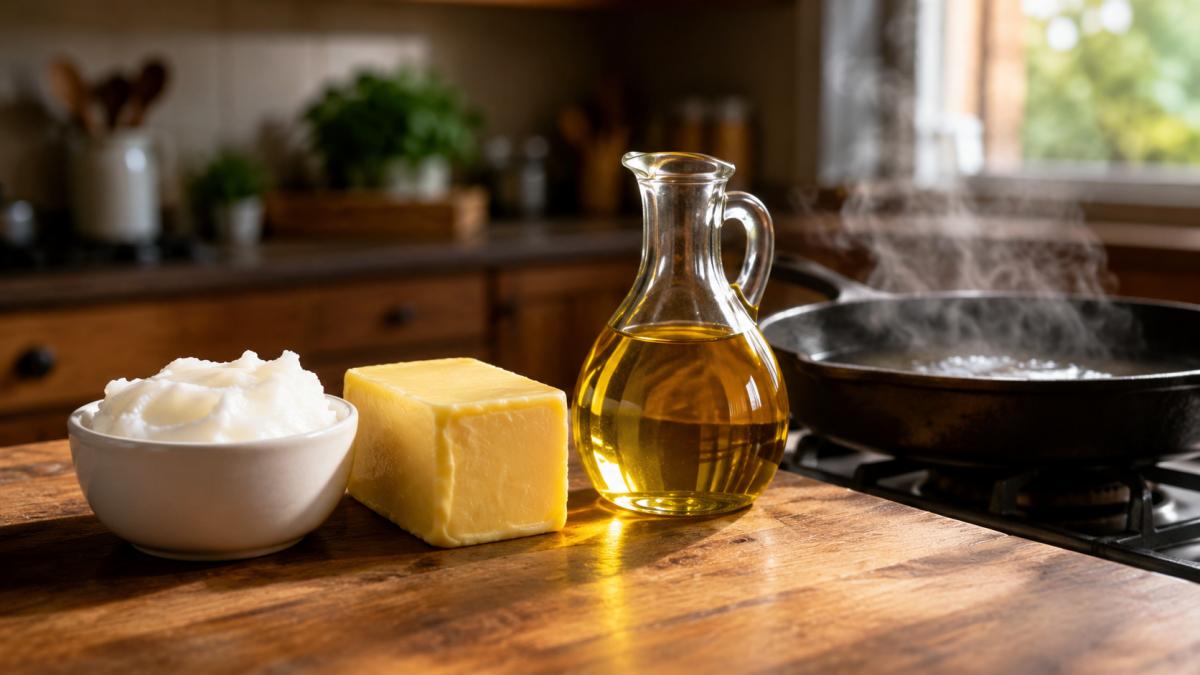
Edible oils rich in saturated fats—such as lard, tallow, and butter—have long been blamed for cardiovascular diseases. However, Dr. Tseng Chien-Yuan, known as the 'Sherlock Holmes of Medicine,' argues in his book 'Precision Nutrition' that saturated fats, which humans have relied on for thousands of years, are actually highly stable and play a crucial role in bodily functions. In recent years, the scientific community has begun revising its negative stance on saturated fats, with even U.S. fast-food chains announcing a return to using beef tallow for frying French fries.
Which oil is best for high-temperature cooking? Saturated fats are structurally stable and resistant to degradation
The stability of oils depends on the number of 'double bonds' in their chemical structure. Dr. Tseng explains that double bonds are the primary cause of oil oxidation, leading to off-flavors and reduced nutritional value. Plant and fish oils contain multiple double bonds and are the least stable; olive oil has one double bond and moderate stability; saturated fats have no double bonds and are the most structurally stable.
When plant oils are subjected to prolonged high-heat cooking or industrial processing, their double bonds can be damaged by oxygen or heat, producing harmful byproducts. In some cases, they may even transform into trans fats, which are proven to harm cardiovascular health. In contrast, saturated fats like coconut oil, ghee, and butter lack double bonds and undergo minimal degradation when heated, making them safer than some plant oils under high-temperature cooking conditions.
Does eating fatty food cause heart disease? A natural experiment provides an unexpected answer
Many indigenous tribes consume diets extremely high in saturated fats. For example, the Inuit in northern North America derive up to 75% of their calories from saturated fats, the Maasai in Africa 66%, the Rendille in Kenya 63%, and the Tokelauans in the South Pacific 60%.
In 1966, a hurricane forced the Tokelauans to migrate to New Zealand, enabling a long-term migration study. The results showed that the migrants reduced their saturated fat intake and increased carbohydrates and sugar. However, compared to those who remained on the islands, the migrants had higher serum total cholesterol, LDL (bad) cholesterol, and triglyceride levels, and lower HDL (good) cholesterol—indicating an increased risk of cardiovascular disease.
What roles do saturated fats play in the human body? Essential for heart function and cell membranes
Saturated fats serve multiple vital functions. Dr. Tseng notes that during rest or sleep, 60–70% of the heart’s energy comes from fatty acid oxidation, with a preference for long-chain fatty acids like palmitic and stearic acid. Additionally, pulmonary surfactant—the substance that prevents alveolar collapse in the lungs—has a core structure composed of two saturated fatty acid chains.
In cellular structure and immunity, saturated fats make up one-third to one-half of human cell membranes, enhancing membrane stability and integrity. Certain saturated fats, such as lauric acid, possess natural antimicrobial properties, disrupting bacterial membranes and inhibiting fungal growth, thereby reducing infection risk. Odd-chain saturated fatty acids found in dairy products have been shown to have anti-inflammatory effects.
As scientific perspectives evolve, saturated fats have been proven to increase HDL (good) cholesterol levels. In early 2025, Steak 'n Shake, a U.S. fast-food chain with 436 locations, announced it would resume using beef tallow for frying French fries, stating that customers 'deserve the best product.'
Author Introduction | Dr. Tseng Chien-Yuan Current: Director, Yuandding Clinic Standing Supervisor, Taiwan Society of Molecular Medicine Editor-in-Chief, 'Biomedical' Journal
This article is adapted with permission from Commonwealth Publishing's 'Precision Nutrition: A DNA Doctor’s Guide to Understanding Your Body and Finding the Right Way to Eat' (Original title: 'Is Eating Less Lard and Butter Healthier? A Hurricane Accidentally Debunked a Dietary Myth').
FACT BOX
- Source: PR Times
- Category: Survey
- Organizations: Steak 'n Shake