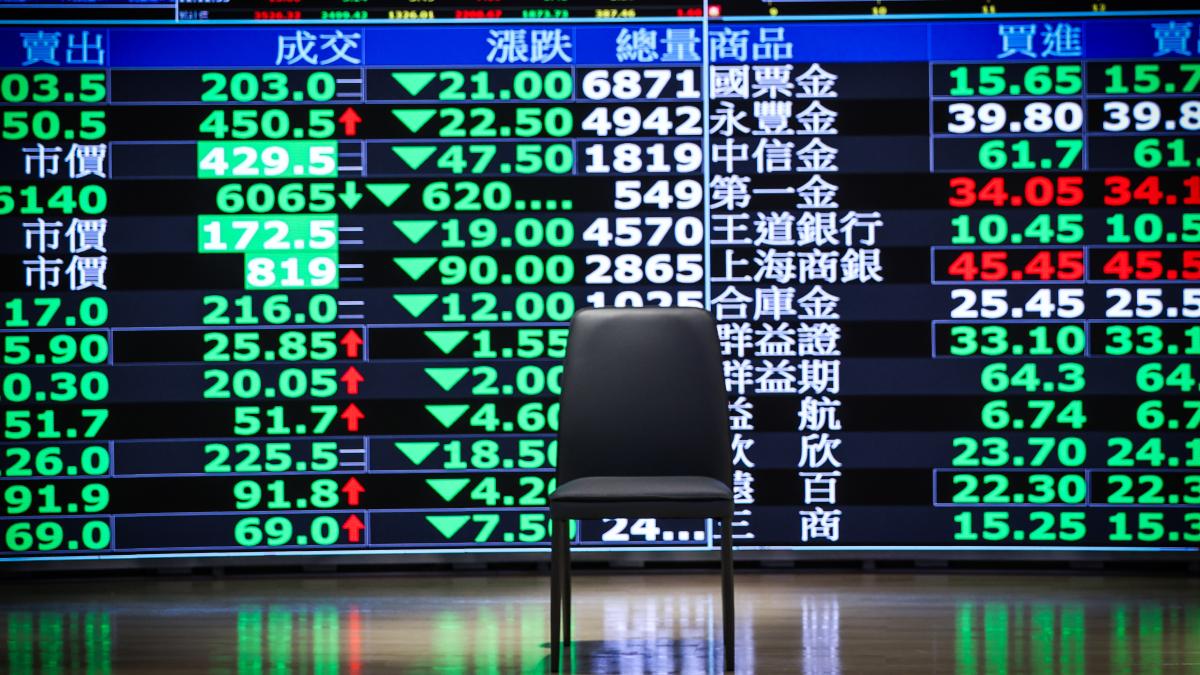
On the 28th, the Taiwan stock market experienced panic selling amid a global semiconductor stock slump and broad declines across Asian markets. The market closed at 41,603.36 points, down 2,030.83 points—the third-largest daily drop in history. With the Taiwan market in a prolonged downtrend, many investors' stock portfolios have significantly shrunk.
Financial expert Yeh Yu-shuo pointed out on Facebook a strange phenomenon: although the overall market correction has not yet reached 20%, many individual stocks have already plunged 30%, 40%, or even over 50%. The root cause, he says, lies in one critical error.
Major institutional investors withdrew a net NT$116.9 billion. Semiconductor and memory stocks were hit hardest.
The Taiwan market plunged over 2,000 points today, with semiconductor supply chain stocks leading the sell-off. TSMC closed at NT$2,280, down NT$70 (2.98%), breaking below its quarterly moving average of around NT$2,347. MediaTek hit the daily trading limit at NT$3,315, Delta Electronics fell to the limit at NT$1,580, and Hon Hai dropped 5.93% to close at NT$238.
Memory stocks were among the worst hit. Influenced by pullbacks in global memory giants, the 'Big Four' memory stocks—Winbond, Nanya Technology, Macronix, and PSMC—all hit the daily trading limit, closing at NT$144, NT$392.5, NT$113, and NT$55.8, respectively.
Yeh noted that today's 2,030-point plunge—dubbed the 'July ghost story'—marks the third-largest single-day drop in Taiwan stock history. Trading volume reached approximately NT$866.8 billion, with institutional investors collectively selling NT$116.9 billion. Foreign investors sold NT$87.5 billion, and proprietary traders sold NT$31.7 billion.
More notably, foreign investors increased their net short positions in Taiwan stock index futures by 3,556 contracts to 82,255, indicating high hedging activity. Meanwhile, retail investors remained on the opposite side, increasing their net long positions by 28,208 contracts to 72,351. The VIX index surged from 37.25 to 40.38, signaling rapidly rising market fear.
Why Has Your Portfolio Halved When the Market Hasn’t? Experts Reveal the Truth Behind the 'Perceived Market Crash'
Yeh emphasized that the most critical issue today isn’t the 2,030-point drop, but the strange observation that many investors have seen their stocks fall 30–50% despite the broader market correction being under 20%. Many AI-related, thematic, and small-to-mid-cap stocks have already halved in value—some even worse than during last year’s market crash.
In other words, while the index appears to be merely correcting, many investors’ portfolios have already experienced a full-blown crash.
Yeh explained that the weighted index is dominated by large-cap stocks. As long as TSMC, financials, and other heavyweights remain relatively stable, the index can be propped up. However, small and mid-cap stocks lack this cushion. Once capital exits and supply-demand imbalances emerge, their declines often far exceed the broader market.
Therefore, investors must not focus solely on index movements but critically assess their own portfolio composition. Over-concentration in a single sector, lack of diversification, hedging, and risk management can cause even the most promising stocks to erase all accumulated gains in a short reversal.
More exclusive Wind Media insights: • What caused the 2,000-point plunge in Taiwan stocks? Experts reveal a key trigger behind market panic: 'shooting at shadows' • Will Taiwan stocks keep falling? Juan Mu-hua forecasts six key events next week: these two days are market exam days • Can’t handle the rollercoaster Taiwan market? Juan Mu-hua recommends a 3-ETF combo to survive winter and capture gains
FACT BOX
- Source: PR Times
- Category: News