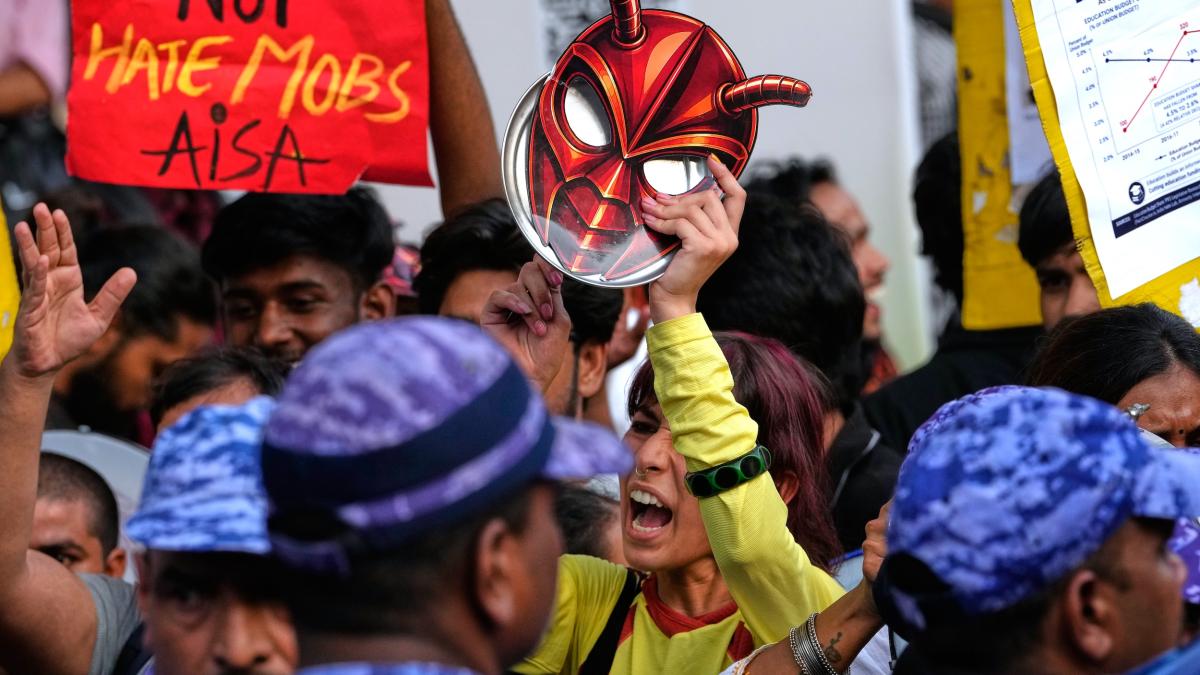
During Narendra Modi's 12 years in power in India, only one cabinet minister had previously resigned, and the reason was allegations of inappropriate sexual conduct. Therefore, the resignation of Education Minister Dharmendra Pradhan after more than a week of intense street protests on the previous Saturday (July 25) became a symbolic moment. Many young people celebrated this as a rare victory. As 22-year-old student activist Sakhi from Delhi said, 'This is the first time I felt that we could bring about change through protest.' Shortly after Pradhan's resignation, a old video of a senior minister in the Modi government resurfaced on social media. In the clip, he boasts, 'Our government will not have anyone resign,' and the video also reflects the confidence of the national youth movement demanding his resignation. Sakhi said that the textbooks she read as a child all emphasized the importance of dissent in a democratic system, 'But in the years Modi has been in power, I have not seen this.' On Instagram, Sakhi posted photos and videos of police violence and the arrest of demonstrators, and also uploaded a short film mocking the police officer standing next to him. Many of the contents have been viewed millions of times. Sakhi said that the government has not understood the momentum of the movement because it cannot grasp the language and platform used by the protesters. 'The government controls mainstream media, Facebook, and WhatsApp, but it missed Instagram.' The latest wave of educational protests erupted in May. At that time, India's largest medical college entrance examination (National Eligibility cum Entrance Test, Undergraduate, NEET-UG) was canceled due to a question paper leak, forcing nearly 2 million students to retake the exam. More than 20 students committed suicide, and their families blamed the tragedy on the scandal. This anger was guided by the satirical organization 'Cockroach Janta Party' (CJP). The online movement was launched after India's Chief Justice compared unemployed people holding 'false and forged degrees' to cockroaches. Its founder launched a sit-in protest in Delhi, demanding Pradhan's resignation, educational reforms, and compensation to the families of the deceased. Initially, the protest did not receive much attention. The situation changed on July 18 when Delhi police forcibly took away Sonam Wangchuk, an education worker who was on a hunger strike, and sent him to the hospital for treatment. Two days later, tens of thousands of citizens responded to CJP's call to march towards the Parliament, triggering police suppression. Videos of baton charges, tear gas, and shotgun blasts spread quickly online, not only failing to suppress the protests but also sparking greater public outrage and swelling the scale of the demonstrations. View this post on Instagram A BBC News Chinese (@bbcchinese) shared post The dissatisfaction in the hearts of young Indians, and the courage to speak out on the streets, has also spread to other regions of the country. Somaya Korde was detained at home for calling on people online to participate in the protest held in Mumbai on July 20, but in the following days she still participated in multiple demonstrations. The 26-year-old woman said that Pradhan's resignation 'is not the end, but only the beginning.' She said, 'For this generation, this is the first time many have taken to the streets to protest. But there are bigger issues that need to be discussed, and we will discuss those issues.' Korde is the first woman in her family to obtain a law degree and recently also ran for local civic elections. She comes from a community that is officially classified as a 'backward class' due to historical social and economic disadvantages. Like many young Indians, she once saw education as a means to improve her life, but she said that the NEET question paper leak incident destroyed her trust in the system, which had promised that hard work would be rewarded. She said, 'Schools and universities are being privatized, question papers are constantly leaking, and even after completing one's studies, there are not enough job opportunities. In a democratic system, all of this raises questions about government accountability.' Her sense of frustration reflects a broader reality. India has the world's largest young population, but according to government data, the unemployment rate for those aged 15 to 29 has risen from 13.8% a year ago to 16.2% in June. Even university graduates face difficulties. A study by Azim Premji University in 2026 found that fewer than 7% of job seekers secured fixed-paying jobs within a year, and fewer than 4% secured white-collar jobs. Protest activities have become a rallying point for young people to set aside their concerns and express their dissatisfaction. Among them is 18-year-old Harshvardhan Kadam. Due to his father's death last year, he has been working part-time selling laptops after graduating from middle school to help his mother maintain the household. A video Harshvardhan shot during a protest march in Mumbai on July 23 went viral online. In this Instagram short clip, which now has 10 million views, a police officer is caught on camera threatening to fabricate a drug case to frame him while detaining him in a police car. The officer involved was later suspended. Kadam told BBC, 'I did not want him to be suspended. I just wanted to record how the police treated me for participating in a peaceful protest.' When talking about Pradhan's resignation, he said, 'This is just the beginning. It shows that the government will be afraid the next time we speak out.' Swaraj Priyo, a 29-year-old screenwriter from Guwahati, said that over the years of protesting under Modi's government and seeing no change, he had felt his hope fade. But he said this movement has brought back a new dawn: 'This movement has brought back the space for questioning and dissent, and reminded people that everything is not over yet.' More and more people feel that the Modi government is on the defensive. Posters reading 'Pradhan is just an example. Next is Modi's turn' now appear at protest sites across the country. But behind this confidence, there are some concerns. Varuni Poorva, 30, from Patna, who aspires to be a university professor, has been involved in student movements for nearly ten years. She said that Pradhan's resignation shows that the Modi government can be 'forced to surrender.' But she expressed concerns that, although the government has promised not to take action against organizations or participants in the protests, demonstrators may still face 'political persecution.' Over the past week, she has applied for anticipatory bail in case of possible arrest. The police have charged over 100 demonstrators with offenses including attempted murder and arrested more than 40 people. Human Rights Watch pointed out that during Modi's tenure, Indian authorities 'often use fabricated anti-terror and hate speech laws to prosecute activists, journalists, and peaceful demonstrators.' Although many student parents share her concerns about the government possibly intensifying crackdowns, Poorva believes that the protest has given young people new confidence. She said that, as their deeper dissatisfaction remains unresolved, it will be difficult for the government to return to a state of 'business as usual.' At one protest site in Delhi, a graffiti perfectly reflects the current atmosphere. 'We have no jobs. If you erase these, we will come back tomorrow.'
FACT BOX
- Source: PR Times
- Category: 其他