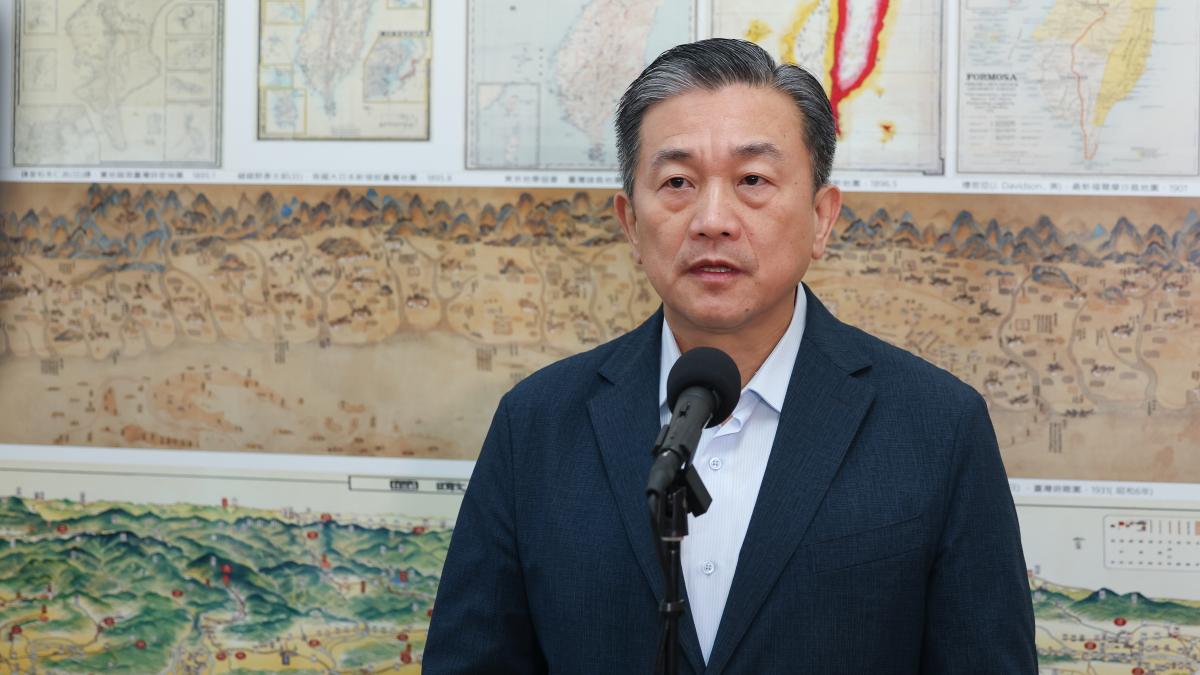
On July 19, 2026, the DPP's 22nd First National Congress concluded. The most notable event was not that the pro-Lai faction secured 7 out of 10 seats in the Central Standing Committee, but that Wang Dingyu, who had long served as a member, announced his resignation at the last moment. He was succeeded by Lin Zhihong, another member of the Yushan Society, and with a crucial vote from Chen Chi-mai's faction, the Yushan Society barely retained its sole seat in the Central Standing Committee. On the surface, it was a 'last-minute replacement,' but in reality, it was a comprehensive settlement of Wang Dingyu's political credibility. He was not defeated at the ballot box but was 'persuaded to retire' by the system before voting. The Yushan Society initially nominated Wang Dingyu, Lin Zhihong, and Cheng Wen-ting for the Central Executive Committee. However, Cheng Wen-ting unexpectedly lost, leaving the faction with only two seats in the Central Executive Committee, which was insufficient to stably nominate one seat in the Central Standing Committee. If Wang Dingyu had insisted, the Yushan Society might have lost even that one seat in the Central Standing Committee. By voluntarily withdrawing, at least the position could be left to a younger member of the same faction. However, the key question is 'why is it necessary to change now?' During the vote allocation negotiations, the party central and various factions must have factored Wang Dingyu's 'controversy coefficient' into the risk premium. If a figure who had been implicated in the archives as an informant and was deeply involved in a color scandal were to stand on the Central Standing Committee stage, opponents in the upcoming nine-in-one election could repeatedly hype the issue, directly exposing the DPP's transitional justice narrative. In other words, Wang Dingyu was no longer an 'asset' but a 'liability,' which was the real underlying logic of the last-minute replacement. The 'Informant Case': Archives in Black and White and the Collapse of the Credibility Line In mid-July, the Archives Management Bureau made public the 'Ministry of Justice Investigation Bureau' comprehensive case from 1979, revealing that Wang Dingyu was registered as a campus informant during his time at National Cheng Kung University under the alias 'Tongde.' His initial stipend of 3,000 yuan was raised to 5,000 yuan due to 'outstanding performance,' and he reported 63 pieces of dynamic information in 1978. Wang Dingyu's response was 'I am not, I did not,' emphasizing that he was merely a member of the student activity center's executive team and citing the clarification of his predecessor in the student movement, Luo Zhengfang. However, since the party's external period, one of the DPP's core political capitals has been 'transitional justice' and 'anti-authoritarian surveillance.' When a party legislator is implicated by official archives for providing campus dynamics to intelligence units, no matter how Wang argues, the argument that 'what should be pursued is the KMT regime' appears pale. More fatal is that Huang Wei-zhe, also a member of the DPP, was also named in the same archives, elevating the 'Informant Case' from an individual credibility issue to a collective historical reckoning issue for the DPP. Chen Yi-xin, the spokesperson of the KMT's Culture and Communication Committee, bluntly stated, 'His response is no longer worth believing,' pointing out that Wang Dingyu had long denied rumors and now denied the informant case, 'Social credit has already gone bankrupt.' Although this statement came from the mouth of an opposing party, it precisely hit the core of the problem: when a political figure's denials are no longer trusted, he loses the qualification to continue occupying a highly sensitive party position. The Scandal Storm: From 'Wang Baqian' to 'Stealing Someone's Mistress' Asset Depreciation Curve Wang Dingyu's private moral controversies are not new but have a clear 'asset depreciation curve.' 2021: Wang Dingyu and then-DPP spokesperson Yan Ruofang were exposed for going in and out together, with Wang defending himself with 'monthly rent of 8,000 yuan,' leading to the nickname 'Wang Baqian' and the splashing of paint on the Tainan service office. March 2026: The Mirror Weekly revealed that Wang Dingyu frequently stayed overnight with Liu Xixuan, the executive director of the Aili Group, in mansions in Taipei and Tainan. The background of Liu's girlfriend's identity and the funding for purchasing cars by the wealthy Chang Rushan led the incident to be defined as 'stealing someone's mistress.' Party reaction: Secretary-General Xu Guoyong 'berated,' and Lai Qingde emphasized in the Central Standing Committee that 'politicians' words and deeds should be self-regulated to a higher standard.' There were reports within the party of convening a Central Review Committee to revoke Wang Dingyu's Central Standing Committee qualifications. Interestingly, media person Xie Hanbing pointed out, 'Male-female relationships have never been within the DPP's consideration.' In other words, if it were just a scandal, Wang Dingyu might not have lost his Central Standing Committee position. What really broke the camel's back was the 'Informant Case' combined with the 'Scandal Case,' forming a double negative asset of 'credibility × morality,' making him the cheapest attack material for opponents in the year-end election campaign. The Factional Scalpel: Lai Qingde's 'Risk Cutting' and the Yushan Society's Compromise Elevating the perspective to the level of factional maneuvering, this Central Standing Committee reshuffle saw the pro-Lai faction securing 7 seats, while the New Tide faction monopolized 3, making them the biggest winners. Wang Dingyu's exit was less about Lai Qingde 'doing it with one word' and more about various factions, under the consensus of 'avoiding the collapse of the DPP's image,' performing a 'precision surgery' on the Yushan Society: The Yushan Society's concession: Proactively replacing Wang Dingyu to retain one seat in the Central Standing Committee was more in line with the faction's survival logic than stubbornly insisting on him. Chen Chi-mai system's key role: Kaohsiung Mayor Chen Chi-mai's release of one vote showed that non-Lai forces were also willing to help complete this 'political hemostasis.' Lai Qingde's harvest: The 'pan-Lai-ization' of the Central Standing Committee further concentrated the dominant power in the layout of the 2028 presidential nomination. However, this scalpel is not without side effects. Wang Dingyu's base in Tainan has shown warning signs: In 2016, he topped the national representative vote with a 72% vote rate, but in 2024, it dropped below 50% to 47%. There are already concerns within the party that Wang Dingyu may even lose his legislative seat. If a breach occurs in Tainan, a sacred green camp constituency, in 2028, the cost of this 'abandoning the car to protect the general' factional surgery may be higher than imagined. Wang Dingyu's loss of the Central Standing Committee position was, on the surface, a technical result of factional vote allocation, but at a deeper level, it was a revaluation of the 'political figure's credibility assets' by the DPP. When archival evidence, media exposure, and internal dissatisfaction overlap, no faction can 'add points to protect' him anymore. For the DPP, this incident exposed a structural contradiction: the transitional justice narrative requires party officials to have a 'height of anti-authoritarian morality,' but those named in the archives are not individual cases. When the 'Informant Case' and the 'Scandal Case' amplify each other, the moral high ground advantage that the DPP has long enjoyed will be eroded. For Wang Dingyu personally, the Central Standing Committee is just the first domino to fall—the real life-and-death struggle is the upcoming re-election of the legislator. Wang Dingyu's 'Central Standing Committee era' has ended, but the credibility crisis and factional reorganization logic reflected in this turmoil have just begun.
FACT BOX
- Source: PR Times
- Category: 人事