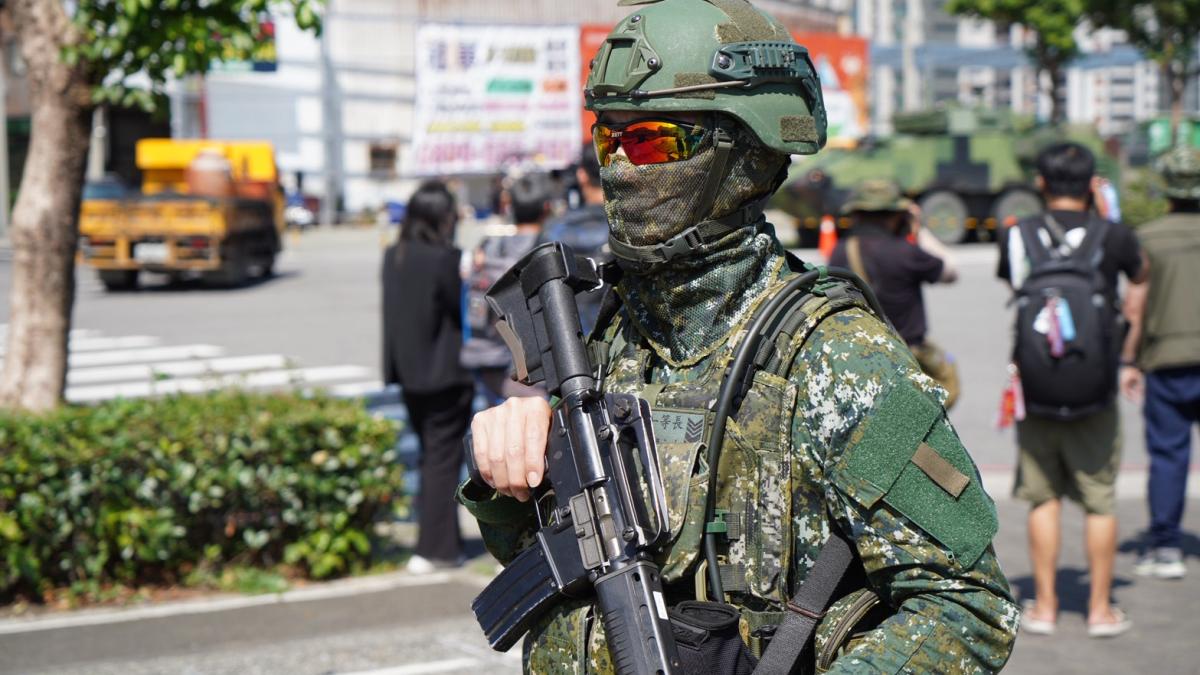
The Republic of China Armed Forces' 'Han Kuang 42' exercise will conduct live drills from August 5 to 14. This year, it adopts a year-round continuous training model, building upon the 'Computer-Assisted Command Post Exercise,' 'Immediate Readiness Drill,' and 'Joint Defense Drill' in a continuous scenario mode to sharpen unit responsiveness in real combat environments.
The Ministry of National Defense held a press conference today (28th) to outline the exercise plan. Aligned with the Chief of General Staff's joint operational plan, this year's exercise focuses on enhancing 'multi-domain denial and resilient defense' combat capabilities, with a total of nine key items to be validated.
### Exercise Phases and Key Actions
(1) Readiness Deployment
Major General Lu Wen-yuan, Director of the Joint Operations Division, Planning Office, Ministry of National Defense, stated that the Chinese military, under the guise of annual joint military exercises, conducts large-scale amphibious landing training to conceal its intent to invade Taiwan and complete final preparations for an assault. In response, the three services will immediately elevate their readiness posture, integrating the Immediate Readiness Drill to execute mobilization preparations, obstacle pre-positioning, material dispersal, cross-regional mobility, and defensive mine-laying preparations—transitioning from peacetime to wartime operations.
(2) Force Protection and Preservation
Lu Wen-yuan stated that assuming the Chinese military completes loading and sea transit under naval, air, and joint blockade cover, the ROC military will simultaneously conduct joint anti-blockade operations, mobilization implementation, obstacle setup, anti-aid-to-the-enemy measures, and protection of critical infrastructure and key political-military targets. This ensures domain security and sustained combat capability, creating a favorable posture for defensive operations.
(3) Joint Anti-Landing
Lu Wen-yuan stated that the exercise simulates the Chinese military conducting joint firepower strikes and maritime transit of landing fleets, combined with amphibious, three-dimensional, multi-point landing scenarios. The ROC military will execute key actions including localized air superiority, area air defense, naval-air coordination, coastal打击, near-shore defense, and area fire destruction, verifying joint operational command and cross-domain fire coordination capabilities.
(4) In-Depth Defense and Sustained Operations
Lu Wen-yuan stated that after breaking through the beachhead, the Chinese military will continue advancing inland under naval and air fire support and special operations coordination. The ROC military will leverage terrain advantages, employing a combination of containment and打击, to conduct layered in-depth defense, continuously delaying, weakening, and disrupting enemy movements and combat power. It will also integrate whole-of-society support to sustain overall operational resilience.
### This Year's Training Objectives
Lu Wen-yuan stated that based on joint operational training goals, aligned with the Chief of General Staff's key joint actions and the 115th-year joint operational plan, the exercise focuses on enhancing 'multi-domain denial and resilient defense' capabilities, with the following training items established:
(1) Contingency Response and Command Adaptation
To strengthen real-time command, control, and adaptability, all levels of ROC military command posts will operate in full-function mode. In coordination with operational progress and enemy situation changes, commanders and staff will train in assessing dynamic situations, making operational decisions, and issuing orders—prompting rapid adjustments in troop and firepower deployment and relocation.
(2) Full-Brigade Mobilization and Combat Power Restoration
To ensure mobilized units can fulfill territorial defense and support missions, two brigade-level units will conduct full mobilization drills in conjunction with this year's 'Tongxin 36' exercise. This will verify their ability to complete mobilization calls, unit assembly, pre-combat training, and combat power restoration within designated timeframes.
(3) Mobilization Production Conversion and Dispersal
To test mobilized factories' wartime production capacity, the exercise will simulate emergency orders triggering evacuation drills by the Military Armaments Bureau's Production and Manufacturing Center No. 202 and civilian mobilization factories with full system assembly capabilities. This deepens the integration of production conversion and production line dispersal mechanisms to support the three services' overall defensive operations and enhance wartime support capacity.
(4) Anti-Blockade Escort
To strengthen maritime traffic line security and the resilience of critical supply logistics, naval and coast guard forces will be integrated. Using joint intelligence, surveillance, reconnaissance, command and control, and coordinated response mechanisms, they will conduct maritime law enforcement, sea area patrols, sea lane security, and critical cargo escort missions to ensure maritime safety.
(5) Anti-Aid-to-the-Enemy Measures for Critical Facilities
To ensure obstruction and destruction measures effectively deny enemy use, each operational area will integrate military and civilian resources, combining garrison forces, artillery firepower, and obstacle materials to conduct anti-aid-to-the-enemy drills at key ports, airports, and transportation hubs within their jurisdiction.
(6) Cross-Regional Force Mobility and Deployment
To respond to the Chinese military's most likely actions and greatest threats, cross-regional deployment will concentrate forces in key areas. During mobility, simulated battlefield conditions such as enemy special operations raids and firepower attacks will test the timing of cross-regional activation, troop movement, command handover, combat power deployment, and logistical sustainment effectiveness.
(7) Mobile Logistics Sustainment
To assess overall logistics support capability, each operational area will integrate logistics support with combat operations according to the operational timeline. Using decentralized storage, in-depth positioning, and mobile resupply methods—combined with troop movement routes and forward support and repair bases—and enhancing concealment, camouflage, and deception measures, this supports sustained layered defense operations.
(8) Building Battlefield Medical Capacity
To enhance overall combat casualty care and troop survival rates, the exercise will integrate ROC forward surgical teams with public and private medical resources. It will drill casualty care under enemy fire, patient evacuation, and medical facility operations, utilizing the 'Field Smart Medical Information System' to monitor battlefield medical capacity and evacuation data, strengthening battlefield medical and health support effectiveness.
(9) Whole-of-Society Defense Resilience
To complete civil-military integration mechanisms, the exercise will conduct the 2026 Urban Resilience Exercise in four counties/cities: 'Kaohsiung City and Pingtung County' on August 7, and 'New Taipei City and Yilan County' on August 13. This will test the specific effectiveness of intelligence transmission, communications, command and control, and situation handling between operational areas and local Joint Emergency Operations Centers (LJEOCs).
Major General Lu Wen-yuan emphasized that the military will continue to implement mission-oriented, realistic training based on enemy threat assessments and defensive operational requirements. It will verify defense preparedness achievements, enhance joint operational capabilities, improve defensive resilience and high-readiness combat power, deter enemy aggression with robust forces, and safeguard national security and regional peace and stability through concrete actions.
FACT BOX
- Source: PR Times
- Category: Event