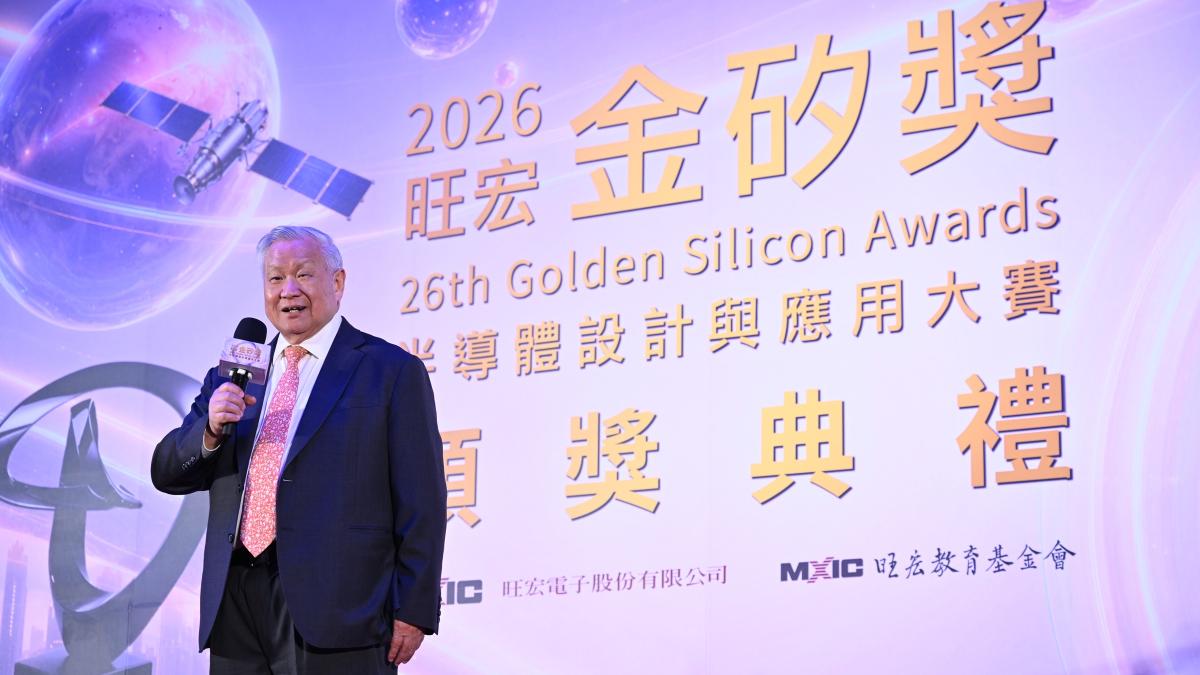
The AI wave is not only driving a new global investment boom in the semiconductor industry but also redefining the direction of semiconductor talent development in Taiwan. The 26th award ceremony of the 'Macronix Golden Silicon Award—Semiconductor Design and Application Competition,' regarded as one of the highest honors for electronics and electrical engineering students in Taiwan, was recently held. This year’s winning entries almost entirely focused on key technologies such as AI computing power, high-speed data transmission, semiconductor smart inspection, and smart factory applications, reflecting how Taiwan’s next-generation R&D talent is closely aligned with the latest AI-era demands for chips, computing, and intelligent manufacturing.
The Grand Prize in the Design Category was awarded to National Tsing Hua University for their 'Transformer Diffusion Model Processor for Real-Time, High-Quality Image Generation' and to National Yang Ming Chiao Tung University for their 'DSP Architecture Design for 112/224 Gb/s Ultra-High-Speed Wired Receivers.' In the Application Category, Feng Chia University won for their 'Semiconductor Precision Inspection and Analysis Technology Based on Cross-Modal Semantic Association,' and National Changhua University of Education for their 'Centralized Wi-Fi Triple-Link Redundant Transmission Strategy for Seamless Roaming.' Notably, the NCUE team also won the Rookie Award in the Application Category, taking home a total prize of NT$700,000 as a single team.
Observing this year’s four grand prize-winning projects, it is clear that Taiwan’s semiconductor talent development is highly synchronized with AI industry trends. The NTHU team focused on edge AI image generation chips, using a Transformer diffusion model processor to reduce memory and bandwidth demands, enabling high-quality AI image generation to move beyond large data centers and toward deployment on end devices. NYCU targeted the high-speed interconnect needs of AI data centers, designing a 112/224 Gb/s high-speed wired receiver DSP architecture to improve data transmission efficiency between GPUs and switches.
On the other hand, the two Application Category winners focused on AI-driven smart manufacturing. Feng Chia University’s team used cross-modal semantic analysis technology to enable semiconductor chip inspection not only to detect defects but also to analyze root causes, shortening a process that previously took 2–4 hours down to just 2–3 minutes. NCUE addressed network latency issues in smart factories by proposing a triple-link Wi-Fi redundant transmission and seamless roaming strategy, with potential applications in smart factories, telemedicine, and drone inspections—areas requiring high-reliability connectivity.
Dr. Wu Cheng-wen, Minister of the National Science and Technology Council, attended the ceremony and shared that since returning to Taiwan in 1988, he has witnessed the semiconductor industry’s growth. He expressed deep appreciation for Dr. Wu Min-chiu, Chairman of Macronix and the Macronix Education Foundation, for his long-term commitment to the semiconductor industry and talent cultivation. He noted that while data science and machine learning once led some to view semiconductors as a mature 'traditional industry,' the rapid development of AI has instead highlighted that semiconductors are the foundation of all software innovation.
Wu emphasized that Taiwan has achieved economic miracles through its semiconductor and technological strengths, and must not rest on its manufacturing advantages. Instead, it must全面提升 autonomous innovation capabilities—from chip design and system integration to materials, equipment, and end applications—continuously building a complete and internationally competitive technology ecosystem.
Dr. Wu Min-chiu, Chairman of Macronix and the Macronix Education Foundation, stated that this year’s entries closely align with modern technological trends like AI, fully demonstrating the abundant innovative energy of Taiwan’s younger generation. He congratulated all participating students on successfully completing their research and thanked industry, academic, and research reviewers for their long-term contributions.
Wu emphasized that the most valuable aspect of the Golden Silicon Award is providing a platform for university students nationwide to exchange ideas and technologies. 'The work you present today may very well become Taiwan’s next major technological achievement. Taiwan’s future will be co-created by all of you.'
Beyond the winning projects, this year’s competition itself reflects new trends in semiconductor talent development. A total of 274 teams from 33 universities across Taiwan, involving nearly 1,000 faculty and students, participated. The female participation rate reached 17.1%, a record high, indicating a continuous increase in female talent in technology fields.
Notably, in response to the rapid advancement of advanced packaging technologies, this year’s competition introduced the 'Heterogeneous Integration' category for the first time, formally incorporating advanced packaging-related technologies into the competition scope. This reflects the industry and academia’s recognition of heterogeneous integration as a key technological direction for the AI chip era.
Since its inception in 2000, the Macronix Golden Silicon Award has now reached its 26th edition, attracting over 6,000 teams and more than 20,000 university faculty and students. It has awarded nearly NT$90 million in scholarships, becoming Taiwan’s largest, longest-running, and highest-prize student competition in the semiconductor field, and a crucial platform for cultivating innovative semiconductor talent in Taiwan.
FACT BOX
- Source: PR Times
- Category: Event