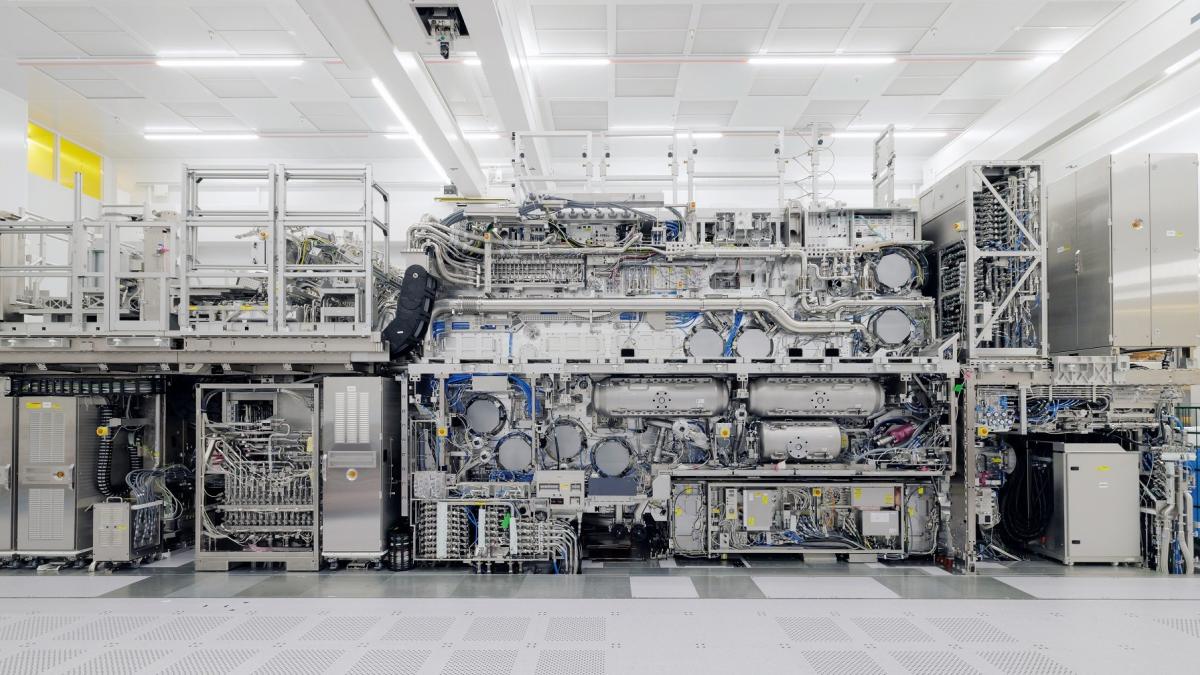
According to sources, China has started mass-producing its self-developed immersion deep ultraviolet (DUV) lithography machines, a key piece of advanced chipmaking equipment, symbolizing a major step in Beijing's efforts to reduce dependence on foreign technology. Reuters reported that anonymous sources, citing sensitivity, revealed the production initiative is led by Shanghai Aisenna Electronics Technology Group, a little-known Chinese state-owned enterprise. After integrating R&D teams from several top Chinese lithography startups, the company has officially begun mass production. An internal close-up of the NXE3400B's EUV light source, droplet generator, and collector mirror, showing in slow motion how light is focused by the bottom collector mirror. (From ASML's official website) This development marks a significant breakthrough in Beijing's national semiconductor self-sufficiency campaign. Semiconductor autonomy is one of the top policy goals of Chinese President Xi Jinping, but it is not expected to pose an immediate commercial threat to Dutch lithography leader ASML in the short term. DUV lithography machines have long been dominated by ASML in the global market and are indispensable core equipment in chip manufacturing. Tech media The Information first reported yesterday that China has begun manufacturing this equipment, noting that an unnamed state-backed company in Shanghai has started production, aiming to produce about five units this year and increase to about 20 by 2027. Reuters was the first to disclose the company's identity. Sources indicated that the DUV lithography machines produced by Aisenna still require further testing and remain significantly behind ASML's equivalent products in technological capability. However, if successfully deployed, Chinese chipmakers could have an alternative source of equipment if Western countries further restrict exports or maintenance services for lithography systems in the future. The Information, citing two informed sources, reported that the Chinese-made DUV lithography machines are expected to be delivered this year to major Chinese chipmakers, including Semiconductor Manufacturing International Corporation (SMIC), Hua Hong Semiconductor, and memory chipmaker ChangXin Memory Technologies (CXMT). Immersion DUV lithography machines use a layer of water film between the projection lens and the silicon wafer, enabling higher exposure resolution than traditional dry DUV systems and allowing for the printing of finer circuit patterns. These machines can produce various chips and, through multiple patterning technology, expose the same circuit layer multiple times to manufacture more advanced semiconductors. ASML did not immediately respond to requests for comment; SMIC, Hua Hong Semiconductor, and CXMT also did not respond to Reuters' inquiries. ● The Shanghai Capital and Technology Behind Aisenna Company registration data shows Aisenna was established in August 2023 with a registered capital of 7 billion RMB (approximately $1 billion), and its shareholders are only two state-owned enterprises: Shanghai Electric Holding Group and a subsidiary under Shanghai International Trust. Little is known about Aisenna. The company has no official website and has not publicly disclosed any operational information. Sources said the company has integrated the R&D team from Yuliangsheng, a lithography startup that began testing DUV prototypes last year, and the technical team from Shanghai Micro Electronics Equipment. Both Shanghai Micro Electronics Equipment and Yuliangsheng, under SiCarrier (a semiconductor equipment company backed by Huawei), are key participants in Beijing's semiconductor autonomy initiative. Company registration and recruitment data show that Aisenna and Yuliangsheng share the same address in Shanghai. Aisenna and its shareholders, as well as Shanghai Micro Electronics Equipment and Yuliangsheng, did not respond to Reuters' requests for comment. ● Catching Up with ASML Due to U.S. export controls, China cannot access ASML's most advanced extreme ultraviolet (EUV) lithography systems; Dutch government export restrictions further limit China's access to certain advanced DUV equipment. Despite Beijing's active push for semiconductor autonomy, China remains one of ASML's most important markets, accounting for about 16% of ASML's net sales in the first half of this year. Although unable to obtain EUV equipment, Chinese chipmakers continue to purchase large quantities of more mature DUV equipment. Reuters reported in December last year, citing sources, that China had successfully developed a prototype of an EUV system, a critical device for manufacturing the world's most advanced chips, though mass production is still years away. Despite the market's clear reaction, multiple analysts believe this news is unlikely to change ASML's profit outlook in the short term. JPMorgan Chase analysts noted in a report today: 'Building a small number of immersion DUV machines does not equate to high-volume manufacturing capability. What truly matters is yield, overlay accuracy, throughput, and reliability across thousands of wafer processes.'
FACT BOX
- Source: PR Times
- Category: News
- Organizations: ASML