Stray dogs have long roamed in packs across Yangmingshan, causing distress among residents and visitors and posing risks to wildlife and natural ecosystems. To address this issue, the Yangmingshan National Park Administration, Taipei City Animal Protection Office, and the Animal Protection Association of the Republic of China have launched a joint three-year population management program targeting stray dog hotspots. For the first time, captured dogs will not be returned to their original locations but will instead be centrally housed and cared for, with volunteer patrols helping to prevent re-aggregation and reproduction, aiming to reduce dog populations at the source and create a safer environment for human-canine coexistence.
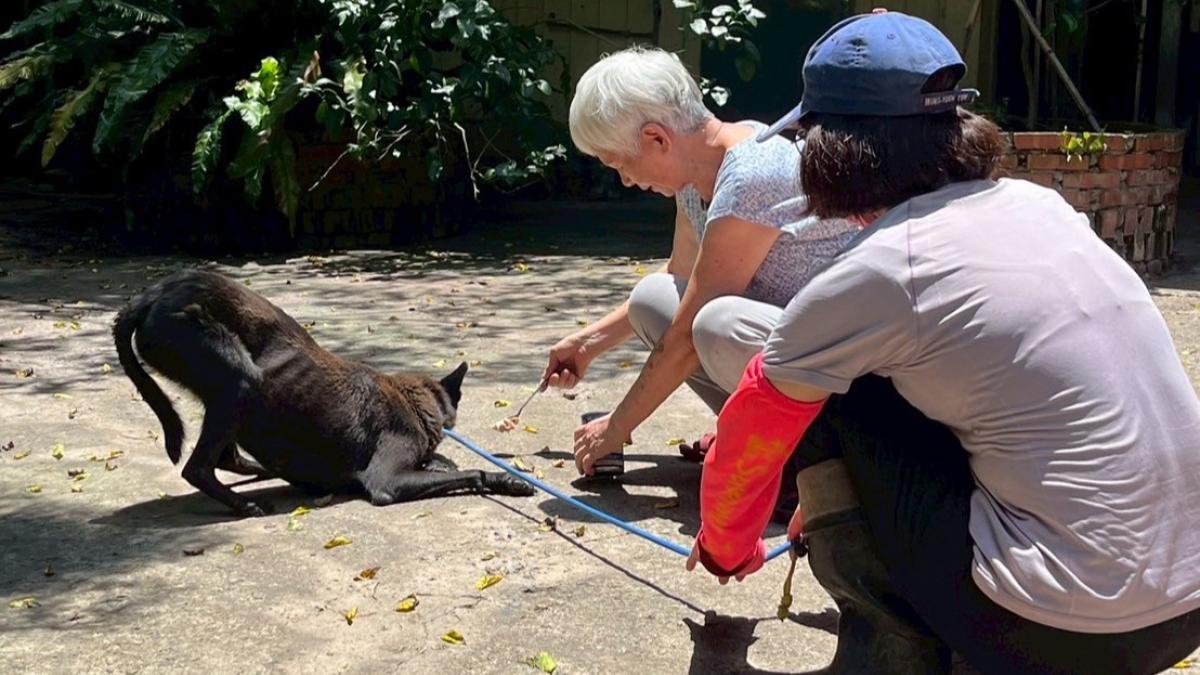
Workers use leashes to control dogs and offer food to calm them, minimizing stress responses after capture and ensuring safety for both humans and animals. (Photo courtesy of the Animal Protection Association of the Republic of China)
Stray dogs reproduce rapidly, and despite repeated capture efforts in the past, packs often reformed, making this a long-standing local challenge. With Yangmingshan’s vast area and wide-ranging dog activity, the problem has persisted for years. Dog packs not only disrupt residents’ lives but also alarm tourists and threaten local wildlife.
This year, the Yangmingshan National Park Administration and Taipei City Animal Protection Office have partnered to commission the Animal Protection Association of the Republic of China to implement a population management plan. The initiative will be rolled out in three phases, combining scientific surveys, professional capture, proper housing, and community collaboration to establish a more comprehensive management system.
Large humane traps and monitoring equipment have been installed in stray dog hotspots across Yangmingshan, with staff conducting regular inspections to improve capture efficiency and safety. (Photo courtesy of the Animal Protection Association of the Republic of China)
A key feature of this program is that captured dogs will no longer be released back into their original habitats. Instead, they will be transferred to suitable facilities for care and housing, preventing re-aggregation and continued breeding. The Association aims to alleviate public concerns about rehoming while reducing human-canine conflicts, ensuring that population management produces long-term results rather than just temporary relocation.
After capture, a black dog is moved into an indoor housing space, where caregivers stay with it, offering comfort and helping it gradually adapt to its new environment. (Photo courtesy of the Animal Protection Association of the Republic of China)
Workers lead captured dogs on leashes and use food to build trust, preparing them for health checks, adaptation training, and housing. (Photo courtesy of the Animal Protection Association of the Republic of China)
Beyond capture, the program also integrates community efforts into frontline management. The Association, in collaboration with the Yangmingshan National Park Administration and village leaders from Shilin and Beitou districts, has organized volunteer patrol teams. Through regular inspections, public outreach, and劝导 (guidance), they aim to reduce indiscriminate feeding of stray dogs.
Secretary-General Li Chao-chuan pointed out that regular feeding encourages dogs to congregate in specific areas, increasing risks of breeding and territorial conflicts. Stray dog management cannot rely solely on capture; it must also address food sources, pet abandonment, and community reporting systems to truly reduce dog populations.
After capture, dogs will be cared for using resources from facilities managed by the Association, including the Langlang Food Bank Home, Doglai-Fu Home, and Bali Conservation Center. They will undergo health checks, daily care, and adaptation training, with adoption opportunities assessed based on individual conditions.
As of July 20, the Association has successfully captured two stray dogs, one of which has already been relocated to a new home and is adapting well. The Association will continue expanding hotspot surveys, capture operations, and housing efforts, while promoting education, public awareness, and community involvement to balance resident safety, animal welfare, and ecological conservation.
Li Chao-chuan emphasized that the stray dog issue cannot be solved by a single entity. Only through collaboration among government agencies, NGOs, and local residents—integrating source management, proper housing, and sustained public education—can Yangmingshan gradually restore a safe, comfortable, and harmonious natural environment.
FACT BOX
- Source: PR Times
- Category: キャンペーン