A strong earthquake struck Kumamoto Prefecture in Kyushu, Japan, at 4:27 PM on July 28. The Japan Meteorological Agency (JMA) measured the quake at magnitude 7.1 (the U.S. Geological Survey USGS reported 6.8), with maximum seismic intensity reaching level 7 and a focal depth of approximately 10 kilometers. The quake caused building collapses, widespread power and water outages, and multiple fires. Prime Minister Takagi Sanae confirmed on the 29th that the earthquake has killed at least 13 people, with another 5 in cardiac pulmonary arrest (CPA) and over 250 injured. Rescue teams are racing against time.
According to Japan's Fire and Disaster Management Agency, over 260,000 people in Kumamoto and neighboring Nagasaki Prefectures received evacuation orders after the quake. About an hour after the tremor, the 'Aeon Mall' in Kamiamakusa Town, Kumamoto Prefecture, suffered a violent explosive impact, causing partial collapse of the second-floor slab and trapping around 30 customers and employees. Kumamoto Governor Kimura Kei stated that police, firefighters, and 3,600 Self-Defense Force personnel conducted rescue operations overnight. By the morning of the 29th, eight people had been rescued from the rubble, including two women in their 20s who were pronounced dead at the scene, one in CPA, and five with injuries.
On July 28, 2026, the Aeon Mall in Kashima City, southern Kumamoto Prefecture, suffered severe damage after an earthquake. (AP)
Prime Minister Takagi Sanae expressed condolences to the families of the deceased and thanked the rescue teams for their overnight efforts on the morning of the 29th. 'There are still people waiting to be rescued. This is a race against time,' Takagi emphasized. 'The government will mobilize all available resources to save lives.'
TSMC Kumamoto Plant Personnel Safely Evacuated
Kumamoto Prefecture has transformed into a global semiconductor manufacturing hub in recent years due to TSMC's factory establishment. After the strong quake on the 28th, TSMC immediately activated its emergency response protocol and evacuated all personnel from the plant. TSMC released a statement confirming that preliminary structural inspections showed no damage to the facility, all personnel are safe, and operations are gradually resuming. Supply chain partners including Sony's semiconductor division also confirmed their employees have safely evacuated.
On July 28, 2026, a large chimney at Nippon Paper Industries' Yatsushiro Factory in Kumamoto Prefecture collapsed due to the strong earthquake. (AP)
Although the semiconductor supply chain remains intact, Kumamoto's industrial and civil infrastructure has suffered severe damage. A giant chimney at a paper mill in Yatsushiro City collapsed during the quake, trapping 11 workers. Rescue teams have rescued four, two of whom are in CPA. Kyushu Electric Power reported that over 35,000 households remained without power as of the morning of the 29th; the Ministry of Land, Infrastructure, Transport and Tourism stated that about 84,000 households across five surrounding prefectures are without water. Kumamoto Airport is expected to resume operations on the 29th, but multiple railway lines including the Kyushu Shinkansen remain suspended, and sections of major expressways remain closed.
On July 28, 2026, the Kyushu Expressway in Yatsushiro City was damaged by the strong earthquake in Kyushu, Kumamoto Prefecture. (AP)
Hard-Hit Areas Face Water and Power Outages; Residents Forced to Shelter in Vehicles
The Mainichi Shimbun reported that in Hitoyoshi Town, Kumamoto Prefecture, where seismic intensity 7 was recorded, public services are severely disrupted. Local officials admitted, 'We are also paralyzed.' With the town office experiencing power and water outages, generators only maintain basic lighting, and computer systems are completely down, preventing updates to official disaster websites. Eleven designated evacuation centers in the town cannot be activated due to lack of water and electricity. Authorities have urgently opened the grounds of three elementary and two junior high schools for 'car camping' (overnight sheltering in vehicles) via disaster radio.
Seventy-nine-year-old resident Iwao Shigemi, who spent the night of aftershocks in his car, said the strong quake threw him and his wife off the sofa, and upon going outside, found the house across the street completely destroyed. His 77-year-old wife expressed concern: 'With such hot weather, if recovery takes too long, I'm really worried about heatstroke in the car.' A decade ago, Kumamoto experienced back-to-back magnitude 7 earthquakes within 28 hours, killing over 200 people. Many disaster victims now fear history repeating itself and are unable to sleep through the night.
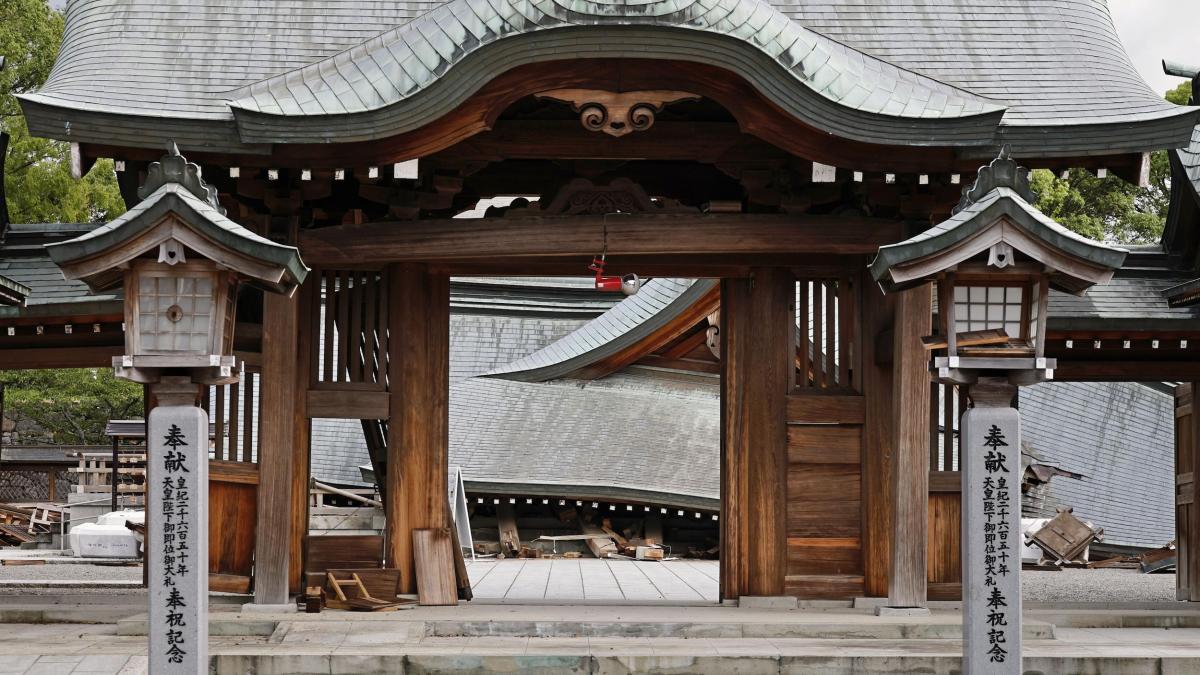
Yatsushiro City saw multiple residential collapses and a freight train derail and overturn due to the strong quake. Local evacuation centers have taken in about 140 evacuees. Seventy-six-year-old resident Fujimoto Kazuko said that despite taking refuge in her car, constant aftershocks throughout the night made it impossible to sleep. In Uki City, 73-year-old farmer Sugihara Tadasao died after being crushed by a beam when his house collapsed. His younger brother Sugihara Naruo (67) tearfully said, 'I only hope he didn't suffer too much.' Additionally, the 'Yatsushiro Castle Ruins,' designated a national historic site, including Yatsushiro Palace and stone walls, suffered collapses. Takahara Shrine in Yatsushiro City also collapsed.
On July 28, 2026, the Yatsushiro Shrine in southern Kyushu, Kumamoto Prefecture, collapsed after the earthquake. (AP)
Experts Warn of 'Larger Aftershocks'
Regarding the cause of this earthquake, Professor Tohda Shinsuke, a seismogeologist at Tohoku University, analyzed that the epicenter lies on the 'Hinagu Fault,' south of the 'Futagawa Fault' that was active during the 2016 Kumamoto earthquake. The Japan Meteorological Agency urged residents in affected areas to remain highly alert for strong aftershocks and landslides caused by heavy rain.
Professor Tohda warned: 'The 80-kilometer-long Hinagu Fault only ruptured about 4 to 5 kilometers on its northern side during the earthquake 10 years ago. The stress transfer from adjacent fault movements at that time significantly increased the risk of a major earthquake on this fault, which has now occurred. However, the fault has not fully released its energy, and unruptured segments may still exist. In the coming week, earthquakes of equal or even greater magnitude cannot be ruled out.'
On July 28, 2026, the signboard of the restaurant Saizeriya fell to the ground after the earthquake in southern Kyushu, Kumamoto Prefecture. (AP)
On July 28, 2026, part of the stone walls of Kumamoto Castle was damaged after the earthquake in southern Kyushu, Kumamoto Prefecture. (AP)
FACT BOX
- Source: PR Times
- Category: News