Reviewing Tuesday's U.S. market performance, the Dow Jones Industrial Average rose by 537.24 points, the S&P 500 edged up 0.21%, but the Nasdaq Composite dipped 0.22%, and the Philadelphia Semiconductor Index plunged 4.49%. TSMC's American Depositary Receipts (ADR) also fell by $6.78, closing at $392.31.
On Wednesday (29th), Asian markets initially showed signs of rebound. South Korea's stock index surged over 3%, driven by SK Hynix's second-quarter profit soaring 557% year-on-year, lifting its shares over 4%. The Nikkei 225 also rebounded sharply, gaining over 700 points to reclaim the 63,000 level.
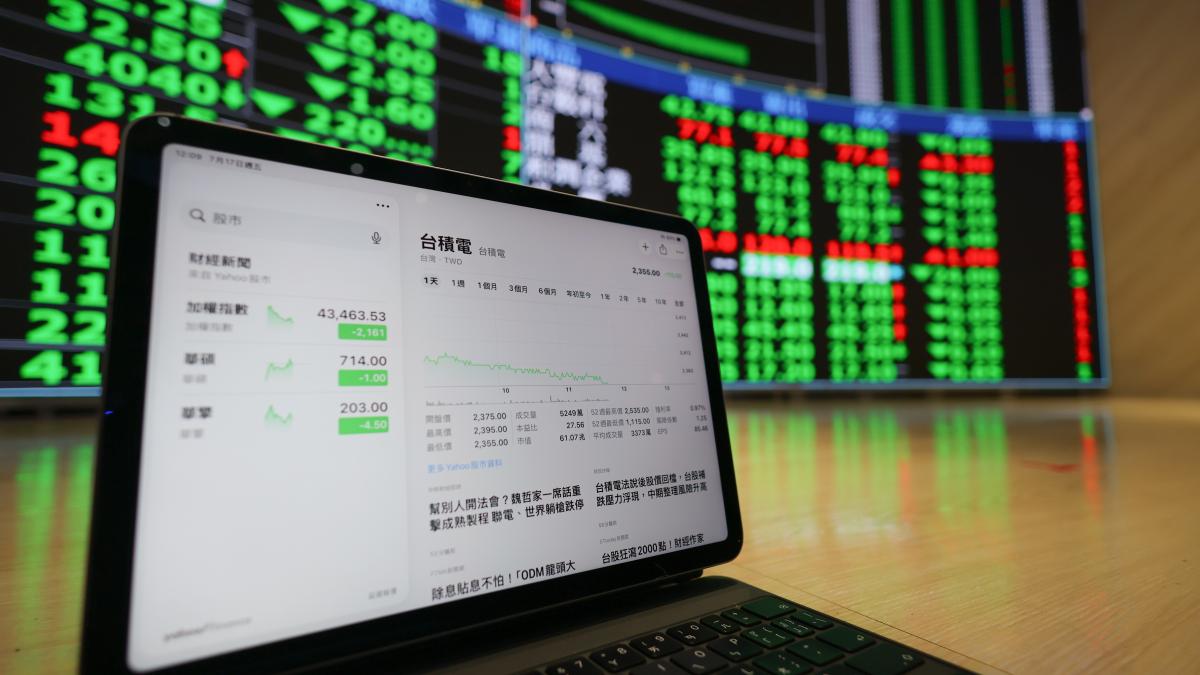
Taiwan's stock market, however, faced a turbulent session. Weighed down by weak semiconductor stocks, it opened down 111.88 points at 41,491.48. Later, major electronics stocks such as Hon Hai, Realtek, AU Optronics, Inventec, Wistron, and仁寶 helped lift the market, along with gains in financial and traditional sector stocks, briefly pushing the index up 95 points to 41,698.
Nonetheless, heavy selling pressure in memory and silicon wafer sectors pulled the market back into negative territory, with losses exceeding 900 points and temporarily breaking below the 41,000 threshold.
Amid growing investor concerns, Finance Minister Chuang Tsui-yun stated during a legislative session on the 28th that short-term market corrections are influenced by various international factors. However, Taiwan's real economy remains stable, and the economic indicator has consecutively shown a 'red light'—signaling robust activity—providing solid fundamental support for the stock market.
Regarding the potential activation of the National Stabilization Fund, Minister Chuang explained that the fund's secretariat continuously monitors global financial conditions and Taiwan's market movements, while also assessing the effectiveness of market stabilization measures implemented by the Financial Supervisory Commission (FSC).
She further emphasized that the National Stabilization Fund operates under strict legal procedures. Any intervention must meet statutory conditions and be approved through formal committee deliberations and resolutions. The government will continue to closely observe market reactions and act strictly in accordance with the National Stabilization Fund Act.
FACT BOX
- Source: PR Times
- Category: News