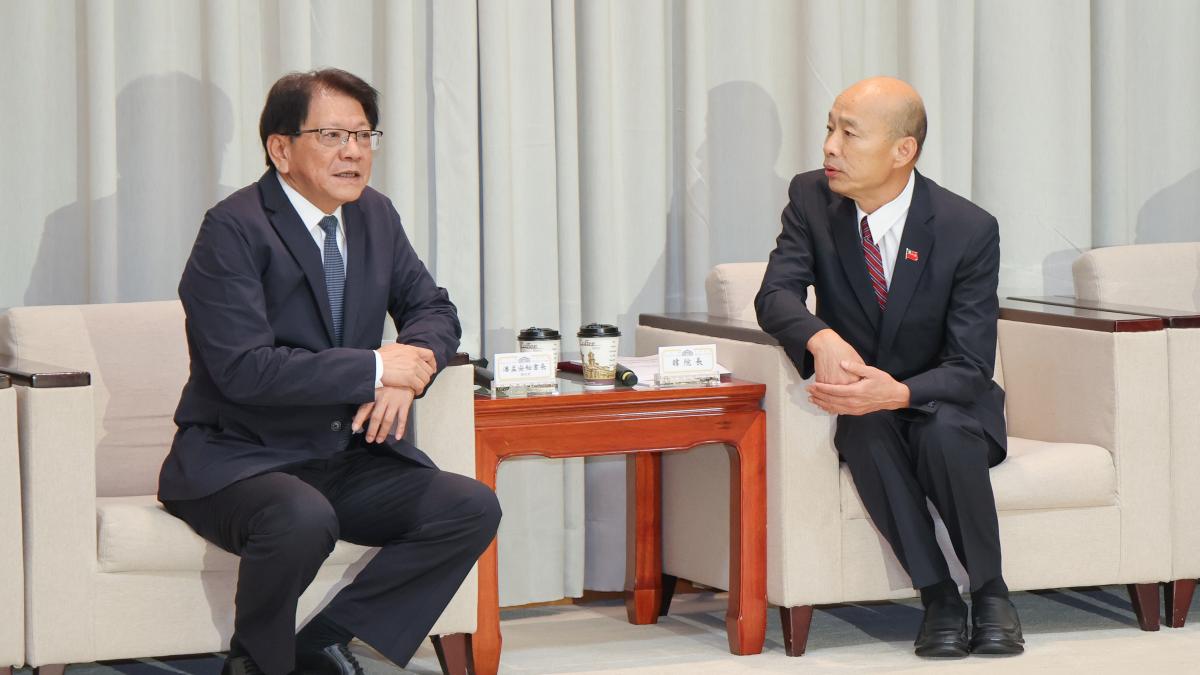
Recently, Presidential Office Secretary-General Pan Men-An, together with nominees for the President and Vice President of the Control Yuan and other Control Yuan members, visited Legislative Yuan President Han Kuo-Yu. Under the current political climate, this meeting received little media attention. Time flies—July is already drawing to a close. Many may not realize or care, but the sixth-term Control Yuan members will reach the end of their term on July 31. Over a month has passed since President Lai nominated the seventh-term President, Vice President, and 27 members of the Control Yuan (though two KMT-affiliated nominees later declined). Yet the Legislative Yuan, constitutionally mandated to exercise consent authority, remains silent. At this rate, after August 1, the Control Yuan will likely become 'an institution without personnel,' just as it was during President Chen Shui-bian’s second term. Last time, the Control Yuan lacked members for three and a half years—how long will it be this time? History loves irony. The DPP, which has long advocated abolishing the Control Yuan, is now nominating Control Yuan members in accordance with the Constitution. Ironically, the KMT, traditionally committed to the Five-Power Constitution, led by Chiang Wan-an, is now calling for the Control Yuan’s abolition. The difference, however, is that the DPP’s past push to abolish the Control Yuan seemed genuine—driven by a desire to amend or rewrite the Constitution and dismantle the KMT’s sacred 'Five-Power Constitution.' In contrast, the KMT’s current call for abolition—whether to mock the DPP’s hypocrisy or to oppose nominations labeled as 'green cronies' or 'political patronage'—is widely seen as mere political rhetoric: a way to undermine a minority president’s nomination power and block Lai’s appointees from becoming Control Yuan members. This mirrors the 2004 case when President Chen’s nominees were frozen by the Legislative Yuan’s procedural committee, only for Ma Ying-jeou to restart nominations and confirmations after gaining full control in 2008. The conclusion is clear: 'Under minority rule, the Control Yuan is likely to become “an institution without personnel.”' As long as constitutional reform is off the table and the Control Yuan’s constitutional powers—impeachment, censure, and audit—are not properly transferred, advocating abolition or refusing to exercise consent power is not only political deception but also unconstitutional. Interpretation No. 632 of the 2007 Grand Justices Conference states: 'Before the current term of the Control Yuan President, Vice President, and members expires, the President must timely nominate successors and submit them to the Legislative Yuan for consent. The Legislative Yuan must also timely exercise its consent power to ensure the Control Yuan functions normally. If the President fails to nominate or the Legislative Yuan fails to consent, resulting in the Control Yuan being unable to perform its duties and fulfill its functions, thereby damaging the integrity of the constitutional system, such conduct is impermissible under the Constitution.' The public will judge the reputations of President Lai’s nominees for Control Yuan President, Vice President, and 27 members. However, if the opposition party opposes them solely on grounds of 'green cronies' or 'patronage,' blocking all nominees en bloc based on party affiliation, it is not only unfair to the nominees but also reveals the narrow-mindedness of the opposition, which will harm their electoral prospects in the year-end and future elections. The author urges opposition leaders not to be swayed by Chiang Wan-an’s rhetoric. By adhering strictly to the Constitution, seriously reviewing nominees, and exercising consent authority in the interest of national and social justice, the opposition can earn the support of moderate, rational voters. Take nominee Chen Yung-Hsing, proposed for Control Yuan President. Beyond labeling him 'pro-independence,' what substantive grounds does the opposition have to oppose him? Dr. Chen’s life story is well documented in the Presidential Office’s nomination materials and his 70th-birthday memoir, 'My Life Symphony.' In recent years, the author has had the opportunity to interact with Dr. Chen and would like to share a brief story. Three to four years ago, a psychiatric regional hospital in Pingtung County faced operational difficulties and urgently needed psychiatrists. Dr. Chen learned of this through a friend and immediately stepped in to help. Despite over a year of effort, no suitable candidates were found. So, about two years ago, Dr. Chen took on the role of hospital director himself (in effect, 'principal and bell-ringer'), conducting outpatient services and daily ward rounds to care for psychiatric patients. He served for a year until a successor was found. Though Dr. Chen previously served as director of major hospitals like Kaishan Hospital and Luodong Holy Mother Hospital, after retirement, despite being in his seventies, he commuted daily from Kaohsiung to Neipu, Pingtung, to ensure uninterrupted care for vulnerable psychiatric patients. Who else in today’s political or medical circles could match such dedication to the disadvantaged? In fact, Dr. Chen has spent his life tackling 'impossible missions.' During the authoritarian era, he served as president of the 'Taiwan Association for Human Rights,' promoted the 'February 28 Justice and Peace Movement,' ran for Hualien County magistrate to break the KMT’s monopoly, was elected as a legislator from Hualien, and supported third forces like the Taiwan Solidarity Union, the New Power Party, and the White Force to transcend blue-green polarization. Dr. Chen has never sought fame or profit, guided instead by a divine calling: 'Where there is need, go there.' From serving remote communities in his youth, to raising 800 million NT dollars as hospital director to build an elderly care facility, serving as chairman of the Mennonite Foundation to support isolated elders in Hualien and Taitung, and currently fundraising for the new building of Pingtung Christian Hospital, his life is one of service. He is also a man of principle who refuses to compromise with authority or evil. In university, he was nearly expelled for publishing a magazine and defending freedom of speech, receiving two major and two minor disciplinary penalties. As Kaohsiung’s health commissioner, he was attacked by gangsters and bled on his white coat for insisting on cracking down on illegal advertisements. A man who has dedicated his life to justice, human rights, and the vulnerable—transcending party lines, selfless, idealistic, and uncompromising—is surely the best candidate for Control Yuan President. Looking back at past Control Yuan presidents—Chen Chu, highly political; Chang Po-ya, less partisan; Wang Chien-shien, pro-unification; and earlier figures like Chien Fu and Chen Liou-an, products of the KMT establishment—who among them is superior to Dr. Chen? Aside from being nominated by a minority president, in what way does he fall short?
FACT BOX
- Source: PR Times
- Category: News