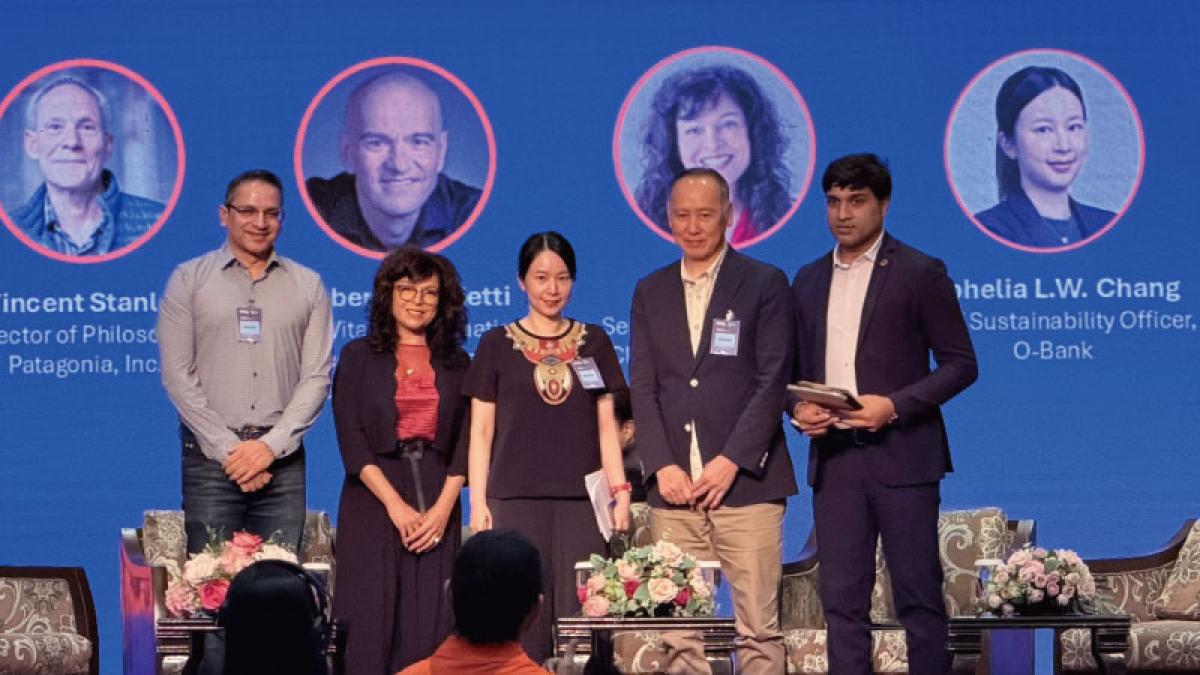
At the 2026 B Corp Asia Annual Conference, Lucy Chang, Vice President and Chief Sustainability Officer of O-Bank, took the stage representing Taiwan’s B Corps, speaking alongside global sustainability pioneers such as Patagonia and Danone. She presented O-Bank’s business model of embedding sustainability into core financial operations, emphasizing initiatives from ESG assessments in corporate financing, performance evaluation design for sales staff, to financial incentives for individual consumers—all aimed at mobilizing more businesses and consumers to join the sustainability movement. These efforts have earned strong recognition from multiple international sustainability rating agencies, providing concrete market validation of O-Bank’s sustainability practices.
Integrating ESG Factors into Investment Review SOPs to Practice Responsible Finance
Chang explained that O-Bank has already integrated ESG factors into its standard operating procedures (SOPs) for investment reviews five years ago. For every corporate loan or medium-to-long-term investment, the borrower’s ESG performance directly influences its internal credit and investment ratings at O-Bank. Four years ago, the bank further began assessing climate risk management measures for industries with high climate exposure, taking follow-up actions based on evaluation results: no lending or investment for excessively high-risk cases; medium-risk cases are managed through enhanced collateral, higher interest rates, or elevated approval levels; and companies with strong ESG performance receive interest rate discounts. Chang stated that this approach enables responsible finance and effectively steers capital flows.
Internally, O-Bank links the carbon intensity of investment clients to business units’ KPIs. If a business unit’s client portfolio shows higher carbon intensity compared to the previous year, its KPI score is reduced. Chang further noted that O-Bank is among the few financial institutions in Taiwan to have pioneered internal carbon pricing for Scope 3 emissions. If a business unit’s clients exceed the bank’s average carbon intensity target, an internal carbon fee is charged to that unit’s management account.
Since the management account forms the basis for evaluating business unit performance, this design forces each salesperson to weigh: “Is the profit from this loan worth more than the internal carbon fee I’ll be charged?” Chang pointed out that this mechanism comprehensively influences frontline behavior.
Creating Unique Incentives to Drive Low-Carbon Consumption Among Individual Customers
For individual consumers, O-Bank partnered with Mastercard to launch Taiwan’s first “carbon emission breakdown” feature, allowing customers to view the carbon footprint of each card transaction for free via O-Bank’s online banking or mobile app. Building on this, O-Bank introduced the “Low-Carbon Lifestyle Card,” offering higher cashback rates when a customer’s average carbon emission per dollar spent falls below 8 grams in a given month.
“The better you treat the planet, the better you get treated by O-Bank!” – Lucy Chang, Chief Sustainability Officer, O-Bank
On accelerating capital flows for transition finance in Asia, Chang emphasized that when banks direct capital through responsible or green finance principles, they can effectively support industrial transformation. For example, O-Bank’s “Sustainability-Linked Loan” mechanism offers interest rate discounts when companies achieve specific ESG goals—even high-emission clients receive favorable terms upon meeting decarbonization targets, supporting industrial transition. Additionally, O-Bank incorporates investment targets’ performance in major international sustainability ratings as a reference indicator in its investment evaluation process. Chang added that when more investors choose banks practicing responsible finance, it can trigger a positive cycle of industrial transformation and progress.
Ranked #1 in Taiwan Across Multiple International ESG Assessments—O-Bank Demonstrates Sustainable Finance Leadership
O-Bank’s long-term commitment to sustainability has earned consistent recognition from international ESG rating agencies. In both Morningstar Sustainalytics and FTSE Russell sustainability assessments, O-Bank ranked first among all listed companies and financial institutions in Taiwan. It was also selected for the S&P Global 2026 Sustainability Yearbook, placing it in the top 5% of global banks. Furthermore, O-Bank received the highest “A” rating for two consecutive years in the international Carbon Disclosure Project (CDP) Climate Change program.
FACT BOX
- Source: PR Times
- Category: Event
- Organizations: Patagonia / Danone / Mastercard