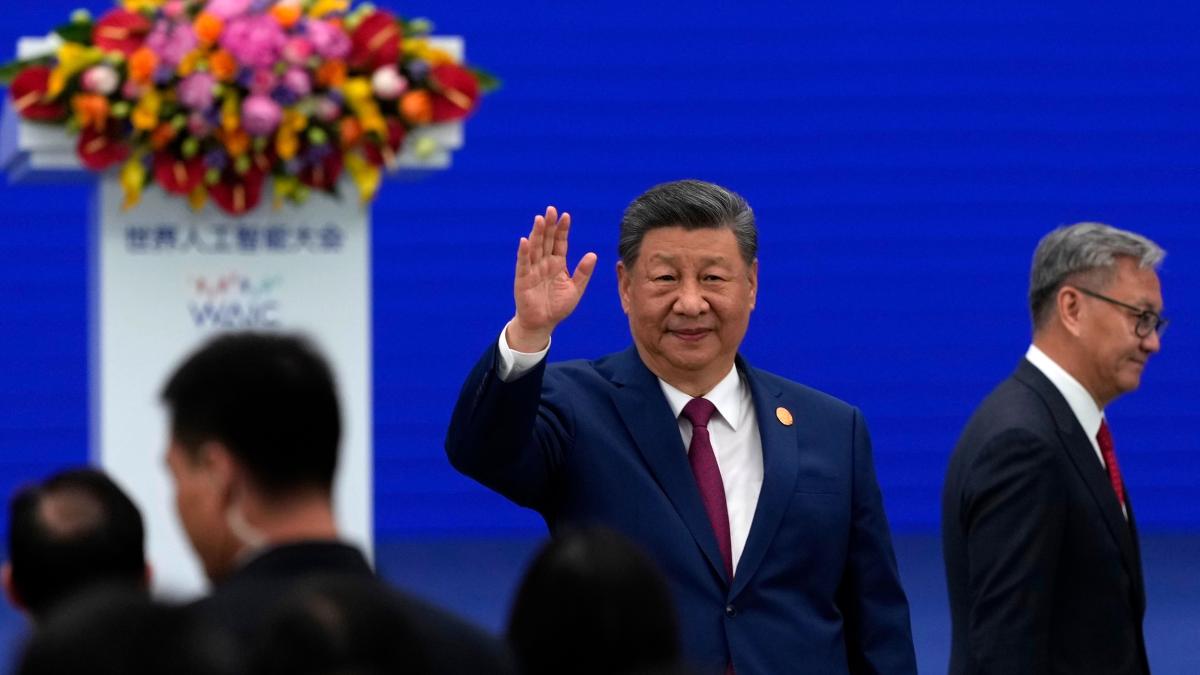
ChangXin Memory, which went public on July 27, conducted its IPO at a price of 8.66 yuan per share, aiming to raise 57.9 billion yuan (8.6 billion USD). However, on the first day of trading on the Shanghai Stock Exchange's Sci-Tech Innovation Board, the closing price soared to 49 yuan, marking a 470% increase. This surge elevated the company's market value to 3.3 trillion yuan. ChangXin Memory became the highest-valued company in China on its first day of trading, and its IPO size set a record for Asia this year. The Economist pointed out that the largest shareholder and earliest investor of ChangXin Memory is actually the Chinese government. From this perspective, Xi Jinping can be considered a pioneering venture capitalist. The Economist noted on July 27 that Xi Jinping has become China's most important venture capitalist in recent years. He has boldly predicted that the Chinese economy will transform into a high-tech powerhouse and has injected massive state funds into areas such as green energy, electric vehicles, and semiconductor manufacturing. The Chinese government is heavily supporting technology companies producing batteries, drones, and even flying cars. By the end of 2024, through over 2,000 institutions known as 'government-guided funds,' the Chinese government has promised to invest 12 trillion yuan. China's first large-scale injection of funds into the technology sector occurred ten years ago, coinciding with the typical profit cycle of venture capital funds. ChangXin Memory, which performed exceptionally well in this IPO, is considered by The Economist to be Xi Jinping's most successful investment to date. ChangXin Memory was co-founded by the Chinese government in 2016, a product of what is known as the 'Hefei Model.' The 'Hefei Model' is named after Hefei, Anhui, the birthplace of ChangXin Memory. Instead of choosing 'winners' from existing companies and adding to their success, the state becomes an early equity partner in strategic technology companies. The Economist pointed out that such investments are reshaping China's economy and are one of Beijing's attempts to weaken foreign dominance in high-tech fields, aiming to make China more self-sufficient. In the memory chip sector, ChangXin Memory is actually dominated by Micron (Micron), SK Hynix (SK Hynix), and Samsung (Samsung), with these three companies accounting for over 90% of the global DRAM market. Originally, there was not much profit left in this mature market, but the AI boom has caused the market value of the memory trio to exceed 1 trillion USD, which has also allowed ChangXin Memory, which obtained memory patents from Germany in 2019, to find a sweet spot. Although the company currently 'only' accounts for 8% of the DRAM market, major US tech giants, including Apple, are considering purchasing Chinese chips to reduce the manufacturing costs of consumer devices, which bodes well for ChangXin Memory's future market share. The Economist pointed out that the Chinese government's investment in ChangXin Memory has brought enormous financial benefits. According to the IPO documents, about 15 government-related investors directly hold 36% of ChangXin Memory's shares. If the government's stake in private equity funds is also included, the government's stake ratio will be even higher. After dilution, the book value of these direct holdings reaches 1.1 trillion yuan, and the government's investment return rate may exceed 40 times. ChangXin Integrated (ChangXin Integrated), as the earliest state-owned investor in ChangXin Memory, currently holds shares worth 345 billion yuan. The Economist believes that any venture capital company in Silicon Valley would be overjoyed to achieve such returns. However, Xi Jinping is not successful in everything he invests in. The Economist pointed out that apart from ChangXin Memory, other government-backed projects have not performed as expected, and the Chinese government has even fallen into a situation that any venture capital institution would not want to face—a lack of exit strategy. Especially after 2020, the Chinese government has launched a severe crackdown on the technology industry, and private equity funds, including those from the United States, have withdrawn their investments from startups. As a result, the Chinese government has become the 'last investor.' In the funds invested in the private equity market last year, 90% came from investors related to the government. From the scale of 'government-guided funds,' it is clear that the Chinese government needs more ChangXin Memory to make up for the losses caused by investment failures in other areas. The Economist also warns that government's massive investments are very likely to breed corruption. In 2022, the Chinese police accused officials in charge of managing the China Semiconductor Fund (with a scale of 343 billion yuan) of embezzling state assets, and the project's allocation of funds was forced to stop. Since government investments, if they incur losses, may lead to accusations of misconduct against the responsible officials, this also leads them to treat equity investments as loans, often imposing harsh conditions on the founders of startups. In addition, China's venture capital (VC) industry is facing a serious 'liquidation' crisis because the Chinese government is using political means to support a financial market lacking private buyers. Although ChangXin Memory appears to be flourishing, in reality, its capital chain is fragile and highly dependent on national team blood transfusion. When the major shareholders of ChangXin Memory are regulated not to sell shares for three years, it also means that these investors who made a quick profit are actually immobile for the next three years. The Economist also sarcastically remarked on Xi: Fortunately, Mr. Xi, like many venture capitalists, can 'determine the value of assets' himself—and the scoring standard is to look at political achievements, not whether money is made or not.
FACT BOX
- Source: PR Times
- Category: Funding