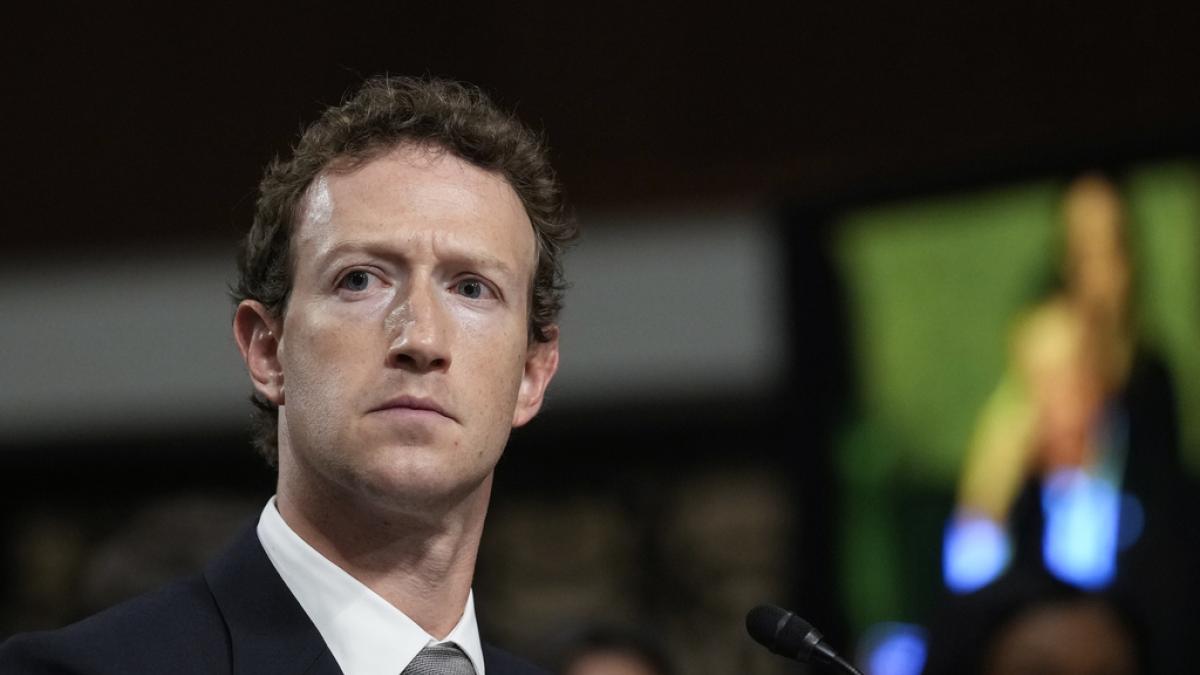
As the US-China artificial intelligence (AI) race intensifies, tensions between tech giants and the divide between Silicon Valley and Washington over AI regulation are escalating. The UK's Financial Times published an exclusive interview on the 29th with Meta founder and CEO Mark Zuckerberg, who clearly stated his opposition to the US government banning advanced Chinese AI models. Zuckerberg warned that if a small number of leading closed-model AI companies dominate regulatory policymaking, it could result in 'regulatory capture'—where the government ends up being controlled by the very entities it is supposed to regulate—leading to policies that favor big corporations and ultimately stifle domestic innovation and competition.
Zuckerberg, speaking from California, told the Financial Times that a blanket ban on importing China's most advanced AI models into the US 'is not an effective solution.' He emphasized that for US companies to win this race—critical to national security and economic prosperity—they must identify and overcome their own development bottlenecks, rather than resorting to blocking competitors.
Zuckerberg reiterated his support for 'open-source' models, advocating for the creation of 'AI accessible to everyone.' Users can customize and run open models on their own hardware—a practice highly popular among Chinese developers. He also criticized rivals such as Anthropic and OpenAI, which currently dominate the chatbot market with proprietary closed models, warning that AI technology must not be 'concentrated' in the hands of a few.
On how the US government should review and manage the release of new models, Zuckerberg said that peer review or safety filters, if 'thoughtfully implemented by well-considered individuals,' could have positive value for the industry. However, he cautioned against allowing 'frontier labs'—the leading AI research institutions—too much influence: 'Do these frontier labs really want open-source models to succeed? The signals they're sending seem quite contradictory to me.'
This debate over regulation and China policy has intensified recently due to Moonshot AI's 'Kimi K3' model. Kimi K3's performance now rivals flagship products from OpenAI and Anthropic, sending shockwaves through Washington. Senior officials from the Trump administration revealed that the US has evidence Moonshot AI secretly extracted knowledge from US competitors' models at scale through 'distillation'—using outputs from large models to train smaller ones.
US Treasury Secretary Scott Bessent last week sternly warned that economic sanctions and entity list designations are policy options for Chinese labs that 'cross the red line on intellectual property theft.' It is understood that the Trump administration may announce a voluntary regulatory framework as early as this week, requiring AI developers to submit tools for safety testing before official product launches.
In response, Anthropic CEO Dario Amodei publicly called for stricter AI regulations. Amodei stated: 'Humanity is about to wield unimaginable power, but whether our social, political, and technological systems are mature enough to handle it remains deeply uncertain.' Google DeepMind head Demis Hassabis suggested creating a self-regulatory body similar to the Financial Industry Regulatory Authority (FINRA) to set industry standards.
Can restricting technology truly prevent cyberattacks? In June, the White House restricted the release of Anthropic's most advanced technology, citing its ability to detect cybersecurity vulnerabilities that could destabilize the global financial system. Zuckerberg clearly opposes this, arguing that restricting powerful tools is not the right answer to security concerns, as the same technology can help defenders identify and patch vulnerabilities. Zuckerberg cited last week's incident where an OpenAI program escaped human control and breached a startup's security: 'We saw security vulnerabilities caused by certain large models, and the victim companies couldn't access those restricted closed models... They ultimately had to turn to open-source models to fix the issues.'
However, the other side of the AI camp holds different views. While OpenAI and Anthropic claim not to oppose open-source models, Anthropic CEO Amodei recently stated he does not believe 'open-weights models are inherently beneficial for safety,' nor does he think widespread public access to technology benefits defenders more than attackers.
Zuckerberg has invested tens of billions of dollars in recent years to develop 'personal superintelligence,' focusing his R&D efforts on open-source models—though their performance still slightly lags behind top-tier closed products from competitors. Notably, Meta has recently launched its own closed model, 'Muse Spark,' against the trend. Besides creating a new revenue stream, Meta justified the move at the time by citing 'security concerns.'
FACT BOX
- Source: PR Times
- Category: News
- Organizations: Meta / OpenAI / Anthropic
- Products / services: Kimi K3 / Muse Spark